


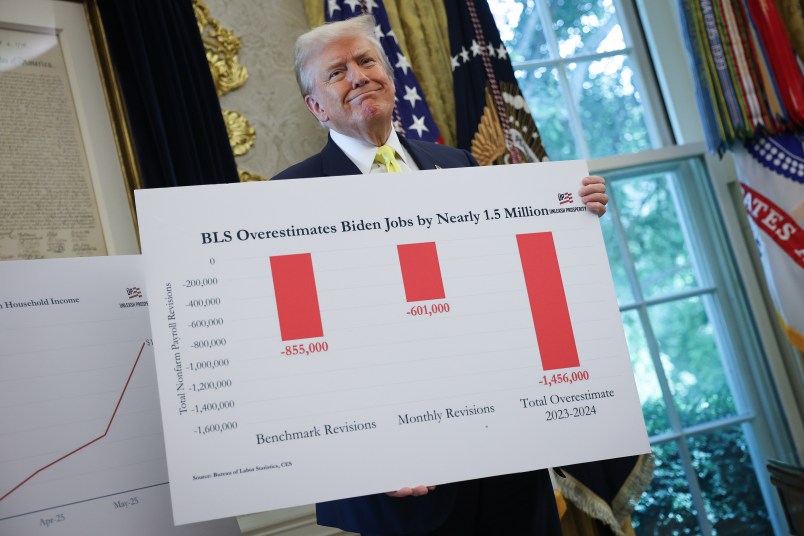
After the first full year of President Donald Trump’s economic policies, which came with rhetoric aimed especially at growing manufacturing job opportunities through protectionist policies like tariffs, the verdict is in: Meh.
“I think it’s definitely fair to say the policies are not helping employment in that industry,” Penn State professor of economics and labor Lonnie Golden told TPM.
The January jobs report from the Bureau of Labor Statistics came in Wednesday morning and showed the nation added just 181,000 jobs between January 2025 and January 2026. That’s about 15,000 jobs a month or fewer than 500 jobs a day in a nation. A booming economy adds about 150,000 jobs a month, Golden said. For context, the U.S. added about 160,000 monthly jobs in 2024.
The first year job market under Trump saw the smallest increase in job creation in 10 years, barring the 2020 pandemic unemployment spike. Going back further, U.S. industries haven’t added fewer jobs than were added in 2025 since the year between 2013 and 2014.
The preliminary takeaway here is that Trump’s purported protectionist policy to boost U.S. manufacturing hasn’t done its job, according to the data.
“If a campaign promise was to create more manufacturing jobs in the U.S. that has not happened and has not been delivered on,” Golden said.
On Truth Social Wednesday, Trump called the January jobs numbers “far greater than expected,” and echoed his incessant call for lower interest rates from the Federal Reserve.
It’s true the jobs numbers exceeded economists already-lowered expectations by about 50,000. A look below the surface offers a bit of insight, but the confluence of decades-long economic trends with modern economic policy make the impact of Trump’s tariffs and deportation agenda on the job market harder to measure.
Trump has both touted the lower-than-expected inflation rate reflecting the failure of tariffs to significantly spike prices for consumers, alongside his nationalistic claims of using tariffs to protect U.S. industry. It doesn’t work like that, though. Protectionism implies an increase in the price of foreign goods that would squeeze American consumers and push them to purchase things made in the U.S.A., thereby boosting demand and domestic production.
“If [U.S. importers] eat it rather than passing it on to consumers it’s kind of more difficult to make the case that you made foreign goods more expensive,” Golden said.
While manufacturing has been declining in the U.S. over the last 50 years, the industry saw growth during President Joe Biden’s time in office before leveling off in 2024. Under the Trump administration, that growth has halted and even shown slight declines. At the same time, productivity in manufacturing is up, meaning that there aren’t more individual producers, but that producers are still making more. Economists like Golden look at automation and AI as the driver for increased productivity in light of declining jobs.
Tariff-sensitive industries like furniture, computer and electronics, plastics and rubber, and apparel all saw negative job growth year-over-year, pointing to Trump’s tariffs regime as one factor for job loss. Retail and wholesale trade saw net negative job growth, as did warehousing and truck transportation, industries tied closely to trade and that would’ve been acutely affected by costlier international trade conditions.
Even before the January jobs report was published, Trump administration officials tried to blunt the impact of potentially paltry job growth by pointing to the administration’s deportation policies as decreasing the total number of workers in the U.S. and therefore decreasing the total number of jobs needed to show growth. This narrative is “a stretch,” Golden said. First, data has shown that while Trump’s anti-immigration push may be more public and performative, the number of people removed from the country has been about the same as during other presidential administrations.
“I think they’re trying to justify the policy,” Golden said. “As far as I can see, the unemployment rate among native born workers is about the same as among foreign born,” which, he said, is where data might reflect the impact of deportation.





On a more positive note, ketchup futures are through the roof!
And so on …
(Did I mention that it’s a Rasmussen Poll!)
Well no one could have predicted such an upstanding citizen and good, honest family man would have failed his campaign promises. Glad the legacy media is on this. Glad that goddam AG made of brown sugar is on it. Bravo American electorate, you must be very proud . . .
A few years ago I invested in five or six top AI stocks, as a result my stock portfolio is doing better than ever but the other day I overheard my middle aged son saying that all the money is held by boomers. I worry about him and his siblings and my grandchildren. What happens if AI renders white collar workers like my son unemployable.
Frist!?!Well I woulda been, if it weren’t forthose meddling kidshaving to turn my iPhone off and on AGAIN before being able to post!I’ll note again that “Vile Bill” Clinton was excoriated by the so-called liberal media (SCLM) if he didn’t produce 250,000 jobs per month.

The president is supposed to be excoriated by the press if the economy doesn’t produce enough jobs month in and month out.