

WASHINGTON (AP) — There’s a border crisis in Pennsylvania. The radical left is surging in New Jersey. And Nancy Pelosi is a threat to New York.
Republican candidates in the nation’s premiere midterm battlegrounds have embraced a central message in their fight to maintain the House majority this fall — and it has little to do with the surging economy or the sweeping tax cuts that the GOP celebrated as a once-in-a-generation achievement just eight months ago.
Instead, as Republicans enter the final month of the primary season, they’re looking ahead to a general-election strategy of embracing anxiety as a tool to motivate voters.
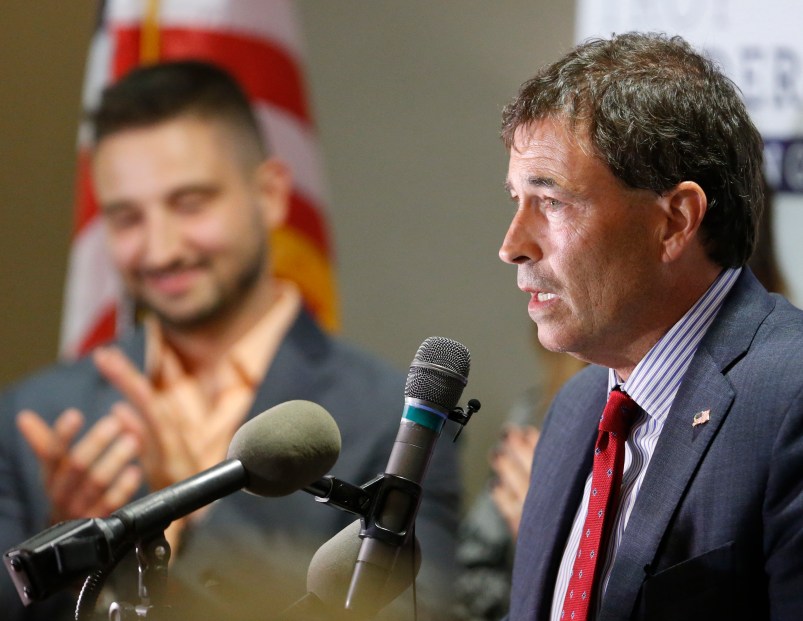
That was clear this week as the GOP’s closing message in an Ohio special election questioned Democrat Danny O’Connor’s connection to Pelosi, the House Democratic leader and preferred super villain for Republicans.
“We wish it got the pitch forks out and it doesn’t,” GOP ad maker Will Ritter said of the Republican tax cuts.
Some Republican strategists are frustrated the party isn’t focused on the tax law or the broader health of the economy in the run-up to Election Day. Others concede that in the Trump era, there’s no better motivator than fear of the other side, particularly the prospect of Pelosi returning to the speaker’s chair.
The plan had some success in Ohio: The race was too close to call Wednesday as Republican Troy Balderson maintained a razor-thin advantage over O’Connor, staving off an embarrassing GOP debate for now. Going forward, the debate over highlighting the tax law will help determine whether Republicans will maintain control of Capitol Hill after November.
While Republicans are reluctant to engage on tax cuts, it’s a fight Democrats — and their voters — want.
“The tax cuts were for the top … income earners,” said George Stringer, a 58-year-old Democrat who lives in Detroit. “The rich keep getting richer, the poor keep getting poorer.”
In Ohio, which hosted the season’s final special election, O’Connor railed against the tax cuts as a giveaway to the rich that threatened Medicare and Social Security. While his Republican opponent may prevail, the 31-year-old Democrat trailed by less than 1 percentage point in a district that’s been in Republican hands since before he was born. On the defensive, Balderson appeared in a late ad sitting next to his ailing mother and promising that he wouldn’t dismantle the social safety net.
It’s somewhat similar to the problems Democrats faced in 2010, when they controlled the White House and Congress and managed to pass the most significant health care legislation since the creation of Medicare and Medicaid. They celebrated with President Barack Obama in the Rose Garden, only to run from it in the midterm elections that became a disaster for the party.
President Donald Trump, plagued by scandal and wed to his Twitter account, sits atop the struggle.
Republican pollster Frank Luntz said Trump energizes the Republican base, but that his broadsides and distractions will also alienate the swing voters who tip battleground House districts.
“This is political malpractice,” he said. “You can’t find me a time in modern times when the economy was this strong and the governing party was headed toward a potential political disaster like this.”
Republicans are also reluctant to embrace their tax cuts because the benefits don’t change the household budget for many Americans. The party predicts that will change next year when families file their first tax returns under the new law. But as electoral strategy, that’s akin to Democrats in 2010 insisting voters would like the health care law once they understood it.
The tax debate comes amid new evidence of a Democratic surge in early elections across America.
Michigan Democrats will feature the state’s first all-female statewide ticket this November following Tuesday’s primary elections. Democrat Rashida Tlaib also won a race to run unopposed for the Detroit-area House seat vacated by John Conyers, making her poised to become the first Muslim woman in Congress. In Kansas, 38-year-old attorney Sharice Davids won her congressional primary and became the state’s first Native American and gay nominee for Congress.
Both Davids and Tlaib campaigned aggressively against the Republican tax cuts.
Beyond avoiding the tax law, there has been a consistent theme for Republicans across House battlegrounds: casting the Democrat as too liberal.
A National Republican Congressional Committee ad in Ohio tied Democratic candidate O’Connor to Pelosi and “the liberal resistance movement.” A super PAC backed by House Speaker Paul Ryan charged that it was O’Connor who would cut Social Security and Medicare by $800 billion; fact checkers have questioned the accuracy of the attack.
In central Kentucky, GOP Rep. Andy Barr is reminding voters that Amy McGrath, a former fighter pilot, voted for President Barack Obama and opposes Trump’s proposed border wall. In suburban Pennsylvania, vulnerable Republican Rep. Brian Fitzpatrick has warned of “a border in crisis” and demanded a surge of immigration enforcement agents. And in New Jersey, Republican Rep. Leonard Lance featured an ad in which Democrat opponent Tom Malinowski calls himself a “lifelong progressive Democrat” over and over. Lance also warns of his “dangerous policies” like abolishing U.S. Immigration and Customs Enforcement.
Anthony Brindisi, Democratic nominee in an upstate New York district, is the target of an ad from Rep. Claudia Tenney claiming that Pelosi is “bankrolling” Brindisi “because he’ll support their radical immigration agenda.”
Brindisi blasted the Tenney ad as dishonest, repeating his general support for border security and opposition to Pelosi continuing as Democratic leader. “I’d think after almost two years of being in Congress, the first advertisement that my opponent would run would be something about her accomplishments,” Brindisi said.
He’s running his own tax ad, localizing the law by highlighting Tenney’s campaign support from the cable giant Charter, whose New York subsidiary, Spectrum, has raised rates and spent hundreds of millions on stock buybacks after getting a tax windfall. “I want to point out to the voters that when we talk about the swamp, this is the worst kind of example,” Brindisi told The Associated Press.
Republicans aren’t apologizing for their tax votes, even if it’s not at the forefront of their campaigns.
Rep. Mimi Walters, a vulnerable Republican in southern California, said in a recent interview that she plans to use it in her paid advertising this fall. But her ads so far this year have focused on other topics.
“In the beginning … there was a lot of pushback. That’s just natural. You’re making a big change, and people weren’t sure,” said Walters, who represents one of 25 districts nationally that sent a Republican to the House in 2016 but opted for Hillary Clinton over Trump in the presidential race.
“Now that people have started to see the benefits … people come up and thank me,” Walters said, adding that she’s “results oriented” and pointing to economic growth figures that she says prove “we made the right decision.”



What is on the minds of Republicans right now? Not the tax cut- they sleep well with that one. They are afraid of Democrats being in charge. It’s not just about protecting tRump either, it’s fear of losing control. They are also afraid of the Dems following the same playbook Republicans have been using.
As far as voters go, Republicans are afraid their base won’t turn out, and so they need to motive the base.
If Dems were smart they would elect Ted Lieu Speaker of the House. It’s time to cull its aging leadership and replace it dynamic people.
I often cite Denmark as a model for the US. Relatively low public-debt-to-GDP ratio, 37% compared to 110% for the US, and low Gini coefficient, .28 compared to .48 for the US, so much fairer wealth distribution. But sho’ nuff’, Denmark has gone nuts on the immigration issue, zoning parts of the country into ghettos and imposing since last month precisely those barriers to citizenship that Miller has only requested. The migration issue clearly has legs; it gives the right a distinct scapegoat on which to heap all blame. In a way, the US as a nation of migrants may have more resilience on this issue. People do learn some sort of English pretty fast and we’re not quite to the ghetto point even if red-lining has long been practiced. On the down side, the US social safety net is far more fragile and uneducated foreign labor has long been treated as a resource. Laura Ingraham seems to have kept her job after her latest hit job, suggesting the GOP may be closer to the Danish right than earlier thought. Democrats need to consider that the GOP plans to keep using the immigration bulldozer forever (or at least until regularized immigration and citizenship policies are implemented). The GOP delights in a broken system that punishes select groups with the randomness of Gilead.
Perhaps Charlie Brown can’t figure out the football thing but most other folks can. The Tax Cuts did nothing for the majority of Americans. Nor did the previous ones. They know that and it doesn’t matter how much the GOP tries to beat the lie that they did into them. They know where the money went and know the GOP used them when they gave it away. The economy is right where it would be if Donald Duck was elected president. It was hell bent for where it is now by late 2015. Digby wrote a bit 2 years ago about that saying the USA would probably elect a GOP’er and he would take credit for the inevitable. Voila.
But the Democrats are the masters of “blowin it”…I remain skeptical.
They only need to find somebody who is smart and not compromised by his corporate donors to contrast with Kevin McCarthy. His backing comes from Big Oil, Big Ag, Defense contractors, and his legacy of Big Pharma from Bill Thomas. The fact that McCarthy is so compromised needs more discussion. While his district, thanks mainly to California’s policies, has lots of wind and solar power, he still has connections to a lot of the oil that was redistricted out when they redrew the district lines. While old carbon extraction poses an existential risk to much of the life on our planet, he denies it is a problem. Most investment in wind and solar is at the front end, yet he wants to cut out the tax and support benefits precisely at the front end to be more fair to dirty, unrenewable shale oil to achieve “independence”. While 37% of children 5 and under live in poverty in Bakersfield, he has consistently voted against the interests of children – breathing the worst air in the country. Lieu could certainly do all of this, but so could dozens of Democrats.