


The Supreme Court will consider President Trump’s effort to rewrite who gets to be an American citizen Wednesday, an attempt to pervert the Constitution and law that was born in the far-right fever swamp.
In Trump v. Barbara, the Trump administration is trying to erase the 14th Amendment’s promise of birthright citizenship to anyone born on American soil, with very narrow exceptions. The Supreme Court has already upheld that interpretation of the Citizenship Clause, and Congress has codified it in law multiple times.
Trump wants to exclude “temporary visitors” and “illegal aliens” from that sacred right, questioning their allegiance to and belonging in the United States. Part of the administration’s anti-immigrant regime, their arguments are thin and contradictory, leading to losses in every single court that’s heard them.
Contradictory Arguments
The Trump administration is resting its radical reinterpretation of the Citizenship Clause on the phrase “subject to the jurisdiction thereof” in “All persons born or naturalized in the United States, and subject to the jurisdiction thereof, are citizens of the United States and of the State wherein they reside.”
Justice Department lawyers argue that immigrants in the country illegally are not subject to the jurisdiction of the United States because they lack sufficient loyalty to the country. A breathtakingly xenophobic argument, it also completely warps the word “jurisdiction,” long understood to mean that while in the United States, a person is subject to its laws. Under the normal definition, undocumented immigrants are absolutely under U.S. jurisdiction, otherwise the Trump administration would not be able to arrest them.
To make matters more incoherent, the administration also tacks on a requirement that the parents of children eligible for birthright citizenship have a “domicile” in the country — arguing that undocumented immigrants cannot establish one because they are in the country illegally.
“Children of alien parents who are domiciled elsewhere, and are only temporarily present in the United States, owe primary allegiance to their parents’ home countries, not the United States,” the government writes in a brief.
Overturning a Landmark Case
Though they won’t say it, the administration is asking the Court to overturn United States v. Wong Kim Ark, a 1898 case that established that children of “foreigners” born in the United States are American citizens.
The “domicile” gambit is an attempt to feign that their theory can coexist with the landmark case, rather than nullify it. Wong Kim Ark’s parents had a “domicile” in the United States, so the administration argues that the decision is limited to that situation. The domicile theory is also a shoehorned way for the administration to explain why its theory wouldn’t apply to naturalized citizens and other long-term residents, though it makes little sense, given that many undocumented immigrants have lived in the United States for decades.
That the 14th Amendment (with its Citizenship Clause) was passed in response to the infamous Dred Scott decision is another indicator of where the administration stands on these bedrock beliefs.
Reliance on White Supremacists
Accordingly, the administration struggles to make its arguments without relying on white supremacists.
“The government cites other commentators who suggested that the children of temporary visitors were not citizens,” the respondents, a class of babies born in the United States to immigrant parents, write. “Many of these sources, driven by opposition to Reconstruction and anti-Chinese sentiment, were attempting to undermine the clear meaning of the Citizenship Clause.”
Responding that some of their sources were not racist, the administration hand-waved in a brief: “Respondents attack the motives of Francis Wharton and David Dudley Field, but this Court has repeatedly cited their work in other contexts.”
In From the Fringe
For the longest time, the belief that birthright citizenship should end was the sole province of the far-right fringe.
That fringe was in part represented by by the Claremont Institute, the Southern California think-tank devoted to hard right causes and the aggressive use of executive power. The group has filled the ranks of the Trump administration, whose ties to Claremont have earned them their own moniker: the “Claremonsters.”
Monstrous or not, people affiliated with the Claremont Institute argued, starting in the 1990s, that everyone had the 14th Amendment all wrong. The historical record, they say, doesn’t guarantee birthright citizenship to anyone except the children of legal, permanent residents. It all comes down to a faulty reading of the phrase “subject to the jurisdiction thereof,” they argued. That, they say, restricts citizenship to only those with provable allegiance to the United States — no undocumented immigrants, tourists, or anyone without a green card.
It flies in the face of more than a century of court decisions. The question was largely seen as settled under Wong Kim Ark. But as Claremonters will proudly say, the argument takes aim at a deeper idea: that American citizenship is rooted in belief in a creed, not ancestry.
Vice President JD Vance alluded to this in a speech to the Claremont Institute last year. There, he argued that Americans with ancestry are more American than those who simply believe in a set of ideas, a proposition might include “hundreds of millions” of “foreign citizens.”
“I think the people whose ancestors fought in the Civil War have a hell of a lot more claim over America than the people who say they don’t belong,” he said.
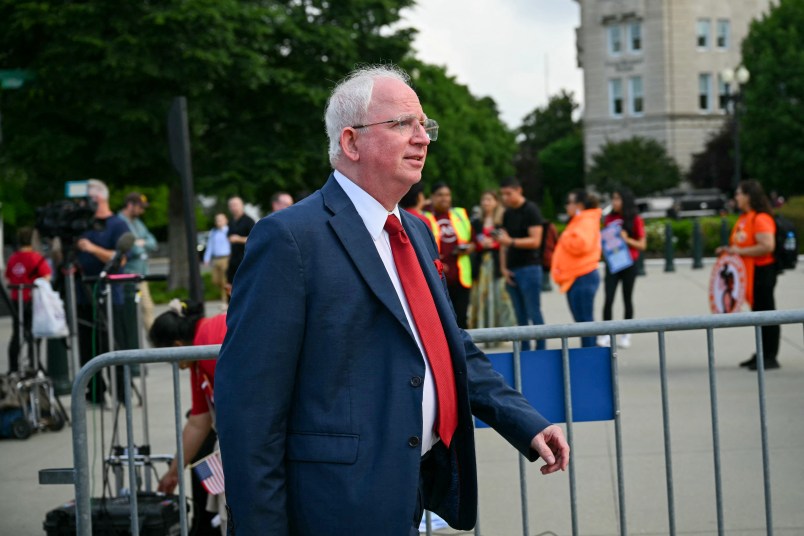
The main advocates for the idea have been John Eastman and a few other Claremont associates. Eastman submitted an amicus brief to the Supreme Court in 2016 in a case that touched on the issue.
Eastman went on to provide critical legal support to Trump’s effort to overturn the 2020 election. He did so with the help of an attorney who co-authored the 2016 amicus: Ken Chesebro, who worked with Eastman to build out a legal architecture that would have allowed Trump to stay in power after losing that year’s election via a coup.
Eastman spent years advocating for an end to birthright citizenship, appearing before a House panel in 2005 to make what was at the time a lonely case. Since then, Trump, right-wing lawyers, and the conservative movement have moved so far to the right that they’re squarely behind him, with the federal government now endorsing an idea long relegated to extremists.
On Tuesday, Eastman kept shilling. In an interview with Steve Bannon, he refused to recognize that what he envisions would transform what it means to be an American.
“It’s only more recently,” he said, “that we’ve adopted this more radical view that anybody born here, no matter the circumstances, are citizens.”



How difficult is “All Persons”?
All mean all. Not half, not a quarter, not anything but all.
I am going to love to see how the “originalists” try to say all doesn’t mean all.
not 3/5ths?
When Fredrich Trump, trump’s grandfather, became a naturalized citizen he swore that he no longer had any loyalty to the German government.
After he made his money, he returned to Germany, married, and intended to remain in Germany. However, he was charged with dodging mandatory military service, convicted, stripped of his German citizenship and deported.
You can made the case that his naturalization was invalid because he lied about his loyalties.
If Fredrich Trump was not an American and birthright citizenship is not valid, then his son Fred Trump was German, not American. And Donald Trump would be German and Scot, not American.
Unpopular opinion: The 14th Amendment should not be at issue in this case.
It’s a fundamental principle of constitutional jurisprudence that the courts should not get to the constitutional jurisprudence if the case can be decided on other grounds.
Congress has express constitutional authority to decide who is a citizen, and they’ve passed the same law roughly a dozen times since the 14th Amendment providing that all persons born in the United States and subject to the jurisdiction thereof are citizens of the United States. That includes many times of it being passed since Wong Kim Ark made it an undisputed floor for for citizenship under the 14th.
Congress knew about Wong Kim Ark. They legislatively blessed the holding of Wong Kim Ark. Forget the 14th, Congress prevails on this without any further inquiry.
Prediction for late June: Every single one of the Justices will ignore the rule against doing the Constitution where other grounds will provide the outcome.
Don’t forget that Trump’s grandfather made his money in the US illegally, partly by running a brothel. And that would have put him at the head of the deportation list according to the maladministration’s current thinking.