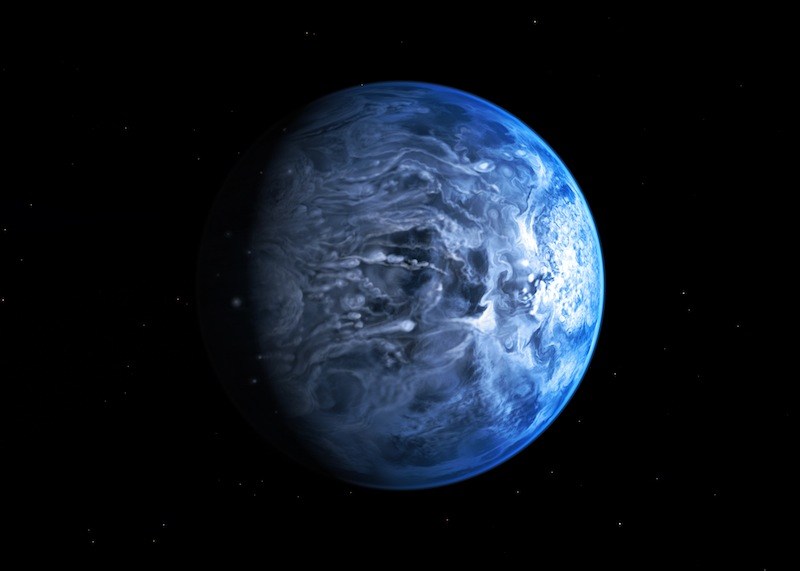
Photo: In this undated illustration provided by the European Space Agency (ESA), an artists impression of one of Earth’s nearest planets outside the solar system named HD 189733B.
LONDON (AP) — Astronomers have for the first time managed to determine the color of a planet outside the solar system, a blue gas giant some 63 light years away.
An international team of astronomers working with the Hubble Telescope made the discovery observing HD 189733B, one of Earth’s nearest planets outside the solar system.Frederic Pont of the University of Exeter in England said Friday that “measuring the planet’s color is a real first — we have never managed it before with a planet outside our own solar system.”
To ascertain the planet’s color the astronomers measured the amount of light reflected off its surface as it eclipsed its host star.
HD 189733B belongs to a class of “hot Jupiters” and has an atmosphere temperature of around 1,000 degrees Celsius (1,832 Fahrenheit).
Copyright 2013 The Associated Press.