

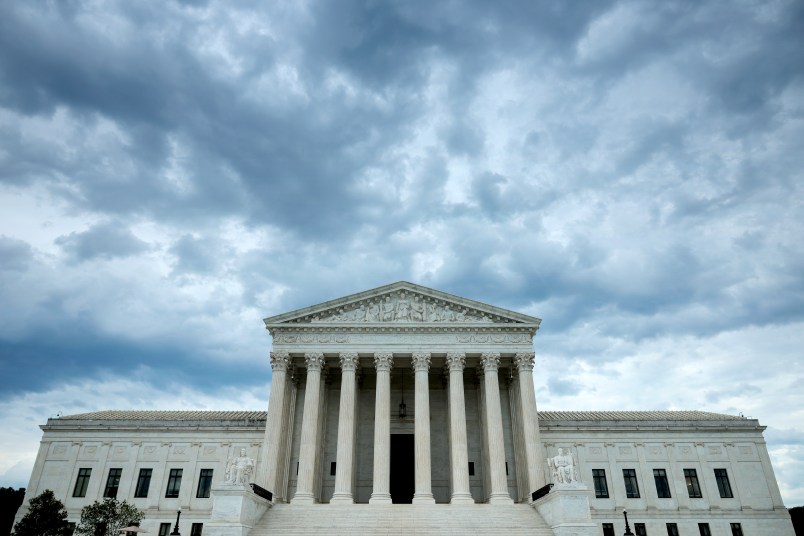
Today’s Supreme Court justices insist that they are not “politicians in robes” and merely act as umpires calling “balls and strikes.” But for the first 100 years of the nation, members of the Court were actively and openly involved in partisan politics. Justices penned newspaper articles and pamphlets, wrote or consulted on congressional legislation, campaigned for friends, and even ran for political office themselves while on the bench. Some were candidates for local or state office, but the presidency was often the most coveted prize; more than a third of sitting Supreme Court justices were presidential candidates in the nation’s first century.
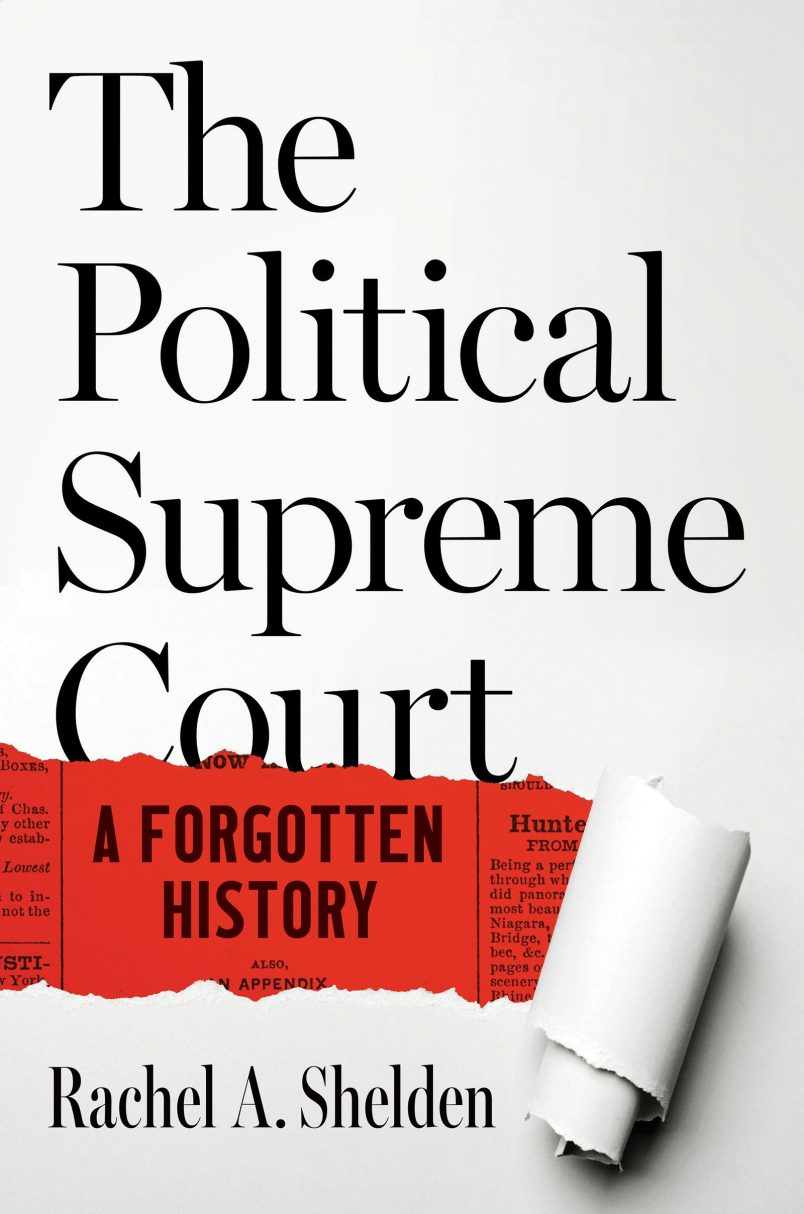
This activity was not corruption or a violation of ethical standards. Justices engaged in politics because the Supreme Court was designed — and operated — as a political body, as I explain in my new book, The Political Supreme Court: A Forgotten History. Justices came to the bench from partisan political positions (rather than judicial ones) and were selected for their political experience. Once confirmed, they continued to participate in the world of partisan politics — and unlike our modern two-party system, that world featured multiple parties on the national, state, and local level that were constantly in flux. Through the federal court system designed by Congress, justices were also expected to represent individual regions of the country through the practice of “circuit riding.” In addition to his duties in the capital, each justice was required to sit as a circuit judge in his assigned region, presiding primarily over federal jury trials and interacting with the voters and partisan political leaders of their region.
Through their judicial opinions, in newspaper articles, in partisan campaign documents, and in speeches and addresses, members of the Court were also part of a broad political conversation about the shape and meaning of the U.S. Constitution. While today Americans generally accept judicial supremacy — the idea that the Supreme Court should serve as the final authority over the Constitution — 19th-century Americans did not subscribe to this view. Instead, the Constitution ultimately belonged to the people, who exercised their authority through their elected representatives and in popular protest.
The late 1850s, when justices were deeply enmeshed in the politics of slavery, is one of the historical moments that best captures the constitutional conversation and the broader political activity of the nineteenth-century Court. The adapted excerpt below recounts some of the ways that members of the Supreme Court mixed politics and constitutional conversation amid the infamous Supreme Court case of Dred Scott v. Sandford in 1857, as well as the popular political reaction to the decision.
Four months after James Buchanan claimed victory in the presidential election in November 1856, Chief Justice Roger Taney announced his infamous opinion in Dred Scott v. Sandford, declaring that Black people could not be citizens of the United States and that Congress had no power to legislate for the territories. Generations of scholars have argued that by invalidating a federal law and defining national citizenship, Taney was attempting to apply a legal remedy to a harrowing national political conflict — with disastrous consequences for the Supreme Court and for the nation.
Yet, Taney and the other justices knew that the world of the Supreme Court concerned far more than legal remedies. Situated amid the politics of the capital and the circuits, the justices, the advocates, and the personnel of the various federal courts were all participants in a political conversation about the future of the nation — a conversation that they also conducted outside the walls of the Supreme Court chamber. In this context, Dred Scott was not the justices’ only contribution to the political conflicts and conversations at the heart of these years.
Instead, when the Court heard reargument in Dred Scott v. Sandford in December 1856, most of the justices and each of the advocates — Henry Geyer, Reverdy Johnson, and Montgomery Blair — had long been involved politically with the questions that animated the case, from territorial acquisition and slavery expansion to presidential politics and state-level electioneering. Some members of the Court had run for president with their views on slavery, territorial expansion, and compromise as key selling points in their candidacies; John McLean and James Wayne were both perennial candidates for these reasons. Other justices, like John Catron, Peter Daniel, and Robert Grier, preferred to stay out of the limelight, instead offering policy and political advice or campaigning on behalf of candidates — from presidents to state representatives. Many of the justices were also tied to the advocates politically, either during the arguments or at earlier points in their judicial careers; they were frequent interlocutors and correspondents in and out of Washington. Similarly, the attorneys themselves were all major political actors with active stakes in presidential and legislative business.
As importantly, justices’ political activities occurred in an atmosphere in which the Supreme Court remained one voice in the constitutional conversation, rather than the final authority. Justices could offer their constitutional views from the bench, but legislators in Congress and at the state level, state judiciaries, the president, and individual citizens claimed the right to offer their own interpretations. By the time Dred Scott arrived at the Supreme Court, constitutional questions about territorial expansion, Black citizenship, and slavery were well-worn subjects in campaigns, elections, and legislative debates — but also in local and state courthouses, at Black political conventions and town meetings, and among antislavery organizations. Dred Scott and his wife, Harriet Scott, had been among the many enslaved people in Missouri who had used their legal and constitutional knowledge to press for freedom and citizenship. Their efforts were part of a broader constitutional culture that did not end with Dred Scott but continued after Taney’s decision.
Members of the Court participated in both the constitutional debates of the courtroom and the constitutional debates of the political world. Justice Catron had long understood how and why this dynamic worked. As he told Andrew Jackson shortly after joining the Supreme Court in the late 1830s, when it came to his fellow justices, he found that “political tendencies are just as strong on all constitutional, and political questions, as they are in any other department of government.” These kinds of divisions were “just as natural, & almost as common, as in the Senate.” On circuit and in Washington, justices had long been incorporated into the world of constitutional debate beyond the bench, where they participated in electoral campaigns, advocated for partisan positions in newspapers and pamphlets, and wrote legislation for congressional allies.
Dred Scott, then, was neither the endpoint of a long debate over slavery in the Supreme Court, nor an aberration in the justices’ ethical behavior or activity away from the bench, nor the beginning of a new epoch in the history of judicial politics. Roger Taney and some of his fellow justices may have wanted to apply a judicial remedy to a political conflict, but they could not escape the reality that the Court’s power was limited. Rather than serving as high priests of the judicial profession, members of the Court had long drawn their authority from the political structure and practices of the federal judiciary, and nothing about Taney’s declaration changed this — much as he hoped it would. Instead, the case was a perfect representation of the ways that judicial and political life were deeply intertwined.
In the aftermath of the Dred Scott case, conflict over the territories did not dissipate; Americans across the political spectrum continued to debate the issue, highlighting the limited authority of the Supreme Court. In fact, the next presidential election in 1860 would feature a partisan battle over different constitutional visions for the nation’s future. Although each party’s platform included other issues, the problem of slavery in the territories and the Dred Scott decision were central features of every nomination and campaign that year. Yet, rather than accepting Dred Scott as authoritative, partisans employed the various justices’ opinions in the case as arguments in a broader constitutional conversation.
Republicans rejected the decision outright, insisting on the right to ban slavery from the territories. Their 1860 platform repudiated the Court’s final authority on constitutional questions and charged Democrats in Congress and the federal courts with abusing their power. This was not a new statement for the party: As one Illinois Republican joked on the floor of the House in 1859, Democrats kept supporting their constitutional arguments by invoking the aid of “a tribunal which sits yearly, in an appropriate dismal room in the basement of this Capitol, where one can easily realize [Charles] Dickens’s description of the Foggy high court of chancery” — associating the Supreme Court with the farcical body at the heart of Dickens’s 1853 novel Bleak House. Republicans’ constitutional arguments against the Court also went well beyond Dred Scott; in the late 1850s, popular resistance to the Fugitive Slave Act in the North had increased, and in Wisconsin, state officials had directly defied the Supreme Court’s ruling in a case involving an abolitionist editor.
Other partisans also questioned the Court’s authority. A group of mostly Upper South politicians who had never associated with the Democratic Party strongly disagreed with the idea that Congress had no right to legislate for the territories and had begun to organize a new Constitutional Union Party in the waning months of 1859. Constitutional Unionists were self-professed “conservatives” who defined themselves as opponents of “fanaticism,” instead committed to moderation and independence. Their party’s ideas were simple (if vague): Save the nation through a commitment to the Constitution and the Union.
The problem with Dred Scott, such men believed, was that it had upended important national compromises that had been treated with “veneration” by both Northerners and Southerners for decades. Democrats were to blame for both the decision and the ensuing crisis. One Maryland member of the new party specifically referred to Dred Scott as a “Democratic case, decided by Democratic judges, resting on Democratic party political views of the Constitution and laws, and inspired by Democratic prejudices and sentiments.”
The Democratic Party itself was also divided. After the 1856 contest, Illinois Senator Stephen Douglas, the “Little Giant,” had been seen as the Democrats’ front-runner for an 1860 nomination, but by then he faced growing opposition from Southerners who questioned his commitment to allowing slavery in the territories. Roger Taney’s territorial ruling in Dred Scott had been controversial in Illinois, so Republicans in the state — particularly Douglas’s 1858 Senate opponent, Abraham Lincoln — had tried to undermine Douglas by tying him directly to Taney’s opinion. Douglas pushed back, arguing that slavery could not exist anywhere without popular will and positive law, so the people of a territory could exclude slavery from its borders, regardless of what the Court had ruled. Douglas’s argument provided clear separation from Taney but also enraged Southern Democrats, who swore they would never back his presidential prospects.
Douglas was still determined to win the nomination, and he had a vast network of political allies to pursue and promote his cause. One of the Little Giant’s strongest supporters was David A. Smalley, a federal district judge and Douglas’s old schoolmate from Vermont. Smalley had been nominated to the federal court in 1856 by President Pierce, and since then the judge remained an active player in national politics as a “red hot Douglas man,” promoting Douglas Democrats in federal patronage positions and organizing New Englanders ahead of the 1860 election. In a sentiment that other members of the Supreme Court could appreciate, Smalley had told Douglas, “I shall not forget or entirely forsake politicks on the Bench.” The Vermont judge had been a lever of politics both publicly and privately and had even served as the chairman of the Democratic National Committee since 1857.
Members of the Supreme Court were also heavily involved in the 1860 election — including as candidates. In fact, five of the nine sitting justices were touted as presidential possibilities that year, representing each of the parties in play: John Archibald Campbell, Roger Taney, and James Wayne were all touted as Democratic candidates; Samuel Nelson was considered for both the Democratic nomination and the Constitutional Union Party; and John McLean—Abraham Lincoln’s Republican choice in 1856—was both a potential Republican and Constitutional Union Party nominee.
Ultimately, no justice captured the nomination and in 1860, Abraham Lincoln was elected president by a party that openly rejected the Court’s territorial ruling three years earlier. By opposing the Dred Scott decision, however, Lincoln and his colleagues were not flouting constitutional authority, nor were they making an argument that the Supreme Court was an illegitimate institution that possessed no power to interpret the Constitution. Instead, Republicans staked their electoral campaign on the argument that Taney and his allies had claimed an ultimate power for the Court that it simply did not possess. By winning the 1860 election, Lincoln and the Republicans had proved that the Court could not command that authority.
From The Political Supreme Court: A Forgotten History by Rachel Shelden. Copyright © 2026 by Rachel Shelden. Published in the W. Hodding Carter III Books imprint of the University of North Carolina Press. Used by permission of the publisher.




Any 6-3 decision with the usual suspects is politics not law anyway.
So, we’re supposed to view today’s SC as continuing a grand American tradition? I realize there are problems with the SC supremacy view, but I think that outlook is an improvement over the mud wrestling of the 19th century.
I think you should revisit the first sentence, which together with the second and the sixth establishes the basic contrast between then and now.
Wow…so, a “supreme court originalist.” The corrupt “conservative” supermajority must love your work. Just because earlier justices played politics doesn’t make it “right.”
Congress didn’t simply ignore Dred Scott, they passed the reconstruction amendments to effectively overturn it. And future decisions confirmed. Article III doesn’t mention politicking (I don’t believe political parties are addressed at all in the Constitution), but it does give the Judiciary that elusive balls and strikes responsibility. That courts, and this court in particular, have twisted that doesn’t excuse their blatantly political and corrupt activities. At least not for this non-lawyer
I think you may have missed the point here. The current SCOTUS are two-thirds right-wing ideologues masquerading as neutral arbiters, the kind who said at their confirmation hearings that they’d respect precedent and then promptly threw a lot of precedent out. If the conservative justices had said what they were actually going to do, there’s a chance they wouldn’t have been confirmed; but if they were at least the voters would have a clear sense of what we were going to get. That’s what would have happened in the nineteenth century. This is not an originalist argument at all–it’s a call to stop pretending in a way that conceals anti-democratic (to say the least) right-wing (undeniably) overreach by this Court.