

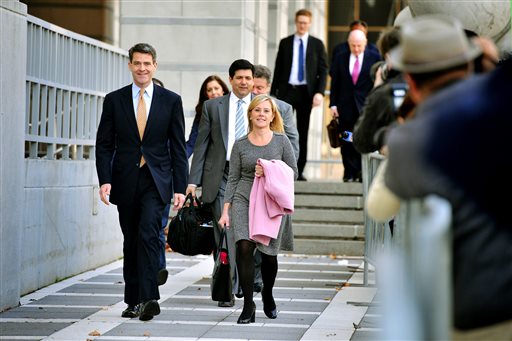
NEWARK, N.J. (AP) — Defense attorneys in the George Washington Bridge lane-closing trial filed for a mistrial Thursday in the middle of jury deliberations.
The motion comes a day after attorneys for two former allies of Republican Gov. Chris Christie asked the judge to give new instructions to jurors on the top conspiracy count in the indictment.
A brief filed by defense attorneys with Thursday’s mistrial motion was almost completely redacted. Federal prosecutors also submitted a motion to seal a letter they sent to the judge, saying it was based on matters addressed in a closed courtroom Wednesday.
The judge hasn’t yet ruled on the motion.
Jurors have deliberated for parts of three days without reaching a verdict. They left early Wednesday while the lawyers argued privately in court.
Prosecutors say Bridget Kelly and Bill Baroni used the September 2013 traffic jams to punish a Democratic mayor who didn’t support Christie’s re-election. Kelly was Christie’s deputy chief of staff and Baroni was Christie’s top appointee to the authority that runs the bridge, which connects Fort Lee and New York City and is the country’s busiest.
For the last three years, the narrative in the scandal dubbed Bridgegate has focused on the alleged plot to use gridlock to punish Fort Lee Mayor Mark Sokolich, and the government spent much of the six-week trial presenting evidence aimed at buttressing those claims.
For jurors, however, Sokolich might as well have been one of the traffic cones that were moved on the morning of Sept. 9, 2013, cutting three access lanes to one.
Under conspiracy law, the motive or intent behind a conspiracy doesn’t always have to be proved; only the agreement to break the law does. In this case, the primary crime alleged was misusing the property of an organization receiving federal benefits — the Port Authority of New York and New Jersey, which operates the bridge.
Defense attorneys argued vehemently that Judge Susan Wigenton should instruct jurors that they could find Baroni and Kelly not guilty if they felt the government hadn’t proved Sokolich was the intended target. But Wigenton refused.
Christie has denied any knowledge of the plot and wasn’t charged. But Kelly, Baroni and another Port Authority official all testified Christie was informed about the lane closings either before or while they were going on.
The most serious charges against Kelly and Baroni carry the possibility of 20 years in prison.
Copyright 2016 The Associated Press. All rights reserved. This material may not be published, broadcast, rewritten or redistributed.



I hope the mistrial motion is denied. It’s time these folks were subject to a jury of their peers… and hopefully some justice.
Mistrial motions in this context are routine.
This jury’s been out 3 days. That’s not unusual for public corruption trials of this length. All during that month, jury members were told not to discuss the case among themselves or with anyone before the end of all arguments and directions from the judge. It’s pretty easy to see how several days get eaten up off the bat in just introducing themselves, getting to know each other enough to select a foreman, organizing themselves, walking thru the evidence, finding out where they have disagreements, etc.
The jury in the Libby trial was in court about the same time before starting to talk. They came back with final verdicts on Day 11 of deliberations.