


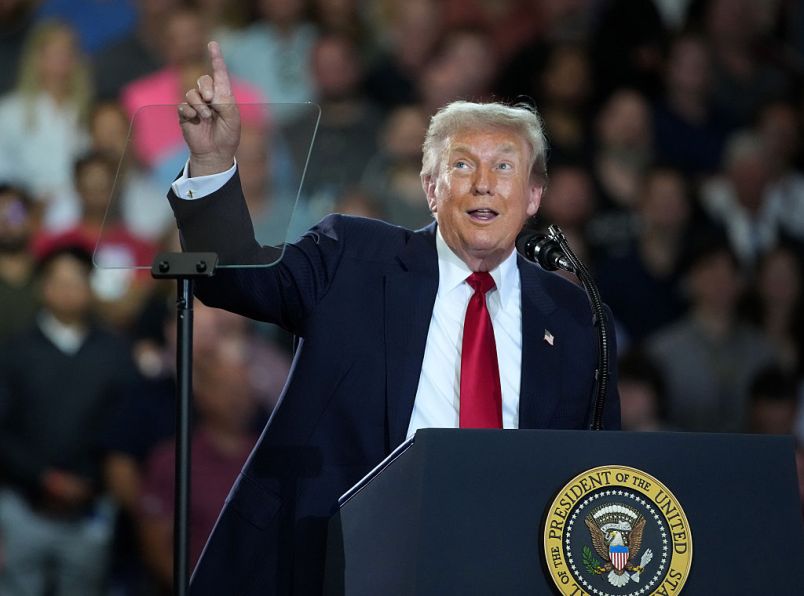
Multiple challenges to President Donald Trump’s March “election integrity” executive order are moving through the federal judiciary simultaneously, including one that has reached the Supreme Court. On Tuesday, an appeals court in Washington D.C. presiding over a separate challenge to the EO sided with the administration, agreeing that it is too early for plaintiffs to challenge the order that would overhaul the absentee voting system.
Notably, the plaintiffs in the case before the Supreme Court — Trump v. California — are states, who may have an easier sell: They need to do a massive amount of work and spend tons of money to put the order into action now, even before it’s finalized, to be ready for November. The panel of D.C. judges found that the plaintiff in the second case — the Democratic Senatorial Campaign Committee — could only point to speculative harms that might arise if the order is enforced.
The Trump administration has taken steps to finalize and enforce the order, but the D.C. Circuit Court only looked at the body of evidence the district court analyzed. The panel — two Obama appointees and one Trump appointee — unanimously upheld the lower court’s finding that it’s too early to challenge the order.
“Plaintiffs claim four types of injuries that… flow not from Executive Order 14,399 itself, but entirely from predicted future actions contemplated by that Order,” the panel wrote.
Part of the reason the DSCC challenged the order immediately, its lawyers wrote, was to avoid running afoul of the Purcell principle, the inconsistently applied theory that federal courts shouldn’t change voting laws just before elections. The panel — perhaps naively, given the Supreme Court’s predilection for deciding that Purcell matters only when it helps Republicans — assured the DSCC that its worry is unfounded.
“Plaintiffs’ fear has the Purcell principle backwards,” they wrote. “If the federal agencies were to take the actions the Plaintiffs fear and if they were to attempt to impose those massive changes on the States’ voting systems on the threshold of the upcoming election, then those actions (if found unlawful) could be enjoined without implicating any federalism or reliance interests because the injunction would preserve the States’ existing electoral status quo.”
The Trump administration is clearly trying to run out the clock on challengers’ ability to stop the order. It’s still blocked, for now, from rulings in other cases. The Supreme Court will weigh in soon on Trump’s request to lift the injunction while litigation plays out.
Read the ruling here:



The shadow docket? Me thinks they’re aiming to allow this.
The court is a political body. It is not coincidental that it considers Republican Party needs before national needs.
The Court has been consistent in giving this administration the benefit of the doubt and lifting lower court injunctions on previous executive orders. And with this one they won’t even have to actually rule on the case, because if they let the Trump administration cook the midterms, they will appoint Stephen Miller as Supreme Court Regent to allow the members of the Court to investigate Democratic voter fraud full time, and his decisions will all be issued by text message only using emojis.
That is certainly a bad sign.
Perhaps?
This looks a tad willful or ostrich head in the sand at the very least. Judge Cannon demonstrated it only takes one corrupt judge to brazenly commit injustice and somehow the Republican Six still deserve the benefit of the doubt?