


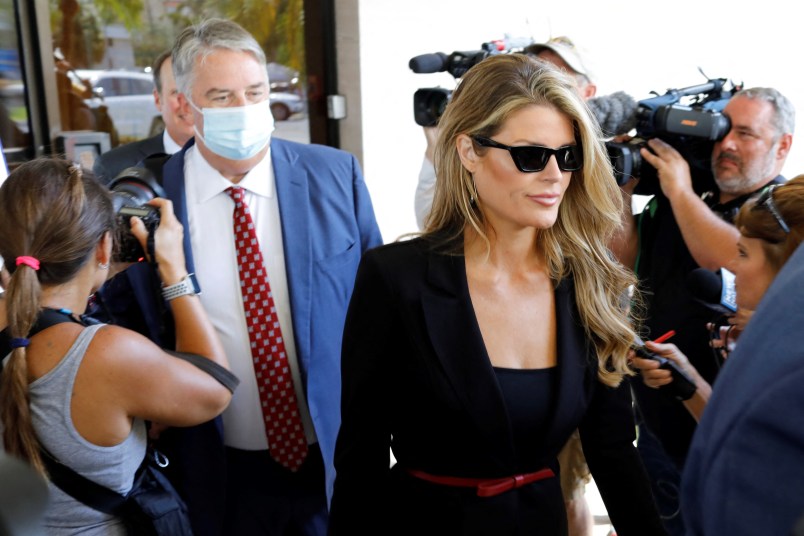
A federal judge has ruled that former insurance lawyer Lindsey Halligan was invalidly appointed as interim U.S. attorney in the Eastern District of Virginia and has dismissed the indictments of former FBI Director James Comey and New York Attorney General Letitia James.
The dual rulings by U.S. District Judge Cameron McGowan Currie of South Carolina are the most significant judicial rebukes yet to the politically motivated prosecutions driven by the White House of political nemeses of President Donald Trump. Comey was indicted for allegedly lying to Congress, and James for alleged mortgage fraud, but both cases were widely seen by legal experts as flimsy and pretextual.
Both indictments were dismissed without prejudice, which means in theory the government can obtain new indictments. But in the Comey case, the statute of limitations has since expired, which may preclude the government from re-indicting him on these charges. While Currie’s ruling doesn’t explicitly say that Comey may not be re-indicted, it strongly suggests that the expired statute of limitations would serve as a bar to a new indictment.
Judge Currie was appointed to hear the Comey and James challenges to Halligan’s appointment because of a conflict of interest that the federal judges in the district had. One of the core issues in the challenge to Halligan’s appointment was whether the attorney general or the judges in that district have the power to appoint interim U.S. attorneys after an initial 120-day appointment has expired.
The Trump administration argued – contrary to settled law and past practice – that the attorney general could appoint consecutive interim U.S. attorneys to their own 120-day terms indefinitely. After analyzing the statute on U.S. attorney vacancies, Currie rejected that argument, using identical language in both rulings:
In sum, the text, structure, and history of section 546 point to one conclusion: the Attorney General’s authority to appoint an interim U.S. Attorney lasts for a total of 120 days from the date she first invokes section 546 after the departure of a Senate-confirmed U.S. Attorney. If the position remains vacant at the end of the 120-day period, the exclusive authority to make further interim appointments under the statute shifts to the district court, where it remains until the President’s nominee is confirmed by the Senate.
In Halligan’s case, Trump removed the prior interim U.S. attorney, Erik Siebert, because he had failed to pursue the politicized prosecutions that the president was demanding. Siebert’s initial 120-day term as an interim U.S. attorney appointed by Attorney General Pam Bondi had already expired, but his term had been extended by the judges in the district. When Bondi purported to appoint Halligan to replace Siebert, it set up a clash over who had the power to name interim attorneys beyond 120 days.
Beyond a mere statutory violation, Currie found that Halligan’s invalid appointment also violated the Constitution’s Appointment Clause. Halligan was neither confirmed by the Senate nor by a process authorized by Congress, Currie concluded. Her unlawful appointment rendered all of Halligan’s purported actions while U.S. attorney void, Currie ruled, which was her basis for dismissing the indictments, which were never valid:
I conclude that all actions flowing from Ms. Halligan’s defective appointment, including securing and signing [the] indictment, constitute unlawful exercises of executive power and must be set aside.
In an ironic historical twist, Currie cited to U.S. District Judge Aileen Cannon’s opinion in dismissing the Mar-a-Lago indictment against Trump on the grounds that Jack Smith was unlawfully appointed as special counsel in violation of the Appointments Clause.
In ruling against the Trump administration, Currie also rejected Bondi’s ham-handed attempts to retroactively ratify Halligan’s appointment by, among other things, designating her as a special attorney:
I reject the Attorney General’s attempt to retroactively confer Special Attorney status on Ms. Halligan. Regardless of what the Attorney General “intended” … or “could have” done, the fact remains that Ms. Halligan was not an “attorney authorized by law” to conduct grand jury proceedings when she secured Mr. Comey’s indictment.
After waving away several of the Trump administration’s more tenuous arguments, Currie zeroed in on Bondi’s attempt to ratify Halligan’s purported actions as interim U.S. attorney as a last ditch effort to save the indictments so sought by the president. Bondi’s attempted ratification failed, Currie said, because Halligan was not a government attorney in any capacity at the time she presented the indictments – and ruling otherwise would yield absurd results:
The implications of a contrary conclusion are extraordinary. It would mean the Government could send any private citizen off the street — attorney or not — into the grand jury room to secure an indictment so long as the Attorney General gives her approval after the fact. That cannot be the law.
At this point, Currie’s rulings in the two cases diverge slightly because of the statute of limitations issue in the Comey case. The administration rushed to indict Comey before the statute of limitations expired, and it did expire after the purported indictment of Comey and before Bondi attempted to ratify Halligan’s work. Currie ruled that because the statute of limitation’s had already expired, Bondi didn’t have the power to ratify something she didn’t any longer have the power to do herself.
While Currie proceeded to dismiss both indictments without prejudice – meaning the charges can be refiled – a footnote in the Comey ruling suggests Currie may think he’s shielded from further prosecution. She cites case law that says the statute of limitations stops running once an indictment is returned, meaning in theory Comey could be re-indicted, but not where the initial indictment was void. “[I]f the earlier indictment is void, there is no legitimate peg on which to hang such a judicial limitations-tolling result,” Currie quoted from another case.
In both cases, Currie found the questions of whether dismissal should be with or without prejudice fairly easy to resolve. The case law, she said, directed her to restore Comey and James to the positions they were in before Halligan’s invalid indictments.
This is the third time federal judges have found interim U.S. attorneys to have been invalidly appointed in Trump’s second terms, echoing similar rulings in New Jersey and Nevada.
At the time of Currie’s dismissals of their cases, Comey and James both had multiple other motions to dismiss their indictments pending that were based on substantial legal and factual grounds, including claims of vindictive prosecutions. Comey was also mounting a vigorous challenge to whether his indictment had ever been voted on by the grand jury, after Halligan made a hash of the grand jury proceedings. But Currie was asked only to focus on the threshold issue of whether Halligan was properly appointed.
If new indictments are brought, Lindsey Halligan won’t be the prosecutor, and whoever is won’t have been appointed by Bondi.



We’re they dismissed with prejudice?
No!
hahahahahahhahaha
I was talking with a co-worker and estimated how many hundred thousand dollars this has already cost Comey & James. These attorneys are not cheap. They are billing over $2,000 per hour if not more.
That was completely predictable. These cases might go down as the most botched prosecution efforts in the DOJs entire history.