

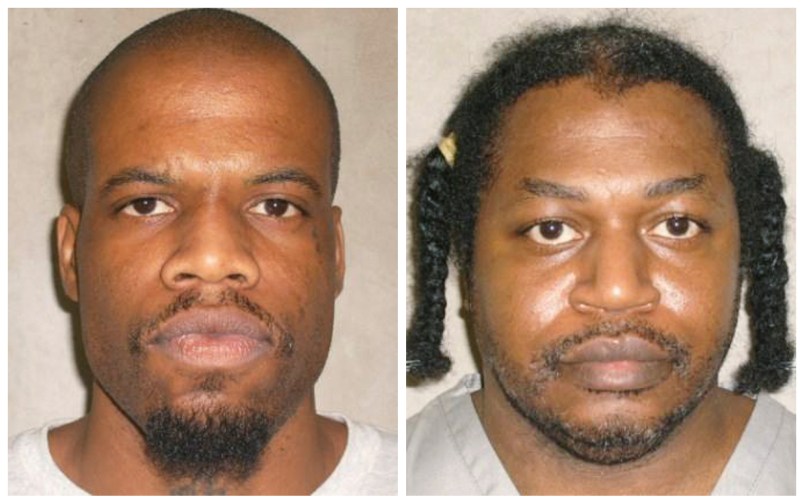
COLUMBUS, Ohio (AP) — The botched execution of an Oklahoma inmate is certain to fire up the debate over what constitutes cruel and unusual punishment — the phrase written into the U.S. Constitution and defined by the courts, piece by piece, over two centuries.
Convicted killer Clayton Lockett, 38, began writhing, clenching his teeth and straining to lift his head off the pillow Tuesday evening after he was supposedly rendered unconscious by the first of three drugs in the state’s new lethal injection combination.
The execution was halted, and Lockett died of a heart attack about a half-hour later, authorities said.
While officials later blamed a ruptured vein — not the drugs themselves — the case is raising questions about the ability of states to administer lethal injections that meet the Eighth Amendment requirement that punishments be neither cruel nor unusual.
Death penalty opponents such as the American Civil Liberties Union called for a moratorium on capital punishment. And the White House said the procedure fell short of the humane standards required when the death penalty is carried out.
In light of other apparently bungled executions around the U.S. in recent years, Jen Moreno, staff attorney at the Berkeley School of Law Death Penalty Clinic, said the risks are clear.
“To say that they’re isolated incidents is mischaracterizing them, and what they really are is foreseeable consequences of using an inherently dangerous procedure,” she said.
The U.S. Supreme Court upheld the constitutionality of lethal injection in 2008 in a case out of Kentucky. As part of that decision, the high court said there is no constitutional right to a painless execution.
The “Constitution does not demand the avoidance of all risk of pain in carrying out executions,” Chief Justice John Roberts said.
That decision involved a three-drug method that many states no longer use because certain drugs have been cut off by European suppliers.
More recently, attorneys making the cruel-and-unusual argument have targeted the newer drug combinations adopted around the country, their reliability and their suppliers, but they have had little success.
Making that argument has always been difficult.
The Supreme Court has never declared a method of execution unconstitutional on the grounds that it is cruel and unusual. Over the past 135 years, it upheld the firing squad (1879), the electric chair (1890), and then lethal injection.
The court made it clear over the years that the Eighth Amendment prohibits inflicting pain merely to torture or punish an inmate, drawing a distinction between a method like electrocution and European practices such as drawing and quartering. The Constitution prohibits “unnecessary and wanton infliction of pain,” the court said in 1976.
It has also held that “an isolated mishap” during an execution does not violate the Eighth Amendment, “because such an event, while regrettable, does not suggest cruelty or a ‘substantial risk of serious harm,'” according to a 1947 decision allowing Louisiana to return an inmate to the electric chair after a botched attempt a year earlier.
That suggests that an isolated episode — say, one bungled execution in Oklahoma — might not be enough to bring the issue before the Supreme Court.
But if it can be shown that there’s a pattern, “at some point the court’s going to have to look at it,” said Dale Baich, a federal public defender in Arizona who has represented death row inmates.
States have botched several executions previously, leading at times to changes in execution policies but no widespread prohibition.
In 2000, Florida switched from the electric chair to injection after bungled electrocutions raised concerns that the state’s death penalty would be declared unconstitutional.
Ohio executioners in 2006 needed more than an hour to put Joseph Clark to death because of trouble with his veins.
Later that year, it took Florida killer Angel Diaz 36 minutes to die, with an autopsy showing that the needles that were used to send the lethal drugs into his veins had penetrated his muscles.
In 2009, Ohio abandoned an execution attempt after Romell Broom was pricked 18 times with needles. Broom remains on death row, challenging the state’s right to try again.
In January, an Ohio inmate snorted and gasped during the 26 minutes it took him to die. The state said this week it doesn’t believe Dennis McGuire suffered, but it also announced it would increase the drug dosages “to allay any remaining concerns.”
Also in January, Oklahoma death row inmate Michael Lee Wilson said during his execution: “I feel my whole body burning.”
The use of custom-mixed, or compounded, drugs by Georgia, Missouri, Ohio, Oklahoma, South Dakota and Texas has opened a new line of attack for defense attorneys, who have demanded to know the identities of the drug suppliers. They have argued that deficiencies in the purity and potency of the drugs could cause a slow and torturous death.
Bolstering this argument: Compounding pharmacies are not regulated by the federal government, and a 2012 meningitis outbreak that killed 64 people was linked to contaminated drugs from one such business in Massachusetts.
But courts so far have rejected those arguments in a number of states.
Legal issues aside, one problem with the cruel-and-unusual argument is the difficulty in measuring pain in unconscious people, whether surgical patients or death row inmates.
Doctors can rely on heart monitors or blood pressure machines to measure reaction in sedated patients, but those methods are not foolproof. Such machines aren’t used in death chambers.
___
Associated Press writers Jim Salter in St. Louis and Michael Graczyk in Houston contributed to this report.
Copyright 2014 The Associated Press. All rights reserved. This material may not be published, broadcast, rewritten or redistributed.







“…cruel…”
Conservatives don’t care. To them, it is impossible to be “too cruel” to a convicted killer. Face it, we know the issue is morals and values, but we don’t have a strong hand on religious principles in this current political makeup.
The leverage we do have, however, is over the principle of “unusual”.
In my opinion, we have an extremely compelling argument that it is inherently incompatible with our basic legal definitions to tolerate the State killing people with drugs purposely kept secret from the public. There is no justification for that. One can claim the State has a legitimate right to keep a security apparatus secret from the public. It can keep nuclear plant plans secret.
But keeping secret the exact method the State will use to kill a trapped human being? That’s more than odd.
Without knowing the method, we can’t begin to address the issue of cruel. If we know the method, we can personalize the effect of it, and we can come to a considered judgment about what we will permit the State to do to us.
Okies blow a double header. Governor pissed to lose her conservative cred trophy.
We should go back to the tried and true methods of execution like the firing squad. That’s far more humane than killing innocents with missiles fired from drones.
The key isn’t the word “cruel” or the word “unusual.” The key is the word and. The Constitution permits cruel punishment. It also permits unusual punishment. What it doesn’t permit is a form of punishment that is both cruel and unusual.
The Republicans, of course, don’t care, as long as the guy ends up dead.
While having no sympathy for these criminals and wishing Warner had been the subject of the “botched” attempt for his child rape, I’m stunned by the incompetence of the state officials…people who worry that Bibles aren’t everywhere yet approach state-mandated death with a casual, pinch-pennied indifference…I marvel at the ugliness of the soul hiding behind Gov. Fallin’s pastel tailoring.