

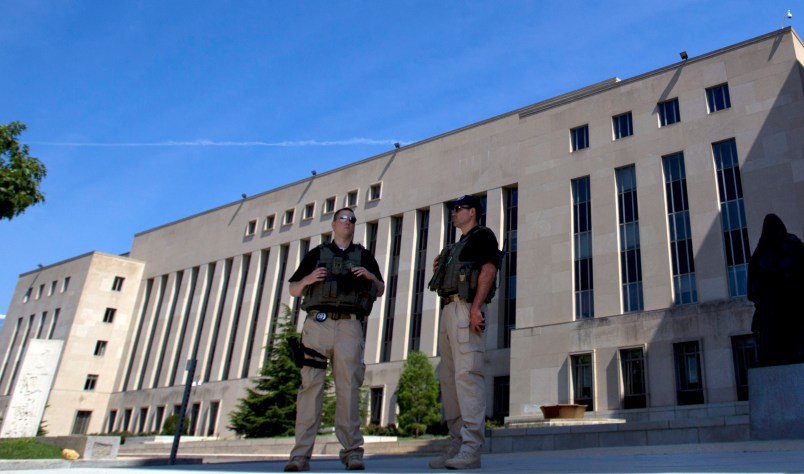
WASHINGTON (AP) — The Libyan militant charged in the Benghazi attacks has pleaded not guilty to conspiracy.
Ahmed Abu Khattala (hah-TAH’-lah) made his initial appearance in federal court in the nation’s capital on Saturday.
A grand jury indictment says Abu Khattala took part in a conspiracy to provide material support and resources to terrorists in the 2012 attacks that killed U.S. Ambassador Chris Stevens and three other Americans.
Abu Khattala was flown by a military helicopter from a Navy ship to Washington earlier Saturday.
In court, he wore a two-piece black track suit and kept his hands behind his back. He looked impassively at the judge for most of a 10-minute court hearing.
Copyright 2014 The Associated Press. All rights reserved. This material may not be published, broadcast, rewritten or redistributed.






“Not guilty”, eh? That’s good enough for “next FOX Noise commentator.”
sad but true. For those of us who do believe in the capability of the American justice system (even though imperfect), we will let the process play out.
“…He looked impassively at the judge…”
So?
I’ll bet he caught every word. He knows they’ve got more than enough evidence to nail him.
Out of curiosity, how is the court’s jurisdiction determined here? He committed a crime against American interests, but he is neither an American, nor was he on American soil when he committed said crime (unless they can prove he was physically in the embassy, but thus far they have only tried him for conspiracy, not for the attacks themselves). Just committing a crime against an American does not put jurisdiction in American courts. If you drive down to Mexico, and get car jacked within sight of the border, but on the Mexican side there isn’t a thing the American courts can do about it. How is this different?
Because it’s terrorism. There are a number of counter-terrorism laws enacted in 2002 in conjunction with the International Convention for the Suppression of Terrorist Bombings becoming effective in the US. Here is one law that is possibly applicable:
As you can see, it is a violation of US law to bomb or attack with explosives or any other lethal device any US embassy of consulate. It is also a violation of US law if a bomb or other lethal device kills or injures an American national. It doesn’t even have to be terrorism (specifically covered by (b)(1)(B) and (b)(2)(D). The US has jurisdiction for bomb or explosives attacks against Americans and American interests by statute backed up by an international treaty that currently has 168 signatories. There are plenty more such laws. See 18 U.S. Code Chapter 113B - TERRORISM
You’re right, though – if you get carjacked in Mexico, you’re on your own.