

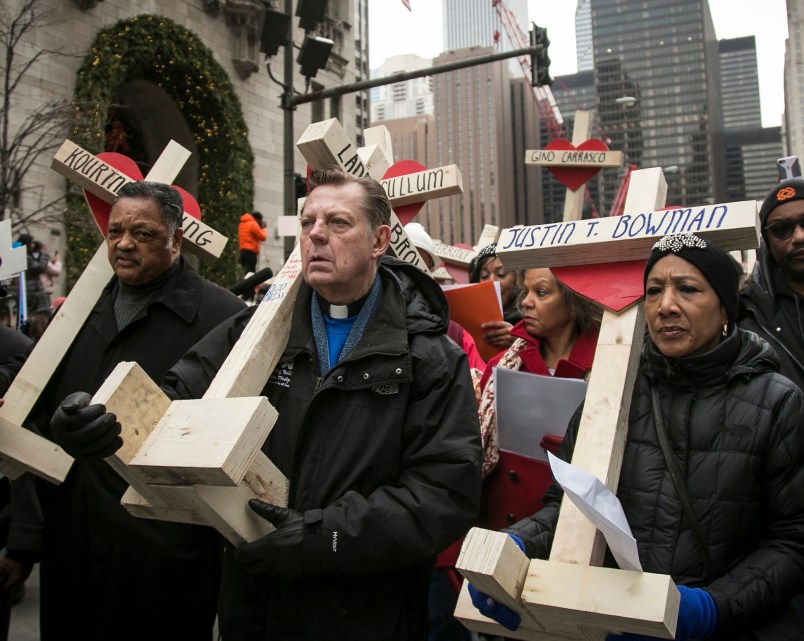
CHICAGO (AP) — Thousands of anti-violence protesters marched along a Chicago interstate on Saturday, shutting down traffic in an effort to draw attention to the gun violence that’s claimed hundreds of lives in some of the city’s poorest neighborhoods and pressure public officials to do more to stop it.
Marchers chanted “Stop the killing” and carried signs reading “We need jobs” and other messages. Some stopped to scrawl on the road with chalk: “Enough is enough” and “Peace.” Toward the front of the march the Rev. Michael Pfleger, who organized the protest, Chicago police Supt. Eddie Johnson and the Rev. Jesse Jackson linked arms.
The march took place along the northbound lanes of Interstate 94, known as the Dan Ryan Expressway, after a roughly hourlong standoff between police and the protesters.
Illinois State Police, which had warned earlier in the week that any pedestrian entering the expressway would face arrest, said early Saturday that an agreement had been reached for protesters to march on a portion of the roadway. Officers and vehicles lined up, forming a barrier to keep protesters in two northbound lanes, allowing some traffic to pass in other northbound lanes.
But Pfleger and protesters insisted there was no agreement and that they would shut down the entire northbound roadway, with Pfleger noting the city closes major roads for parades and other occasions. The crowd began creeping into other lanes — a situation Pfleger said had the potential to become dangerous.
Illinois State Police, which has jurisdiction over expressways, announced around 11:30 a.m. that they were shutting down all northbound lanes of the expressway. Protesters then began walking northbound along a roughly 1.5-mile (2.4-kilometer) route.
“Today we got their attention,” Pfleger said afterward. He said the next step is accomplishing the actual goal — an “aggressive plan” to address the violence . Among the demands the protesters listed were more resources, jobs and better schools for their communities as well as stronger gun laws.
There’s a historical significance to marching along the Dan Ryan Expressway — a roadway some believe was built in the early 1960s to separate white communities and poor, black ones. To the west of the new interstate were Comiskey Park, home of the White Sox, and neighborhoods such as Bridgeport, home to then-Mayor Richard J. Daley and his clan. To the east rose the Robert Taylor Homes, a high-rise public housing complex that became notorious for its violence.
It was the kind of racial and economic segregation that still exists in Chicago today.
Chicago police said the city had 252 homicides and 1,100 shootings in the first six months of this year, a decrease from the same period last year. But those crimes have been heavily concentrated in predominantly black, low-income neighborhoods.






You can block the freeway, but be damn sure you don’t kneel for the national anthem!/s
I just wish stories on Chicago, where violence is a definite issue, would place it on a per-capita basis.
For example in 2018, of the 30 cities with the highest murder rate on a per-capita basis, Chicago comes in # 25.
But all you hear Dotard yapping about is the murder rate in Chicago.
To the mod who just deleted that post, thank you.
So you think you can solve the problem of violence by deleting posts that tell the truth that no one wants to discuss?
They shut down the Dan Ryan. THE DAN RYAN!
Well played.