

This article is part of TPM Cafe, TPM’s home for opinion and news analysis.
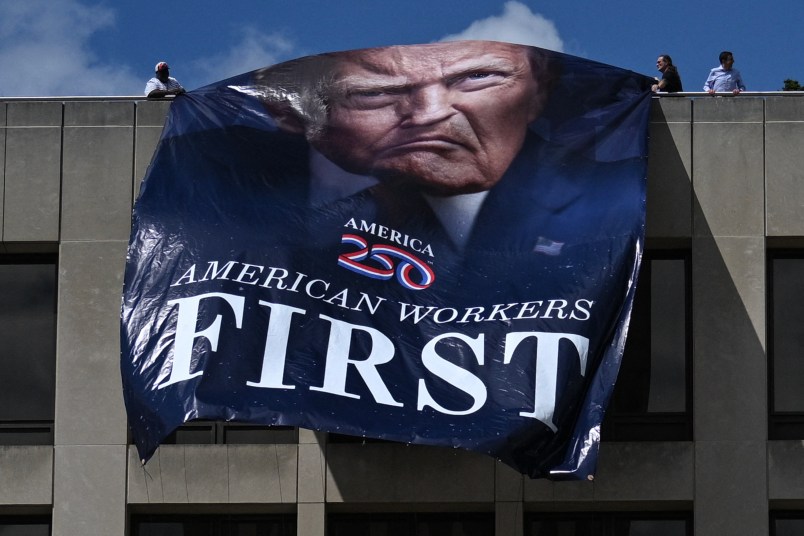
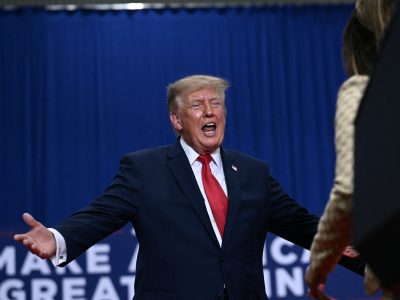
Last week the White House staged a pre-Labor Day Cabinet meeting to celebrate the administration’s supposed victories for American workers. Cabinet members took turns offering fawning, sycophantic praise of their boss in a display of precisely the workplace dynamics the labor movement fights to eliminate. It was an apt symbol of this administration’s approach to workers.
The brutal truth is that the Trump administration and conservatives in Congress are eviscerating workers’ rights in this country. The administration wants to repeal more than 60 workplace regulations, has stripped collective bargaining rights from more than a million federal workers, and is hollowing out the Department of Labor.
This is a moment for states to act — and not timidly or in isolation. Blue states have extraordinary untapped power, especially if they choose to wield it together. As federal labor protections crumble, states must fill the void, thinking boldly and creatively about how to build a country that supports working people.
Focusing on states will require a shift for national progressive leaders, many of whom have long viewed the federal government as the only real stage. Some unions, community organizations, and activists began shifting years ago, turning to states (and also localities). Pro-worker lawmakers have responded, passing higher minimum wages, paid sick and family leave, heat protections, warehouse worker safeguards, non-compete bans, and collective bargaining for farmworkers and public employees.
But the current moment calls for exponential acceleration of state action. At a baseline, states must immediately shield people from rollbacks and hold the line on current federal protections. States must go further, though, and with a scale and speed that matches the crisis in order to ensure fair wages, safe workplaces, and the right to form and join unions.
States can coordinate on passing “trigger laws” that snap into effect if federal standards are repealed, ensuring that rollbacks in Washington don’t leave workers exposed. They can share data on labor violators and coordinate enforcement, joining forces to bring multi-state cases pursuing corporate behemoths that violate workers’ rights. Taking a page from conservatives’ book, states can pass model worker protection laws and pool research, bill drafting, and communications strategies. These aren’t abstract ideas — states already cooperate this way in other arenas, from clean energy to professional licensing.
Some states are already experimenting. New Jersey, Pennsylvania, and Delaware signed an agreement to coordinate wage-theft enforcement. New York’s legislature this year passed a trigger bill to safeguard collective bargaining rights if the National Labor Relations Act collapses, with similar bills proposed in California and Massachusetts. Illinois enacted a law locking in certain workplace protections if federal standards are weakened. And the attorneys general of D.C. and Minnesota brought coordinated lawsuits against the gig company Shipt for allegedly misclassifying workers as independent contractors, depriving them of rights. But these examples are too few and too quiet. To meet the moment, we need a bolder, more visible strategy.
Imagine if a dozen states simultaneously introduced bills to enact workplace heat protections, ban non-compete agreements, guarantee unemployment benefits to striking workers, or make wage theft a felony. Coordinating “drop dates” so labor bills are introduced across states at once would create headlines and momentum. Imagine if two dozen states followed Maryland’s lead in requiring workforce standards in its private equity portfolio, ensuring that state pensions are invested in companies with good labor practices. Imagine if attorneys general from across the country launched joint investigations into Amazon’s treatment of “Flex” drivers as independent contractors, holding the company accountable for denying them employee rights.
Imagine if states created an interstate compact to operate a shared database of labor violators so that a scofflaw company barred from public contracts in Oregon couldn’t simply turn around and win contracts in Washington or California. Imagine if a group of states developed shared high-road labor standards required for bidding on any of their government contracts, or jointly purchased goods or services from businesses with demonstrated high-quality jobs. Imagine if a group of state agencies pooled resources to replace small but crucial federal agencies that have been demolished: states could fund regional mediation centers or workplace safety research programs. And imagine a coordinated media strategy to tell a clear story about states pooling power to improve people’s lives.
None of this requires permission from the federal government. What’s needed is political will, coordination, and the resolve to treat state power as real power.
Conservatives know the power that comes from states acting together. Republican state financial officers recently issued joint letters to Wall Street giants demanding an end to considering ESG factors in investment decisions. GOP states have organized interstate compacts to try to thwart the Affordable Care Act and expand cross-state efforts to harass and intimidate immigrants. Right-wing officials understand that states can shape markets, set national narratives, and shift federal policy by acting together. Progressives should be just as ambitious, to protect workers and strengthen democracy.
Standing up for workers and unions is right on the merits, and it’s also smart politics. A new Gallup poll shows labor union approval at a record high of 68 percent.
Labor Day is the perfect moment to begin.The stakes are enormous. Nearly 170 million workers are in the U.S. labor force. Their safety, wages, and ability to organize are on the line. So are trillions of dollars in pension funds, billions in state procurement contracts, and the health of local economies. Every state dollar spent with a law-abiding contractor is a dollar not fueling wage theft. Every pension fund invested in high-road companies is leverage against exploitation.
States possess tremendous power. Where pro-worker majorities control that power, they need to exercise it fully, intentionally, and without fear. They need to act visibly, collectively, and with urgency.
Labor Day should not just be a time for picnics or barbeques, and it certainly shouldn’t be an occasion to take turns complimenting the boss. It should be a rallying cry for the battles ahead. If the federal government won’t protect America’s workers, then states must. And, as any student of the labor movement knows, the best way to gain and exert power — for workers and also for states — is through collective action.



I’m in a Red State, Ohio, I just signed a petition yesterday to keep home rule in my blue city, Columbus, so that the legislature can’t override the protections our city makes for its citizens. People are finally seeing that everything IS in fact local and we need to protect that or lose even more than we have already.
The only time CF-DJT has ever complimented a worker: “Young lady, Jeff is great guy, you are lucky to be working for him.”
This sounds good, and I will pass it along to the state’s AG! Ever since Trump returned to the White House and began turning it into the Tasteless Gilt House, the Democratic AGs have been meeting (weekly, I thnk) to coordinate their responses to his latest dictatorial nonsense.
They could help coordinate a labor protection program as described!
The Congressional representatives, state legislators, and even city councilors ought to get in on this, too. Thanks!
I just wish Trump and the GOP would admit what they really want. To bring back slavery.
“Like alcoholism, sycophancy is an addiction. An alcoholic looks for booze to drink. A ‘bootlicker’ looks for ‘boots’ to ‘lick’.” – Vikram Karve