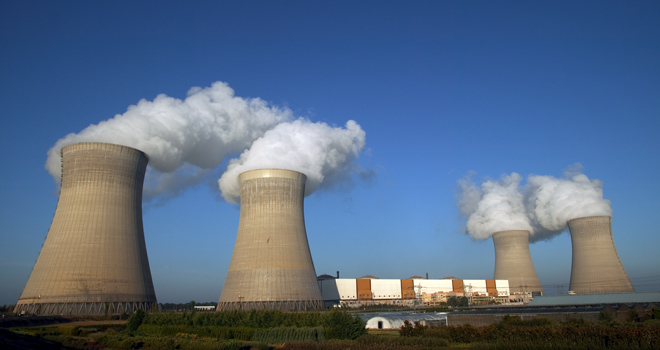
An Associated Press investigation has found that tritium, a radioactive form of hydrogen, has leaked from three-quarters of U.S. commercial nuclear power sites.
The tritium often leaked into groundwater from “corroded, buried piping,” and in most cases concentrations exceeded the federal drinking water standard. But none of the leaks are known to have reached public water supplies themselves.
Any exposure to radioactivity, no matter how slight, boosts cancer risk, according to the National Academy of Sciences. Federal regulators set a limit for how much tritium is allowed in drinking water. So far, federal and industry officials say, the tritium leaks pose no health threat.
But it’s hard to know how far some leaks have traveled into groundwater. Tritium moves through soil quickly, and when it is detected it often indicates the presence of more powerful radioactive isotopes that are often spilled at the same time.
According to the AP, the leaks of tritium have “been less radioactive than a single X-ray,” and the U.S. Nuclear Regulatory Commission and industry “a public relations problem, not a public health or accident threat.”
Nearly two-thirds of the leaks were reported over the last five years, but the leaks sometimes go undiscovered for years. Safety experts worry that the leaks betray a bigger problem about the piping buried under reactors.
“Any leak is a problem because you have the leak itself — but it also says something about the piping,” Mario V. Bonaca, a former member of the NRC’s Advisory Committee on Reactor Safeguards, told the AP. “Evidently something has to be done.”
Read the rest here.