


A lot of things happened. Here are some of the things. This is TPM’s Morning Memo.
It’s Too Easy to Blame Only SCOTUS
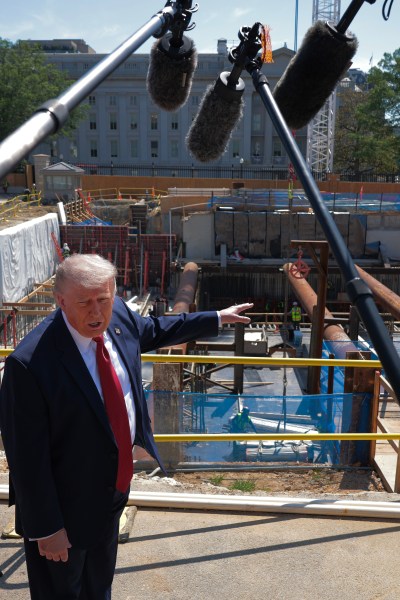
The Roberts Court rightly gets heaped with opprobrium for its role in enabling Donald Trump and setting the rule of law ablaze. Its latest bouquet to Trump — which Chief Justice John Roberts could not bring himself to participate in — covers the high court in no glory, clearing the way for the completion of his unlawful ballroom project that began with the demolition of the East Wing.
But I’m not sure this particular case is best put in the bucket of another Roberts Court disaster or that viewing it only from that perspective is especially revealing.
What the ballroom case shows is how badly broken things are — well beyond the Supreme Court, whose 5-4 ruling found that the National Trust for Historic Preservation lacked standing to challenge the legality of the vanity ballroom project, which is to say it had no right to sue under these circumstances.
Set aside the merits of that decision for the moment and consider all of the breakdowns that had to happen to get to the point where the National Trust unexpectedly and out of the blue had to stake its reputation, financial resources, time, and energy on trying to prevent the president from desecrating one of the country’s most historic public buildings.
You wouldn’t design a system where it’s up to historic preservationists to drop everything to race to court to protect the White House from being torn down by a renegade president without approval or appropriation from Congress. By the time the National Trust filed suit in December, the East Wing had already been demolished in October.
Even if the National Trust had prevailed in court, I’m not sure how much comfort we should have taken in that result. Better than losing, for sure. But as a reliable and durable mechanism for ensuring lawful government conduct and maintaining the constitutional separation of powers and checks and balances, it leaves a whole lot to be desired.
It’s a pattern we’ve seen repeatedly in Trump II: No clear mechanism to arrest Trump’s onslaught and so into the breach step people and organizations committed to stopping a rogue president, but often poorly situated factually and legally to fend him off. Often, these willing warriors have been the option of last resort after structural guardrails have failed, institutions have abdicated their responsibilities, and those who know better have eschewed their professional obligations.
Chief among the abdicators is, of course, the Republican Congress, whose abdication has been so complete that it has eroded the foundation of the three-branch system. While elections remain vital, the essence of the rule of law is that the law will be abided regardless of who wins the election. A Democratic win in November will be better than losing, but how much comfort can we take in knowing that we’re only one election away from another lawless regime.
So while the Roberts Court deserves every bit of your scorn and Supreme Court reform is essential, it will not be sufficient. The Supreme Court can’t replace Congress, even though the Roberts Court would happily do so. And Congress can’t simply return to how it functioned before given that Trump tried to demolish it on Jan. 6 and sideline it since returning to office.
The Retribution: Jim Comey Edition
A new grand jury subpoena has been issued to Jim Comey confidante Daniel Richman in a continuation of President Trump’s campaign of retribution against the former FBI director. Some key points:
- The subpoena came from a grand jury in South Florida and “appears to be connected to the so-called grand conspiracy case that has sought to implicate Mr. Comey and other federal officials who have investigated Mr. Trump in an overarching plot to deprive him of his rights,” according to the NYT.
- Richman, a Columbia University law professor, was already entangled in politicized investigations of Comey under Trump I (for allegedly leaking classified information) and earlier in Trump II (for allegedly lying to Congress). The second investigation resulted in Comey’s indictment, which he successfully had dismissed because Trump aide Lindsey Halligan wasn’t lawfully appointed as acting U.S. attorney when she obtained the indictment.
- The NYT says it’s not clear what prosecutors are aiming to get from Richman this time. Fox News, which first reported the subpoena, says it’s “part of a new investigation into Comey allegedly leaking classified information to … the New York Times” — which connects it back to the Trump I probe.
California Pushes Back on ICE
The California legislature passed bills for Gov. Gavin Newsom’s signature that would:
- ban the use of electric shock gloves by law enforcement through 2030; and
- bar former federal immigration enforcement officers from a wide range of public sector jobs.
Today in Not Normal
TPM’s Hunter Walker reports that in a 2020 podcast, the GOP nominee for governor in Colorado described encountering a young girl who had been possessed by Satan: “She’s a little girl, a pretty girl, just adorable, just like a little girl you want to bring home and just make her your daughter, except she had a demon in her.”
Driscoll Warns Trump About Hegseth
In one of his last acts before tendering his resignation as secretary of the Army, Dan Driscoll had a White House meeting with President Trump in which he warned that Defense Secretary Pete Hegseth’s purge of top generals was compromising Army readiness and transformation, The Atlantic reports.
Quote of the Day
“Those who have contributed the least are suffering the most.”—Nepali official Maheshwar Dhakal, on carbon emissions in the developed world, in the aftermath of the glacial collapse and catastrophic flash flood that killed hundreds and left thousands missing in the Himalayas
Wendell Berry, 1934-2026
No writer or thinker has had as much influence on the course of my life as Wendell Berry, who has died at 92. I was an especially earnest 20-year-old when I threw a couple of his books in my pack and set out solo, like a damn fool, for my first mountain climb even though I had no climbing experience and no familiarity with mountains. After laboring mightily through waist-deep snow on the Pacific Crest Trail just to get to timberline, I was pinned down in my tent overnight by thunderstorms on Oregon’s Mt. Thielsen, the spired mountain known as the lightning rod of the Cascades. By the time the skies cleared enough to summit, I had become mesmerized by Berry’s writing.
As a young man, I took Berry very literally. I would farm, of course, but two generations removed from the kinds of farms Berry wrote about, I had no more business farming than I did climbing mountains solo. So instead I tried to roll back the clock by moving to Missouri, where my mother’s family had farmed for generations, and went to law school there, with a loose notion of being a lawyer-farmer like Berry’s fictional Wheeler Catlett, based on his own father.
Those plans got shelved when journalism called me back, but the themes of Berry’s writing remained an abiding touchstone for my life, even if I was a little less literal about them as I got older. He made me wary of my own ambition and of doing inadvertent damage in the world. He nudged me toward a particular kind of proportionality in work (small publishers and a small law firm) and in living that left room to cut across the grain of modern life.
As much as I wanted to engage with him directly, my aversion to fanboying kept me from ever seeking him out. When I picked up stories over the years about young idealists making pilgrimages to Kentucky to meet the man himself, I vowed to leave him well enough alone. The closest I came to overt fandom was attending his Jefferson Lecture in 2012 at the Kennedy Center. Still, I felt a smidge of envy when Nick Offerman emerged over the past decade as my generation’s bridge to Berry. But it took Offerman, by his own admission, 20 years of hounding — and turning himself into a more-than-passable woodworker — to earn an audience with Berry and his wife Tanya on their porch. That’s more than I could have mustered.
I didn’t always agree with Berry. I wanted to challenge some of his convictions. I wanted to press him on the tradeoffs often implied by but sometimes not directly addressed in his writing. But mostly I wanted him to tickle my brain. Even in disagreement, he had a self-effacing charm and a wit in his public persona that I admired.
For all of his eloquence on the quiet virtues of husbandry and stewardship, his “boomers” versus “stickers” framing of American history, and his paeans to a mostly vanished agrarian life that I had gotten glimpses of from my own family as a young boy, one of the things that has stuck with me the longest is a self-deprecating exchange Berry had with a reader almost 40 years ago.
In the late 1980s, Berry wrote an essay for Harper’s titled “Why I Am Not Going to Buy a Computer,” extolling the virtues of his Royal Standard typewriter. The coup de grâce of the essay was the line: “When somebody has used a computer to write work that is demonstrably better than Dante’s, and when this better is demonstrably attributable to the use of a computer, then I will speak of computers with a more respectful tone of voice, though I still will not buy one.”
The letters to the editor that followed became the basis of the introduction to another of his essays — “Feminism, the Body, and the Machine” — and this portion has stayed with me as the standard for gracious good-humored concession:
Only one of the negative letters seemed to me to have much intelligence in it. That one was from R. N. Neff of Arlington, Virginia, who scored a direct hit: “Not to be obtuse, but being willing to bare my illiterate soul for all to see, is there indeed a work demonstrably better than Dante’s … which was written on a Royal standard typewriter?” I like this retort so well that I am tempted to count it a favorable response, raising the total to four.
If you’re unfamiliar with Berry’s work, I’d suggest starting with The Unsettling of America (1977) and Home Economics (1987).
News? Tips? Feedback? Please let me know. For sensitive information, use the encrypted methods here.



Frist!
The above ground work has been continuous. He never stopped building when he got the court order. Crews are working 20 hours per day, 7 days per week. This SCOTUS ruling is just a small blip on the timeline.
Oh, and the new estimate is over $900 million
Trump cuts down the iconic weeping willows in front of thr Kennedy Center. So, inaddition to being our worst, most evil, most traitorous President, he’s our most petty.
Heather & Paul:
Which makes them different from y’all, how?
(@atrupar.com on Bluesky )