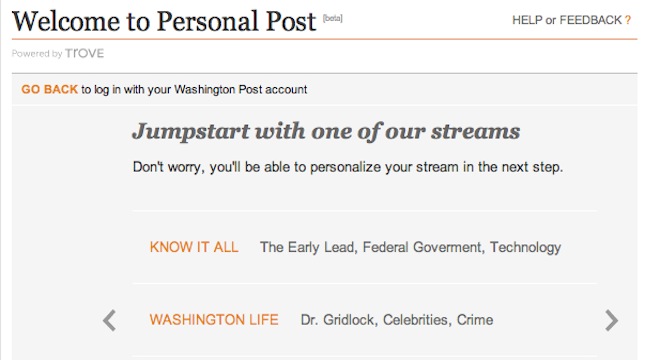
The Washington Post on Friday unveiled a new product on its website, “Personal Post,” a custom news aggregator that displays stories from across the newspaper’s sections in a vertical column, designed specifically to appeal to an individual reader’s story preferences.
The product, which is in a public beta right now and available at personalpost.washingtonpost.com, works like this: Users can sign-in with Facebook or their previous Post online accounts and begin manually picking which sections of the newspaper they would like to appear in their Personal Post. Or, users can choose from a list of curated sections and blogs put together by the paper’s staff called “story streams,” such as the “National Pulse” stream, which includes news from the “Policy & Regulation” and “Polling” sections, and columnist/reporter Ezra Klein.
The stories appear as headlines and summaries in an individual user’s Personal Post, sometimes accompanied by large photos. Clicking on a story summary will take the user to the full text on the Post‘s main website. If a user doesn’t like a particular story or wants less of that type of content in the Personal Post, the user can hover their cursor over the story and click “Remove from top stories.” The product then “learns” to show less of that type of content going forward.Also, when navigating the rest of the Post‘s main website (not just the Personal Post section), a user can click on an orange “P” button in a box to the left of every story to add more of that topic to their Personal Post page.
“We’re excited about Personal Post and hope you’ll like it,” the paper’s editors wrote in a blog post on Friday. “This is in beta, so we are committed to making it better by adding new personalized content and features — things such as galleries and videos, ways to keep up with your neighborhood, your favorite author or the local high school, and breaking news on topics you haven’t explored.”
Intriguingly, the Post explained to TechCrunch that the Personal Post isn’t supposed to be especially integrated with social media. Indeed, the Personal Post’s FAQ section, it specifically states “Personal Post is not a social reading feature, so what you read on Personal Post is not visible to others.”
And yet, every story that shows up in the user’s Personal Post does come equipped with the now ubiquitous “share” buttons to post the story on a user’s Facebook, Google Plus, or Twitter account.
The new product was designed using technology from Trove, the broader, stand-alone news aggregator app launched by the newspaper in April 2011. Trove requires a user to log in using Facebook Connect, but pulls content from around the Web, not just The Washington Post. (The Washington Post Media Group’s CEO, Donald Graham, is Chairman of Facebook’s board of directors and maintains a friendship, or so-called “bromance,” with Facebook founder and CEO Mark Zuckerberg.)
Both products were also the work of WaPoLabs, the Washington Post Media Company‘s Web and software research arm.
That said, as excited as the paper’s editors might be about such products, it’s worth pointing out that not everyone else at the organization feels the same way. The Washington Post ombudsman Patrick B. Pexton penned a notorious column in January entitled “Is The Post innovating too fast?”
As Pexton wrote:
I know from talking to folks in the newsroom that all the change may be exhausting the staff, too. Many of these innovations require considerable staff time, as well as more time from editors and reporters to monitor them. Staffers point out that The Post has 108 blogs; the New York Times has only 62 but with a much larger staff to fill them.
Staffers say that sometimes they feel as if the innovations are just tossed against a wall to see what sticks, without careful thought as to which of them will enhance and shore up The Post’s reputation and brand.
It’s not clear if the new Personal Post is one of the many “innovations” that Pexton was referring to. It’s also too early to tell how the Personal Post will affect the paper’s brand, or perhaps more importantly, declining circulation and ad revenue, going forward. But for now at least, the team behind it is proud of their work and want readers to give it a go.