As politicians in California debate the merits of going forward with the state’s $68 billion high speed rail project given the uncertainty of receiving federal matching funds, across the country, another state has essentially decided to go it alone.
The Virginia Department of Rail and Public Transportation is forging ahead on several state rail improvement and expansion projects using mostly state funding, concerned that even promised federal funds won’t materialize in time.
“We’re excited that we’ve gotten several federal awards, but we’re not banking on them for the future.” said Thelma Drake, the Director of the Department of Rail and Public Transportation, in an interview with TPM.
Drake, a former Republican U.S. House member representing Virginia, who served from 2005 to 2008 before taking on he role as head of the state’s rail agency, explained that Washington was “focused on how to reign in the deficit.”
“We just don’t see a lot of new money for high speed rail,” Drake told TPM.
Specifically, Drake pointed to the fact that on April 18, the Democratic-controlled U.S. Senate Appropriations Committee’s Subcommittee on Transportation disallowed the Obama Administration’s request for $4 billion in federal funding for high speed rail projects in fiscal year 2013.Instead, the subcommittee approved just $1.45 billion for Amtrak’s operating expenses and improvements, less than the $2.17 billion the agency requested in total, and another $100 million for a grant program to support the improvement of existing intercity rail systems.
“For the Senate to take out $4 billion, that says a lot,” Drake told TPM.
To be clear, Virginia has been the recipient of some extensive federal funding for rail projects in the past few years: In 2010, the state received a $75 million grant to support “shovel ready” rail improvements between Richmond and Washington, D.C., with an emphasis on high-speed rail, but as the Washington Examiner recently reported, the 11-mile track that was proposed has yet to be built due to alleged lack of communication between the Federal Railroad Administration, which awarded the grant, the Virginia Department of Rail and Transportation and CSX Corp. the freight company that owns the lines currently in place.
“We don’t have those funds obligated yet,” Drake told TPM, “That’s a major issue, we need to have that done by September 30,” otherwise the funds go back to the federal government to get redistributed to another project potentially in another state.
Virginia also received $44 million from the Federal Railroad Administration in September 2011, but the money was only designated for “preliminary engineering” and “environmental analysis,” of a high-speed rail line between Washington, D.C. and Richmond, not any actual construction, let alone service.
“We have an award to do study work,” is how Drake termed it to TPM.
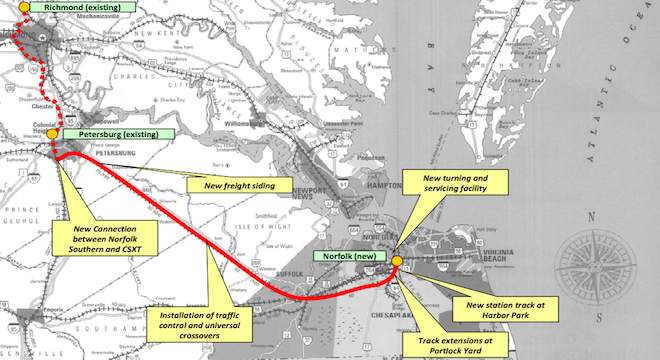
Meanwhile, Drake said that her department was hard at work on an Amtrak extension that would connect Richmond to Norfolk (some 111 miles apart, see diagram at top). The project’s cost recently swelled by about $13 million to a total $114.6 million, due to added safety and infrastructure costs, all paid for in state transportation funding. The state believes the service, which will cost $33 for a one-way ticket between Norfolk and Washington, will pay for itself.
The extension will partially use existing CSX and Norfolk Southern freight lines, plus some new track. The new lines will be able to travel up to 110 miles per hour, less than Amtrak Accela’s 150 mph Accela trains, and less than the186 miles per hour that the U.S. High Speed Rail Association, a lobbying group that wants high speed rail across the country, believes is the minimum threshold for considering a project truly high speed rail.
Still, Drake and Virginia’s Republican Governor Bob McDonnell are both big fans of that project, with McDonnell in January announcing that the Norfolk extension will be operational by December 31, 2012, 10 months ahead of its original schedule.