Updated 1:27 pm ET, Tuesdsay, April 17
The nation’s largest wireless companies — Verizon, AT&T, Sprint and T-Mobile, in that order — recently teamed up with the Federal Communications Commission to create a nationwide database of all cell phones reported stolen or lost, which is set to be up and running by the end of 2013.
Consumers will be able to report their lost or stolen phones to their service providers, who will enter a customer’s unique phone IMEI number into the database, which will prevent the phone from being used to make calls or use the Internet by anyone else.
Before that, the big four national carriers will each launch their own respective databases, expected by the end of 2012, which will eventually be merged into one centralized database.The program, which emulates others of its kind in Europe and Australia, is designed to combat the rapid increase in cell phone thefts. Theft and loss could account for up to $30 billion for consumers in the U.S. this year alone, according to mobile security firm Lookout.
Yet the big four carriers aren’t the only ones who are responsible for the new database: Lookout, too, played a supporting role, providing guidance in developing the system, Lookout’s co-founder and chief technology officer Kevin Mahaffey told TPM via email.
“We corresponded with key players in this to provide counsel on the stolen phone problem,” Mahaffey wrote. “Lookout both supports and applauds the efforts of the government and key players in mobile industry that are collaborating to deter the theft of cellphones and crime overall.”
And yet, Lookout would seem to be doing well on capitalizing the absence of such a system, at least for the time being.
The company, headquartered in San Francisco, was founded in 2007 by Mahaffey and two of his fellow University of Southern California graduates. Mahaffey says he began programming at the tender age of eight.
Another of the co-founders, John Hering, attracted media attention in 2005 for developing a means of hacking a Bluetooth device from a distance of over 1.2 miles over the air, using a “BlueSniper” rifle device.
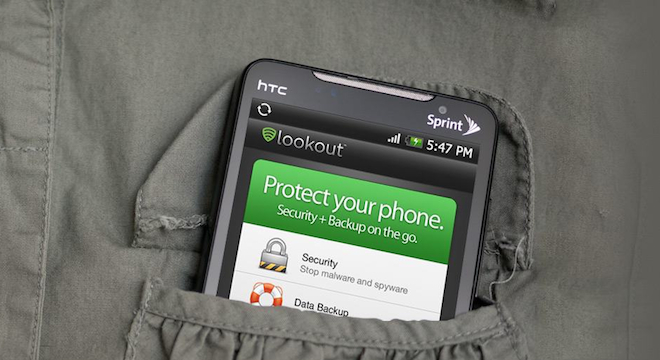
Lookout now makes security software for Android phones and the iPhone, though the iPhone version is temporarily unavailable as it is undergoing an update. The free Lookout app is designed to be an all-in-one mobile security center, with the virus protection and scanning of other apps, geolocation trackers to find someone’s lost or stolen phone, and a remote backup program.
The company counts 15 million users in over 170 countries, Mahaffey told TPM.
However, the company thinks that the upcoming national stolen cell phone database won’t hamper its own business model.
“We think it complements what we do at Lookout and will impact our business positively,” Mahaffey explained, adding further details about the database and corresponding initiatives from the government:
“Lookout’s mission is to safeguard and protect users from all mobile threats, including theft and loss. As part of this initiative, the FCC and smartphone manufactures are slated to implement automatic prompts that will encourage the use of locking devices via a password and the industry at-large has agreed to implement a campaign that will educate consumer on how to protect their cellphones. These are all steps in the right direction that nicely match what we’re doing at Lookout — helping people find their lost or stolen devices.”
However, the reason Lookout may be soon keen on aiding and promoting the new database is because the company recognizes that it can’t possibly deter all cell phone theft.
“There isn’t a blanket solution to solving phone theft, but this initiative will serve as a deterrent to potential thieves by denying both voice and texting capabilities to phones registered in the newly formed database,” Mahaffey told TPM. “We strongly encourage all consumers to take precautionary measures by installing an application like Lookout that has the ability to locate your phone once missing, and to use Lookout to remotely lock and wipe your data if they determine that their phone has been stolen.”
Ed’s note: Updated to clarify Lookout’s projection of $30 billion accounted for a combination of cell phone theft and loss, not just theft, as previously incorrectly reported. Also updated to clarify that Lookout played a supporting role in developing the system. We regret the errors.