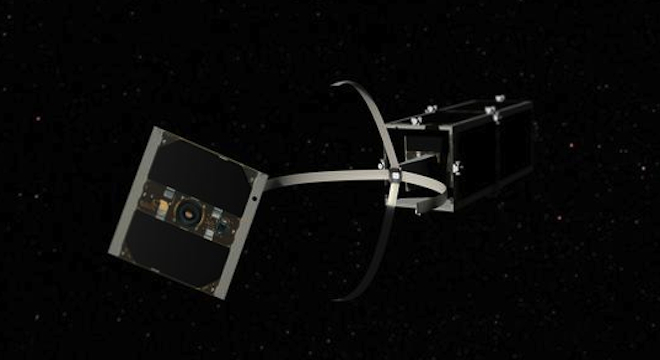
The Swiss have had about enough with how messy with space junk low-earth orbit is becoming. And so the Swiss Space Center is doing something about it.
The agency on Wednesday announced that is beginning work on a “janitor satellite” that will begin to clean up Earth’s orbit by latching onto a piece of space debris traveling at 17,400 miles per-hour and dragging it back into Earth’s atmosphere on a suicide mission, causing both the janitor satellite and the piece of junk to burn up.
The janitor satellite, simply dubbed the “CleanSpace One,” is being designed by the Swiss Space Center at the state-run university Ãcole Polytechnique Fédérale de Lausanne near Lausanne, Switzerland. It will be a small rectangular shape: Just over 11 inches long, 4 inches wide and 4 inches deep, and cost just over $10 million (10 million Swiss francs) to build and launch. It is set to be operational within three to five years, by 2016 hopefully, according to Swiss Space Center.It’s first target will be one of two dead Swiss satellites: either the Swiss Cube, the country’s first orbital object, launched in 2009, or TIsat, which was launched the following year.
The CleanSpace One will complete its mission by using a large pincher grabbing arm (think of those claw crane machines that vex players at arcades and other entertainment venues) “inspired from a plant or animal example.” The arm will grip the dead satellite and drag it back to Earth’s atmosphere, using a precision motor to re-orient its trajectory accordingly. Swiss scientists explain the system in the following video.
But taking down one of those defunct objects is just the beginning of what the agency has in mind.
“We want to offer and sell a whole family of ready-made systems, designed as sustainably as possible, that are able to de-orbit several different kinds of satellites,” said Swiss Space Center Director Volker Gass, in a statement on the Center’s website.
As the Center points out, that kind of technology is becoming increasingly necessary as the near-space around Earth fills up with junk, mostly discarded objects from spacecraft launches, old, dead, satellites, and the shrapnel left in the wake when such objects collide. There’s at least one old spacesuit floating up there too, according to NASA.
NASA estimates that earth’s orbit contains over 500,000 human created objects, 19,000 of which are larger than 4 inches (10 cm). The U.S. Space Surveillance Network has been tracking the larger objects by radar to allow new spacecraft to be steered out of the way, MSNBC reported.
And yet, collisions with active satellites still happen, as was the case in February 2009, when U.S. satellite company Iridium’s telecom satellite was destroyed after colliding with a defunct Russian satellite.
Not to mention the fact that in the past six months alone, the space-watching public was treated to not one, not two, but three different uncontrolled re-entries of large defunct satellites, none of which fortunately caused any damage to anyone or anything on the ground.
Although it sounds a bit far-fetched, the Swiss mission does appear on the face of it to be more practical than a plan posed by the Defense Advanced Research Projects Agency (DARPA), the Pentagon’s future-oriented research arm. DARPA in October 2011 announced it was launching a new program, “Pheonix,” designed to repurpose dead satellites into antennas by attaching mini “satlets” onto the dead ones that would take over the antenna portions of the dead satellites and reactive them. DARPA is counting on being able to attach the satlets remotely, using robotic surgery inspired tools. We’ll see how both that, and Switzerland’s idea, pan out.