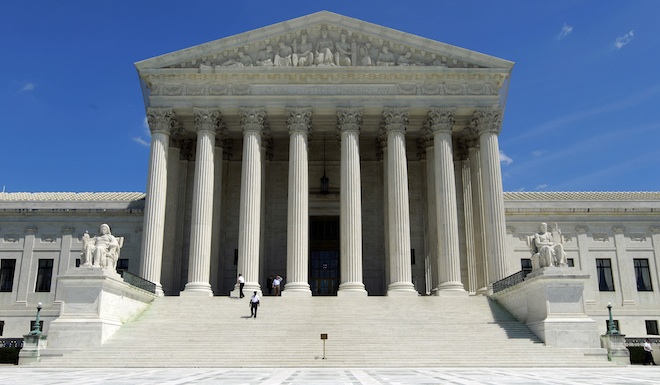
The Supreme Court of the United States could be coming soon to a small screen near you. A remarkably short bill that would amend the U.S. Code to allow Supreme Court hearings to be broadcast live on national TV passed the Senate Judiciary Committee today, with members voting 11 to 7 in favor of introducing the bill to the rest of the Senate.
This still has a long way to becoming law — a markup hearing has yet to be scheduled, followed by a floor vote, as the Hill reported. Even if it were to pass all that and have the President to sign it into law, the language does allow the Supreme Court to refuse cameras into the courtroom in certain cases, when 5 of the 9 Justices vote that doing so “would constitute a violation of the due process rights of 1 or more of the parties,” involved, i.e. in a case where anonymity needs to be protected.
But the vote in the House Judiciary Committee does move the Court a lot closer to being televised, a paradigm shift in the nation’s ongoing legal drama that’s been long clamored for by lawmakers, TV networks and transparency advocates.The idea has taken on a heightened sense of urgency as the Supreme Court nears March 26, the day that oral arguments are scheduled to begin in the case over whether the nation’s new healthcare plan is Constitutional – in particular the so-called “individual mandate.”
As Senator Patrick Leahy (D-VT), one of the bill’s backers and the leader of Tuesday’s hearing, put it:
“Four days ago more than 111 million Americans watched the Super Bowl. No one would have tolerated that game being recorded and broadcast days later or its plays being transcribed and released at the end of the week. The outcome of the Supreme Court argument next month goes to the heart of our democracy and will affect Americans more than the outcome of any football game. Now is the time for the Supreme Court’s public proceedings to become truly accessible to the millions of Americans who will be affected by its rulings.”
The law is necessary for those who want the cameras in the court because despite numerous requests, the Supreme Court has never allowed proceedings to be televised, fearing it would slow down the deliberations and impinge the dignity of the institution.
“We are the most transparent branch of government,” Chief Justice John Roberts said, defending the Court’s refusal to allow cameras at a legal conference in June 2011 (which was, ironically, televised and captured for posterity by CSPAN).
Indeed, he’s not the only one who feels that way. Senator Diane Feinstein (D-CA), the only Democrat of the seven Senators who voted against the bill, brought up the notorious O.J. Simpson murder trial, saying, as The Hill reported: “I do not believe that justice is better because it’s televised. And I have seen actual situations where, in my view, it is worse.”
But Leahy dismissed this reasoning, replying: “I know that some Justices are not fans of televising their proceedings. I understand that they do not want to be made fun of through an unflattering video clip or to be quoted out of context. But that happens to the rest of us in public service all the time. It is not particularly pleasant, but it is part of our democracy. We try to counter misstatements by making sure the record is available to fair-minded people so that they are not left to rely on distortions.”