Supporters of the dual dose of anti-piracy legislation working its way through Congress are speaking up, blasting the mass online protests that opponents have planned for Wednesday as ignorant and misguided.
Those protests — planned by such popular websites including Google, Wikipedia and Reddit — are set to begin at midnight on Tuesday, and will involve many of the participating homepages going dark for a full day. They will instead direct U.S. users to call their representatives and voice complaints about the the Stop Online Piracy Act (SOPA) in the House and the PROTECT IP Act (PIPA) in the Senate.
Broadly speaking, both bills would give copyright holders a more streamlined and powerful system for fighting piracy than under current law, allowing them to file complaints that would then let the U.S. Attorney General seek court orders to take down foreign webpages accused of hosting copyright-infringing activity.
So it’s not exactly surprising that supporters of SOPA and PIPA aren’t in favor of the protests. For example, SOPA’s sponsor, Rep. Lamar Smith (R-TX), targeted Wikipedia specifically for participating in the planned blackout. As he wrote in a statement provided to reporters:
“It is ironic that a website dedicated to providing information is spreading misinformation about the Stop Online Piracy Act. The bill will not harm Wikipedia, domestic blogs or social networking sites. This publicity stunt does a disservice to its users by promoting fear instead of facts. Perhaps during the blackout, Internet users can look elsewhere for an accurate definition of online piracy.
“It’s disappointing that some SOPA critics appear not to have read the bill. The Stop Online Piracy Act only targets foreign websites that are primarily dedicated to illegal activity. It does not grant the Justice Department the authority to seek a court order to shut down any website operated in the U.S.
“This bill will not censor the Internet. But it will protect American workers, inventors and job creators from foreign thieves who steal our products, technology and intellectual property.”
Senator Patrick Leahy (D-VT), sponsor of PIPA, released his own statement deeming the protesters misguided and counterproductive. As he wrote:
“Tomorrow, some U.S.-based websites that will not be affected by the PROTECT IP Act have announced that they will self-censor their content. At the end of the day, it is still American businesses, American consumers and American workers that are feeling the brunt of this problem…
Much of what has been claimed about the Senate’s PROTECT IP Act is flatly wrong and seems intended more to stoke fear and concern than to shed light or foster workable solutions. The PROTECT IP Act will not affect Wikipedia, will not affect Reddit, and will not affect any website that has any legitimate use. A foreign rogue website is clearly defined as one that has no real purpose other than infringement. Theft and fraud on this scale undermines consumer trust in online transactions. Perhaps if these companies would participate constructively, they could point to what in the actual legislation they contend threatens their websites, and then we could dispel their misunderstandings. That is what debate on legislation is intended to do, to fine-tune the bill to confront the problem of stealing while protecting against unintended consequences…”
It’s worth pointing out here what the essence of the dispute is, or what the sponsors of the legislation are characterizing it as: Smith and Leahy argue that online piracy by foreign websites is a terrible drain on the American economy and American businesses, one that needs to be dealt with legislatively as quickly as possible. They also argue that their legislation is targeted specifically to apply to only foreign domains, not U.S. websites.
However, there’s some issues that opponents of the bills have taken with both of those points. Julian Sanchez at the libertarian Cato Institute (formerly of Ars Technica), one of the most articulate and vehement critics of the bills, undertook a comprehensive analysis of the most frequently repeated estimate of the economic cost of piracy — $200 billion to $250 billion a year — and found it to be dubious at best.
Meanwhile, as to the issue of whether or not the legislation is over-broad in its wording and could sweep in U.S. domains, Wikimedia points out that “The definition of ‘foreign infringing sites’ is broad and could well include legitimate sites that host mostly legal content, yet have other purported infringing content on their sites. Again, many international sites may decide not to defend because of the heavy price tag, allowing an unchallenged block by the government.”
Indeed, while economic estimates are just that — estimates, and thus automatically subject to some dispute — a quick look at the pieces of legislation themselves reveals that the wording of the legislation appears to be indeed not as targeted as to completely eliminate all domestic websites.
Section 102 of SOPA defines a “foreign infringing site” as an “Internet site is a U.S.-directed site and is used by users in the United States…and is being operated in a manner that would, if it were a domestic Internet site, subject it (or its associated domain name)” to be in violation of many sections of the U.S. Code, including copyright law.
Section 2 (7) of PIPA defines an “Internet site dedicated to infringing activities” as a website that “has no significant use other than engaging in, enabling, or facilitating the reproduction, distribution, or public performance of copyrighted works, in complete or substantially complete form, in a manner that constitutes copyright infringement,” or “is designed, operated, or marketed by its operator or persons operating in concert with the operator, and facts or circumstances suggest is used, primarily as a means for engaging in, enabling, or facilitating” piracy.
Reading through those word salads, aside from the clunkiness of the language, its not clear that primarily user-generated websites in particular would be exempt from SOPA or PIPA, which would seem to make all of the links posted by users on Reddit, Twitter, Wikipedia et. al. potentially subject to being accused of copyright infringement.
Meanwhile, the Motion Picture Association of America (MPAA), one of SOPA’s and PIPA’s staunchest and most outspoken advocates, released its own statement accusing all of the websites participating in the blackout of being “irresponsible” and turning users into “corporate pawns.”
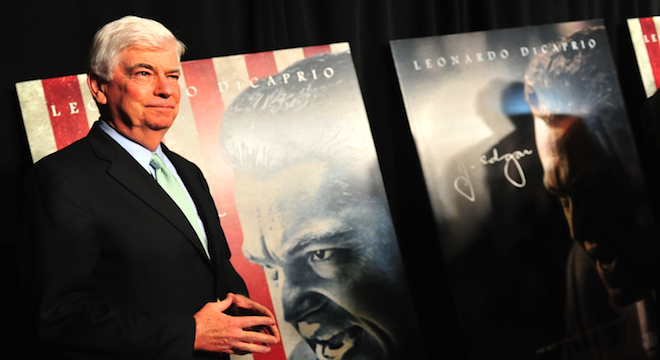
Fittingly enough, the statement came from former U.S. Senator Chris Dodd (D-CT), now the CEO of the MPAA:
“It is an irresponsible response and a disservice to people who rely on them for information and use their services. It is also an abuse of power given the freedoms these companies enjoy in the marketplace today. It’s a dangerous and troubling development when the platforms that serve as gateways to information intentionally skew the facts to incite their users in order to further their corporate interests.
A so-called “blackout” is yet another gimmick, albeit a dangerous one, designed to punish elected and administration officials who are working diligently to protect American jobs from foreign criminals. It is our hope that the White House and the Congress will call on those who intend to stage this “blackout” to stop the hyperbole and PR stunts and engage in meaningful efforts to combat piracy.”
Dodd, like Smith before him and the MPAA’s Michael O’Leary, also pointed to a statement issued by the White House over the weekend as proof that consensus on anti-piracy legislation was moving into focus. The White House statement, though, was quite clear in stating that the Obama Administration would not support bills that didn’t address the cybersecurity and Free Speech concerns expressed by critics of SOPA and PIPA.
Still, supporters of the protests are attempting to make Wednesday, January 18 the “Biggest. Online. Protest. Ever,” according to an email statement sent out by Fight For the Future, one of the many online advocacy groups leading the charge against SOPA and PIPA. We’ll see how it pans out. Stay tuned.
Correction: This article originally misstated the economic analysis of piracy as millions not billions. We have since corrected the error and regret it.