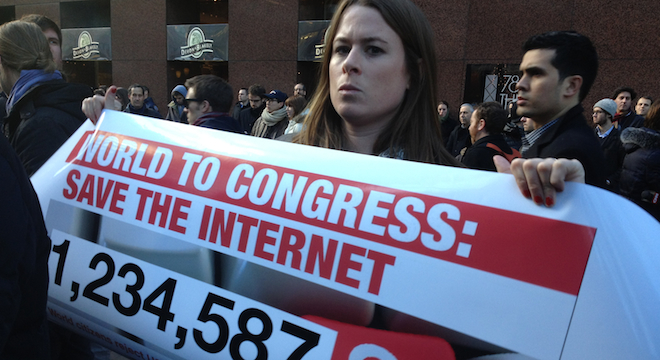
In case you missed it, the Web on Wednesday, January 18 basically revolted en masse against two pieces of anti-piracy legislation being considered by the U.S. Congress, with tens of thousands of websites going dark or “censoring” parts of their U.S. homepages in protest of the two bills — the Stop Online Piracy Act (SOPA) in the House and the PROTECT IP Act (PIPA) in the Senate.
Now that the so-called “Blackout Day,” has come and gone, it is abundantly clear that the political winds in Washington have shifted in favor of the opposition. Numerous Republican former co-sponsors of PIPA have shifted sides, and far more lawmakers on both sides who hadn’t yet taken a stance have finally come out against the bills.
Perhaps more importantly, so, too, the SOPA and PIPA critics also seem to have achieved a decisive victory in greater public relations war.Press outlets around the world covered the protests (and how could they afford not to, with some of the Web’s most popular pages — Google, Wikipedia, even the executives of Facebook and Twitter, participating to varying extent?), with many articles painting the protesters in a sympathetic light.
Editorial boards at right-leaning and left-leaning publications have also written testy columns calling for the legislation to be scrapped (though notably, the Wall Street Journal wrote an editorial applauding the bills, following in the footsteps of tweets made by Rupert Murdoch, the CEO of its parent company, News Corporation).
Now that the furor has died down, at least to a certain degree, various participants and observers have begun tallying the damage. Here’s “Blackout Day,” by the numbers so far:
7 Senators and former co-sponsors of PIPA defected and no longer support the bill, according to Ars Technica. Six were Republicans. Sen. Ben Cardin (D-MD) was the only Democratic Senator and co-sponsor to defect so far.
19 total Senators came out against PIPA, according to Ars Technica. A whip count and call notes are also available at OpenCongress.
3 Representatives and former co-sponsors of SOPA have withdrawn their support, according to The Library of Congress. They included Reps. Lee Terry (R-NE), Ben Quayle (R-AZ), and Tim Holden (D-PA).
40,000 websites completely blacked out, according to Fight For the Future, an advocacy organization that coordinated some of the protests.
30,000 additional websites that participated by altering their homepages in some other way, according to Fight For the Future.
4 of the top 10 most popular websites on the Internet participated in some way, according to Fight For the Future. (Google, Wikipedia, Facebook and Twitter).
5 protests in cities around the country, according to Las Vegas News. The cities were: New York, San Francisco, Seattle, Las Vegas and Washington, D.C.
An estimated 2,000 people turned out for the NY Tech Meetup protest in New York, according to organizers.
An estimated 200 coders turned out in San Francisco to protest the bills, according to Tech President.
162 million people saw the Wikipedia blackout page, according to Wikipedia. Upwards of 8 million people used a Wikipedia tool (which wasn’t blacked out) to contact their representatives.
At least 5 million people signed various online petitions against the legislation, according to Fight For the Future.
4.5 million people “signed” Google’s online petition against SOPA and PIPA, the Los Angeles Times reported.
2.4 million tweets about SOPA from 12 a.m. ET Wednesday to 4 p.m., according to Twitter. “Top 5 terms: SOPA, Stop SOPA, PIPA, Tell Congress.”
486 websites of member organizations of the Progressive Change Campaign Committee (PCCC) participated in the blackout, according to the PCCC.
210,000 people who signed the PCCC’s petition, according to the organization.
103,785 people who signed two online petitions against the bills on the White House’s petition website, according to newly released figures from the White House on Wednesday. These petitions, which had been active for weeks, prompted a White House response on Saturday seemingly against SOPA and PIPA in their current forms.
1 new alternative anti-piracy bill, the OPEN ACT, introduced to the U.S. House by SOPA critic Rep. Darrell Issa (R-CA).