Updated, 2:19 pm ET, Sunday, December 25
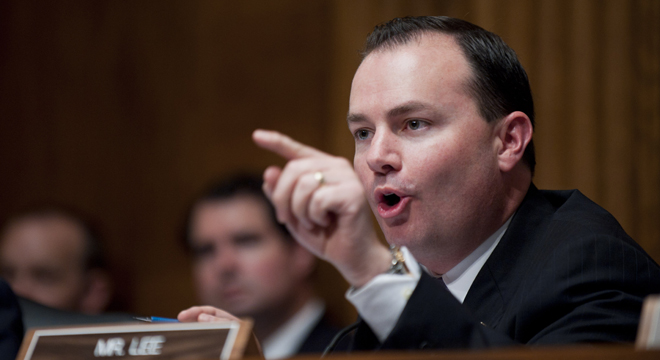
Senators Herb Kohl (D-WI) and Mike Lee (R-UT) have published an open letter they sent to the Federal Trade Commission on Monday asking the agency to investigate Google over its potentially anti-competitive behavior. Wait, haven’t we heard this one before?
Well, yes and no. The FTC in October settled a year-long investigation into Google’s user privacy practices (or lack thereof) in October, making the search giant agree to a historic 20 years worth of privacy audits.But Kohl and Lee –Chairman and Ranking Member of the Senate’s antitrust subcommittee, respectively– have a different bone to pick with Google: Unsatisfied by the hearings their committee held on Google in September (in which Google’s former CEO and current Chairman Eric Schmidt testified), and increasingly concerned over Google’s proposed $12.5 billion acquisition of phone company Motorola Mobility, the Senators want the FTC to launch another investigation into Google, this one focused on the company’s potential to use its dominant position in search to favor its other products.
“While we take no position on the ultimate legality of Google’s practices under the antitrust laws and the FTC Act, We believe these concerns warrant a thorough investigation by the FTC,” write the senators.
Google, for its part, is playing it cool, at least in public. As the company said in a statement to TPM: “These letters are customary, and we appreciate that the committee reserved judgment as we continue to cooperate with the FTC. We are committed to competing fairly on the Internet’s level playing field.”
The Senators point out that although Google began and still sees most of its financial success as a search (read: advertising) company, there’s no mistaking that the company’s ambitions have accelerated along with its revenues.
They write: “Google’s business model has changed dramatically in recent years. Google now seeks not only to link users to relevant Websites, but also to answer user queries, provide a variety of related services, and direct customers to additional information on its own secondary web pages,” e.g. Google Places, Google Finance, Google Maps, Google News and YouTube, to name a few.
More problematically for Google, the senators appear to take at face value the claims of those critics of Google who say the search giant unfairly prioritizes its own products in its search results: “Rather than act as an honest broker of unbiased search results, Google’s search results appear to favor the company’s own web products and services,” the senators write.
They point to Google VP of location and local Marissa Mayer’s own videotaped comments, circa 2007, as evidence that Google isn’t exactly trying to hide that it prioritizes its own services above competitors. In a speech at a tech conference in Seattle, Mayer said “when we roll[ed] out Google Finance, we did put the Google link first. It seems only fair, right? We do all the work for the search page and all these other things, so we do put it first…That has actually been our policy, since then…”
Google’s Schmidt countered that this only referred to Google’s “Onebox,” the area at the top of the page before the search results, but the Senators note this part of the page receives the most attention from users anyway.
But it is Google’s proposed acquisition of Motorola Mobility that really has the senators worried. As they note:
Industry observers have raised concerns that Google may, as a condition of access to the Android operating system, require phone manufacturers to install Google as the default search engine. In response to written questions after our hearing, Google denied that it presently makes this demand, suggesting that manufacturers are free to install any search engine they wish. 16 Yet Google has been unwilling to provide any assurance that it will not adopt such a policy in the future. We urge that your investigation consider all avenues necessary to ensure robust competition in the mobile Intemet search market.
The basic concern over the anti-competitive effects of a proposed merger isn’t exactly uncharacteristic of the senators. Quite the contrary, in fact. Senator Kohl was quite open about his adamant opposition to the recently-scrapped AT&T and T-Mobile merger as well as to the XM/Sirius merger, which was approved in July 2008. Senator Mike Lee was less forthright in his concerns over the AT&T/T-Mobile merger but vociferous in questioning the proposed merger of prescription giants Express Scripts and Medco Health.
We’ve reached out to Senators Lee and Kohl for more information on just what they are hoping the FTC will do, as well as the FTC regarding their response to the letter, and we’ll update when we receive anything back. Sufficed to say, any hope that Google had that the October FTC settlement would smooth its dealings with government regulators are no more.
Late update: Senator Kohl’s office responded to TPM noting that the FTC began a new investigation of Google in June. Kohl’s office also provided the following statement: “The purpose of the letter was for the Senators to express their concerns and detail their findings to the FTC. We don’t know the precise scope of the FTC investigation, so our letter highlighted issues we believe the FTC should examine.”