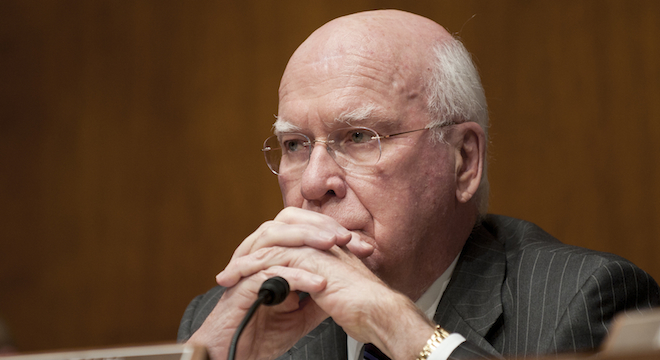
The pirate’s life is not for Senator Patrick Leahy (D-VT).
Leahy is the architect and primary sponsor of the PROTECT IP ACT (PIPA), a piece of anti-online piracy legislation that was the target of an unprecedented mass protest by Web companies and users on January 18.
As a result of the protest, a number of lawmakers came out against PIPA and its sister in the House, the Stop Online Piracy Act (SOPA). Reacting to the sudden loss of support, leaders in Congress on Friday indefinitely postponed further action on the bills, effectively leaving them dead in the water.
But Leahy refuses to give up. On Monday, he read a lengthy prepared statement to Senate floor calling for the Senate to resume its work on the bill and decrying the negative “one-sided” treatment PIPA received on the Web, at the same time praising the Internet’s “democratizing impact around the world.”
Leahy’s statement is long, clocking in at 2,100 plus words, bringing up favorable excerpts from editorials in The Washington Post and The Wall Street Journal advocating that lawmakers pass anti-piracy legislation.
You can read Leahy’s statement in its entirety over at his website, but here are some of the more intriguing passages.Leahy said rogue foreign websites are a terrible drain on the American economy, citing several figures to back it up:
“Rogue websites, primarily based overseas, are stealing American property, harming American consumers, hurting the American economic recovery and costing us American jobs. Stealing and counterfeiting are wrong. They are harmful. The Institute for Policy Innovation estimates that copyright infringement alone costs more than $50 billion a year, and the sale of counterfeits online is estimated to be several times more costly. The AFL-CIO estimates that hundreds of thousands of jobs are lost to these forms of theft… ”
At this point in his live address, Leahy repeated “hundreds of thousands of jobs,” for emphasis.
Still, Leahy remained adamant that PROTECT IP is the right solution to fixing the problem and said he hoped the Senate would resume work on it as soon as possible:
“My hope is that after a brief delay, we will, together, confront this problem. Everyone says they want to stop the Internet piracy. Everyone says that they recognize that stealing and counterfeiting are criminal and serious matters. This is the opportunity for those who want changes in the bill to come forward, join with us and work with us. This is the time to suggest improvements that will better achieve our goals…
“…I hope that in the coming days the Senate will focus on stopping that theft that is undercutting our economic recovery. I remain committed to confronting this problem.”
Leahy blasted the Internet and critics for the bill for engaging in “hyperbole” when it came to PIPA, saying the legislation was tightly-worded and wouldn’t do what its critics accused it of doing:
“I am concerned that while critics of this legislation engage in hyperbole about what the bill plainly does not do, organized crime elements in Russia, in China, and elsewhere who do nothing but peddle in counterfeit products and stolen American content are laughing at their good fortune that congressional action is being delayed.
“Nothing in PROTECT IP can be used to cut off access to a blog. Nothing in PROTECT IP can be used to shut off access to sites like YouTube, Twitter, Facebook or eBay. Nothing in PROTECT IP requires anyone to monitor their networks. Nothing in PROTECT IP criminalizes links to other websites. Nothing in PROTECT IP imposes liability on anyone. Nothing in PROTECT IP can be required without a court order, first, and without providing the full due process of our Federal court system to the defendants before a final judgment is rendered.”
As TPM earlier reported, that may not be the entire case, depending on how courts interpret the language in PIPA. Websites that rely on user-posted links, like Reddit and Twitter for example, could conceivably be considered infringing if a number of links were deemed “primarily infringing.” Not to mention the fact that even if those websites weren’t, the websites that users were linking to could be deemed infringing, and then it would be up to the web administrators to take down those users’ links, leading to a larger obligation on the part of the sites and to a potentially fragmented or broken user experience.
Leahy also noted how big of a champion of the Internet he’s been, historically:
“I admire and respect the marvelous advances of technology and, in particular, those represented by the Internet. I have promoted its democratizing impact around the world. I have fought to keep the Internet free and open, as it has become the incredible force that it is today. I have promoted its potential for access in rural areas, for distance learning, for increasing points of view and allowing all voices to be heard and as a means for small start ups and firms in Vermont and elsewhere to market quality products. Nor is this a newfound interest or passing fancy. I started and chaired a Judiciary Committee panel two decades ago on technology and the law and was a founder of the bipartisan, bicameral congressional Internet Caucus.”
Leahy also cited how much time he’s spent on drafting PIPA (2 years) and says he reached out to critics and the Web community to get PIPA right:
“Two years ago, I announced a bipartisan effort to target the worst-of-the-worst of the foreign rogue websites that profited from piracy, stealing and counterfeiting, while also ensuring that we protect the Internet. I have been working since that time to do just that. In 2010, the bill that Senator Hatch and I introduced was reported unanimously by the Senate Judiciary Committee.
I took seriously the views of all concerned. I reached out to the administration. We incorporated revised definitions suggested by Senator Wyden. We held additional hearings to which we invited Google and Yahoo!. And we redrafted the legislative measure and reintroduced it as The Preventing Real Online Threats to Economic Creativity and Theft of Intellectual Property Act, more commonly known as the PROTECT IP Act. Senator Grassley joined as an original cosponsor. I continued to work with all who showed interest. The measure was reported unanimously from the Judiciary Committee in May 2011, and 40 Senators from both sides of the aisle have cosponsored it.”
Leahy’s staffers additionally told TPM on Monday that “he’s open, as he has been, to working with all interested Senators on this issue,” and that “you’ll see there is some commonality between the PROTECT IP Act and the Wyden-Issa proposal,” that is, the OPEN Act introduced by SOPA/PIPA critics Sen. Ron Wyden (D-OR) and Rep. Darrell Issa (R-CA).
We looked at them both, and the main commonality seems to be between how both bills would force American payment providers and advertisers to cut off their ties with foreign websites accused of piracy. The OPEN Act differs in that it would give the International Trade Commission the power to enforce these orders, compared to the PROTECT IP Act, which would give the U.S. Attorney General the power to seek court orders to do the same.
Still, Leahy’s a powerhouse in the the Senate — the second-longest serving Senator and the Chairman of the Senate Judiciary Committee. If anyone’s got the chops to revive PIPA, it’s him. Now we’ll have to see if anyone else bites. Leahy made reference to “Senator Kyl, Senator Alexander and others” who are willing to work with him on PIPA.
Before PIPA was shelved on Friday, Politico reported that Sen. Jon Kyl (R-AZ) was said to be working on a grand compromise with Leahy to make PIPA more palatable to critics by removing a provision that would force search engines like Google to de-list (remove links) of websites accused of piracy. Staffers told TPM that the agreement had not reached any formal stage, but it remains to be seen if it will get further now. Stay tuned.
Correction: This article originally misstated that Sen. Leahy was Chairman of the “House” Judiciary Committee and brought the reading to the “House” floor, when in fact, he was Chairman of the Senate Judiciary Committee and read on the Senate floor. We regret the errors and have corrected them in copy.