TINA CASEY
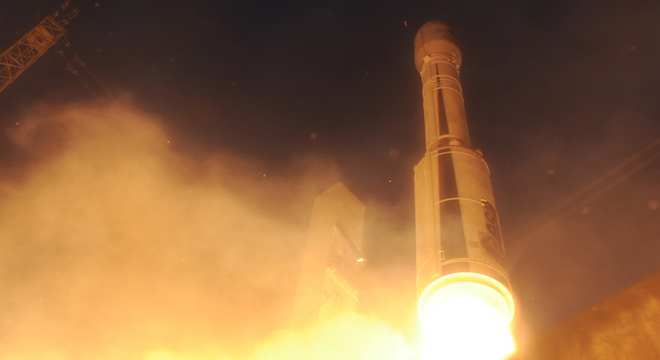
Hold onto your hats sci-fi fans, you’re about to find out how much, exactly, the Earth drags space and time along with it as it rotates. The answer to that and other burning questions is forthcoming from LARES, an Italian satellite that just took off on the European Space Agency’s (ESA) brand new Vega launching system. The primary mission of the satellite is to measure the “bizarre” phenomenon called the Lense-Thirring effect.
Also known as frame dragging, the Lense-Thirring effect puts a real-life spin on any number of science fiction tales dealing with space and time travel.To visualize the effect, Krishna Ramanujan of NASA suggests that you start with something more familiar:
“Frame dragging is like what happens if a bowling ball spins in a thick fluid such as molasses. As the ball spins, it pulls the molasses around itself. Anything stuck in the molasses will also move around the ball. Similarly, as the Earth rotates, it pulls space-time in its vicinity around itself.”
Scientists first predicted the Lense-Thirring effect in 1918 based on Albert Einstein’s theory of general relativity, but according to Ramanujan, it was not measured accurately until 1998, when researchers recorded shifts in the orbits of two satellites. However, the data still had an error of margin of about 20 percent.
In 2004, NASA and an international team came up with a more accurate measurement based on data from the same satellites combined with an improved model of the Earth’s gravity field.
The latest attempt is an all-Italian mission from that country’s space agency (Agenzia Spaziale Italia, or ASI), which aims to get the accuracy up to within one percent. To that end, ASI put together the Laser Relativity Satellite (LARES) for a ride on the Vega launcher.
LARES is a relatively simple, low-cost spherical satellite, weighing 859 pounds, designed to follow the Earth’s orbit by laser, using panels called retroreflectors (retroreflectors deflect light back to its source with little or no scattering). The payoff could be significant in terms of the satellite’s ability to collect data leading to a deeper understanding of gravitational physics.

In addition to measuring the Lense-Thirring effect, LARES will also collect data to test other gravitational principles and alternatives to general relativity.
Fans of global conspiracy theories (Agenda 21, anyone?) may also be interested to know that the LARES mission will help define the International Terrestrial Reference System, which since the late 1980’s has provided the global scientific community with a standard framework of spatial coordinates. The system requires constant updates due to changes in the Earth’s shape from tectonic plate shifting and other phenomena.
That’s a lot of punch for a relatively modest satellite, and it illustrates the concept behind the Vega launch system as a whole. Several European countries began collaborating on the project in the 1990’s with the aim of developing a smaller-scale, lower cost alternative to ESA’s two existing launch systems, Ariane 5 and Soyuz.
Vega is capable of launching several satellites at once, and LARES was just the main payload for this trip. Also hitching a ride were seven smaller “picosatellites” bearing university-based experiements. Vega will be fully qualified to carry commercial payloads once the results of this launch are fully analyzed.
Next up for Vega is another launch in 2013. Future missions will include additional gravity research as well as wind monitoring and the demonstration of advanced reentry technologies.