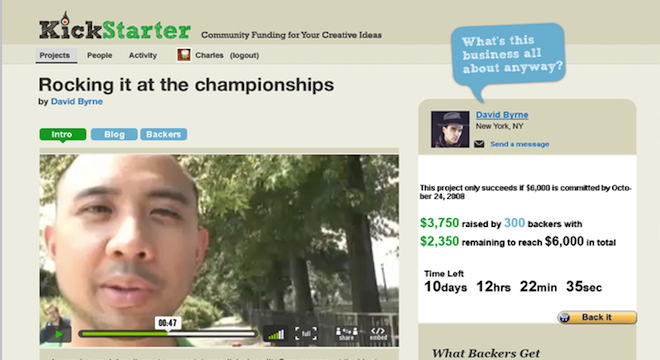
NEW YORK — The New York-based crowdfunding website Kickstarter on Monday celebrated its third birthday with a look back at old website design prototypes and a feature story in the New York Times detailing how it has become yet another portal for startup companies to raise money.
An official blog post by Kickstarter co-founder Yancey Strickler noted that so far, the website — which allows anyone with an idea for a creative project to solicit donations from the public over the Web in exchange for some share of the finished product or result — has successfully funded 21,922 separate projects.
A project is successfully funded on Kickstarter when it reaches an arbitrary, pre-determined fundraising goal set by the project creator within a set window of time, usually about a month.
Further, the website has raised an astronomical over $200 million for those 20,000-plus products in its three years of existence, according to Jenna Wortham at The Times.Of course, on Kickstarter, success is still rarer than failure: There have been about 50,000 projects that have attempted to raise money on the site, so the 20,000 that have made the cut come out to about a 44 percent success rate, as The Times points out in a detailed infographic accompanying its article, which breaks down funding by project category.
If a project does not meet its funding goal, it earns no money. Kickstarter takes a 5 percent commission from all successfully funded projects and Amazon, which runs the online donations payment service on the website, takes between 3 and 5 percent.
In total, that means Kickstarter itself has earned about $10 million from hosting the projects on its website.
The overall numbers exceed those of a recent independent analysis of the website’s funding numbers undertaken by technology news blog the Next Web, which, found that by running a script that tallied the top projects posted on the website, Kickstarter had likely raised a total $160 million as of April 2012, and $119 million in its third year alone (between April 2009 and April 2012).
Kickstarter declined to comment on its funding figures for this report.
Kickstarter’s founders like to promote the diverse range of projects that have been successfully funded on the website, and indeed, according to the inforgraphic prepared by The Times, Film and Music projects make up the total two highest-funded categories so far, with $60 million and $38 million pledged, respectively.
Stricker previously told TPM that he sees the website as facilitating some of the same types of creative artworks as the National Endowment for the Arts, and by the end of 2012, to have provided more money to the arts than that agency.
But there’s no denying that increasingly, the the top-funded projects in Kickstarter’s history have been tech related, as Kickstarter’s Strickler recently illustrated out in a blog post chronicling the history of the most-funded project, the value of which has ballooned from $3,000 in 2009 to over $7 million now.
In fact, of the top 12 most funded projects in Kickstater history so far, the four highest earning and most recent all have to do with consumer tech projects, from the Tik Tok, an iPod Nano watch ($942,578) to the Elevation iPhone Dock ($1.4 million) to the new adventure videogame from DoubleFine studios ($3.3 million) to finally the Pebble smartphone-connecting watch, which has raised $7.2 million with 18 days left in its funding cycle and which TPM previously covered as part of a burgeoning trend of wearable computing devices.
Kickstarter and other crowdfunding websites are also facing something of a watershed moment in the wake of passage of new bipartisan legislation, the JOBS Act, that would specifically allow for private startup companies to solicit investors with stock options offered online, something previously not allowed under Securities and Exchange Commission regulations.
Others have criticized the idea as risky for those without much experience in early-stage investments, with a great potential for fraud.
The President signed the bill into law on April 5, but the SEC still has 270 days after that to review the legislation and decide how it will be implemented (ironically, the SEC is itself turning to the crowd for public comment on the JOBS Act and its implementation).
One rival crowdfunding website, Rock the Post says it is ready to begin hosting private startups looking to sell equity online, but sources close to Kickstarter told TPM that Kickstarter was not looking to get any deeper into the practice of funding startup companies, despite the new allowance.
Kickstarter was from the beginning “founded on the notion that there is value in the world beyond ideas that might produce a profit, and ideas should be able to exist because people feel an affinity toward them,” our source told us.
How the company reconciles its foundational values with an increased pull toward more conventional consumer tech products and companies remains to be seen.