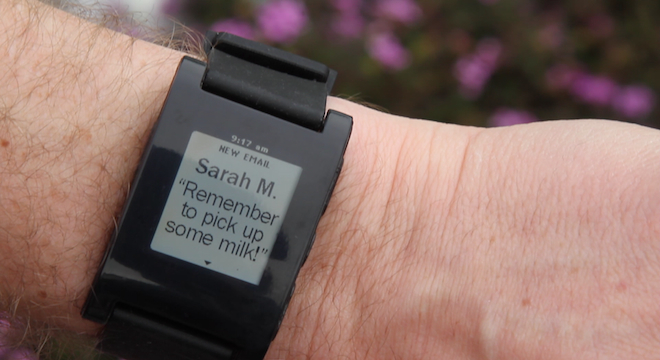
An upcoming digital watch that connects to and displays information from smartphones, as well as its own custom applications, has raised $5 million in online donations in less than two weeks on the crowdfunding website Kickstarter, setting a new all-time funding record for the website. It still has nearly a month left to collect funds.
In that time, the Pebble e-paper watch has gone from an esoteric idea initially rejected by venture capitalists to a nearly legendary underdog Silicon Valley success story, prompting comparisons between the device’s creator, Eric Migicovsky, and late Apple founder Steve Jobs.
But Migicovsky, a 25-year-old native of Vancouver, British Columbia, now based in Palo Alto, California, brushes off such comparisons.
“It’s an honour but I’m not sure if it’s valid,” Migicovsky wrote to TPM in an email. “We’re just starting out. We’ll see where it goes.”
In fact, the runaway success of the Pebble e-paper watch may say as much about where the consumer electronics industry is headed as it does about Migicovsky’s Apple-like attention to product design.Consumers, large companies and industry analysts alike have recently expressed a growing interest in wearable computing devices, or “wearables,” as they are referred to by industry insiders.
The New York Times on Tuesday highlighted a report from market research firm Forrester which projected that “wearables will move mainstream once they get serious investment from the ‘big five’ platforms — Apple, Google, Microsoft, Amazon, and Facebook.”
The analyst behind the Forrester report advised companies to “experiment with wearables now, especially if you’re in an industry that will be disrupted by wearables, including apparel, software, media, gaming, and commerce.”
Already, some are: Google in early April revealed “Project Glass,” prototypes of high-tech glasses the company plans to make, which rely on a technology called augmented reality, the layering of digital information from Google Web services in relevant areas of the user’s view of the real world, giving them real-time map directions as they walk or online product comparisons as they shop, for example.
Other companies, including hit videogame developing firm Valve and sunglasses maker Oakley are reportedly pursuing similar high-tech glasses projects.
The difference between all of these projects and Migicovsky’s watch is that the Pebble e-paper actually has a firm release date: September 2012, giving his small team of nine employees just five months to finish testing and begin manufacturing the watch for distribution to the upwards of 40,000 orders that have paid for it in advance on Kickstarter. The watch will eventually retail online for “over $150.”
“The Pebble will be part of an ecosystem” of wearable computing devices, Migicovsky predicts, ones that will revolve around and use the computing power of the smartphone. Migicovsky doesn’t think that such devices will interfere with one another or compete for a user’s attention, but rather, ideally, support and supplement one another.
The Pebble watch is also already competing in a very real market-based sense with another smartphone-connecting watch from Sony, the Android-only SmartWatch, which will ship in May but is available for pre-order for $149.
The two devices share some similarities in form and function. Both connect to Android smartphones wirelessly using Bluetooth, and both display selected data from a user’s phone in real time on their faces, including incoming texts, calendar alerts, emails, Facebook and Twitter messages, caller ID and more.
But unlike Sony’s watch, the Pebble watch will also support the iPhone, and its display is monochromatic, relying on “e-paper” technology, supposedly making it easier to read in direct sunlight, similar to the e-ink found on the displays of Amazon’s Kindle e-readers, but with a much faster refresh rate.
“The screen is mindblowing,” Migicovsky told TPM in a phone interview. “The blacks are so black that they almost dissolve the boundary of where the screen ends and the case begins.”
For the truly tech-oriented user, the phone promises an even more dynamic experience.
“You can download apps, customize your watch face and basically invent a watch that’s never been built before and can’t be, mechanically,” Migicovsky said.
Migicovsky further teased “all kinds of cool partnerships,” with large companies would be announced on the Pebble Kickstarter page beginning May 2, but declined to say in advance which companies.
But it’s worth noting the Palo Alto area where Pebble is based, is also home to Facebook and Hewlett-Packard, to name a few.
Migicovsky has good cause to be proud of his product: The Pebble is a labor of love that stretches back four years to 2008, when Migicovsky founded Allerta, the company that would become Pebble Technologies, as an engineering student at the University of Waterloo in Ontario. Migicovsky received his bachelor’s degree in engineering systems design a year later.
Allerta’s first product, released in 2009, was another phone-connecting watch called the imPulse, but it was designed solely for BlackBerry devices and lacks the attractive e-paper display of the new Pebble watch. But Migicovsky thinks much has changed since then, not only within his company, but the industry itself.
“Four years ago, smartphones didn’t really exist in a big way,” Migicovsky said, “Can you really imagine life without them now? Now that they’re here, you will see alot of wearable stuff coming down the pipelines.”
That’s one decent answer to the question of what comes after Facebook.