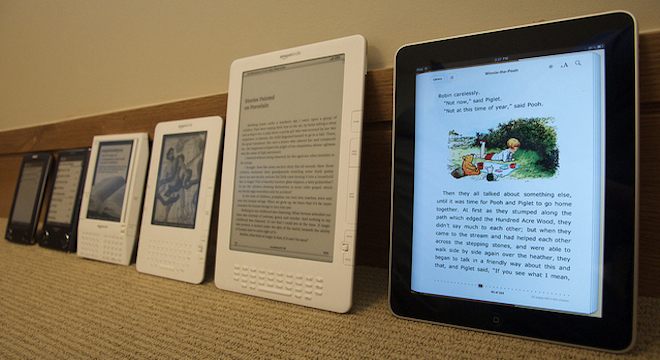
The U.S. Department of Justice is suing Apple and two of its publishing partners for allegedly conspiring to raise the price of e-books, according to an antitrust complaint filed in New York on Wednesday.
The government’s case against Apple seemed to be off to a successful start, too. The court filing names five publishers as Apple’s co-conspirators in the price-fixing scheme — Simon & Schuster, Hachette, Harper Collins, Penguin and Macmillan. But right away, the DOJ announced that it had reached settlements with all but Penguin and Macmillan, who have chosen to fight it out in court presumably alongside Apple, which has not yet commented on the filing.
The settlement, which forces the three admitted conspirators to tear up their current agreements to sell new e-books on Apple’s iBookstore at a fixed cost of no less than $12.99, would initially seem to bode poorly for Apple and the remaining two publishing companies’ chances in court.After all, if fully half of the alleged conspirators have already rolled over, and if all of the publishers had essentially the same agreements with Apple, as the DOJ alleges, then it would seem to be an uphill battle to prove that there wasn’t a conspiracy.
But as it turns out, Apple and the other defiant holdouts who didn’t accept a settlement, Macmillan and Penguin, might have made a smart move.
“Despite the detailed allegations in the complaint, I don’t see clear evidence of the crucial smoking gun,” said Daniel Crane, a professor of antitrust law at the University of Michigan, in an email to TPM.
Such a smoking gun, according to Crane, would be “that the book publishers agreed with each other (as opposed to agreeing with Apple) on an agreement to boycott Amazon unless Amazon shifted to the agency model and accepted their pricing terms.”
Though the lawsuit lauds Amazon for essentially creating the successful U.S. e-book industry, it doesn’t explicitly state that the publishers collectively coerced the company into raising prices. Instead, the suit accuses Macmillan of going to Amazon on its own and giving the company the stark choice of adopting its new, higher-priced “agency model” — where the final price of the books to readers is set in advance — or lose all of Macmillan’s business.
Amazon initially chose to go without Macmillan’s books in print and in electronic versions, but within a few days it relented and agreed to adopt the agency model. The DOJ suit alleges this is because it simply feared a similar boycott on the part of other publishers – but such a boycott never came to pass.
“Amazon quickly came to fully appreciate that not just Macmillan, but all five publisher defendants irrevocably committed themselves to the agency model across all retailers, including taking control of retail pricing…” the suit reads.
As Crane explained to TPM, the publishers “clearly shared lots of information, discussed their frustrations with Amazon, and encouraged each other to shift toward the agency model. But that falls short of a horizontal price-fixing agreement, which is what the Justice Department needs to show.”
Further, Crane said that the news of the settlements of three conspirators “doesn’t say much.”
“After all, what kind of remedy is DOJ going to get?” Crane wrote, “An injunction saying ‘don’t collude any more.’ Big deal. They’ve [the publishers] already flipped Amazon to the agency model, and the industry’s not going back.”
Crane opinion diverges from that of another antitrust law professor and former DOJ prosecutor, Spencer Waller, who on Wednesday told TPM that the agency model would be threatened by the lawsuit.
However, where Crane and Waller agree is that the government’s lawsuit could make it easier for a private class-action lawsuit against the companies to proceed. One such lawsuit was filed in August 2011 by law firm Hagens Berman.
Crane’s analysis coincides with those of other legal experts contacted by CNET. But for now, the case remains anyone’s to lose.
Ed’s note: This article originally incorrectly referred to Crane as Waller in a number of instances. We have since corrected the erros and regret them.