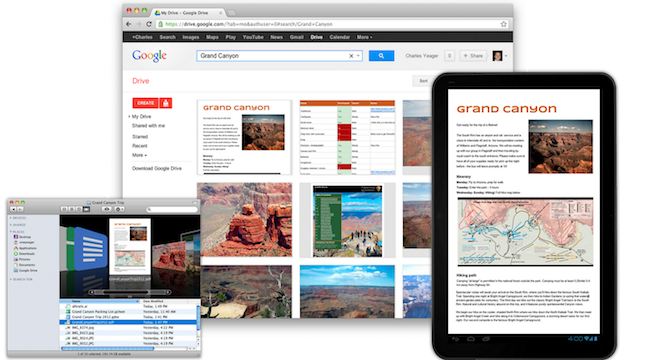
Google on Tuesday unveiled what it affectionately referred to as its “Loch Ness Monster” of products, a long-rumored cloud-based file storage service called simply “Google Drive.”
But now, Google is having trouble keeping its monster under control as a number of Web users have raised privacy issues with the new product.
Targeting competitors such as the successful Dropbox and Microsoft’s SkyDrive service, Google Drive, which is rolling out for all Google account-holders over the next few weeks, allows users to save files from their computers and Android mobile devices wirelessly onto Google’s servers for access from any other computer or Android device.
Google Drive operates on a “freemium” model, offering users 5 gigabytes of free storage and then charging monthly for any additional space needed on top of that at various tiers up to 1 terabyte for $49.99 a month.
“You can upload and access all of your files, including videos, photos, Google Docs, PDFs and beyond,” wrote Sundar Pichai, Google’s senior vice president of Chrome and Google Apps in a blog post trumpeting the new product. Google also released the following video explaining Google Drive.
Yet, in its first two days of its release, Google Drive has had a rough ride.
Specifically, Web users and tech writers have expressed misgivings about Google’s terms of service for Google Drive and all of its other Web products, which seem to allow the company to access and manipulate information uploaded by users to the cloud-based hard drive for any purpose Google deems fit.
The key passage of Google’s terms of service that has caused many to think twice about taking Google Drive for a test drive reads as follows:
“When you upload or otherwise submit content to our Services, you give Google (and those we work with) a worldwide license to use, host, store, reproduce, modify, create derivative works (such as those resulting from translations, adaptations or other changes we make so that your content works better with our Services), communicate, publish, publicly perform, publicly display and distribute such content. ”
Google prefaces this by stating that it won’t assume ownership of your content, “You retain ownership of any intellectual property rights that you hold in that content. In short, what belongs to you stays yours,” and by stating that it will only use the information uploaded to Google Drive and other products “for the limited purpose of operating, promoting, and improving our Services, and to develop new ones.”
“According to its terms, Google does not own user-uploaded files to Google Drive, but the company can do whatever it likes with them,” summarized Zack Whittacker at CNET.
And as Ars Technica‘s Casey Johnson pointed out, the “promotional” aspect of the agreement could allow Google the right to use your personal information in its massive Web advertising platform.
In an even starker contrast, UK Web entrepreneur Jonathan MacDonald tweeted a much-circulated screenshot comparing Dropbox and Microsoft’s SkyDrive, showing that both of those services had terms explicitly stating that a user’s content is theirs and that the only use of it that Dropbox and Microsoft will make of it is to allow it to be hosted on their cloud servers.
Some tech bloggers leapt to Google’s defense, though, arguing that Google’s terms were actually more narrowly drawn. The only trouble with those analyses is that Google’s terms explicitly allow for the possibility of advertising through the “promotional” language, while the other two services do not include that possibility.
Google itself pushed back on the outcry, with a Google spokesperson telling TPM in an email:
“As our Terms of Service make clear, ‘what belongs to you stays yours.’ You own your files and control their sharing, plain and simple. Our Terms of Service enable us to give you the services you want — so if you decide to share a document with someone, or open it on a different device, you can.”
That’s not exactly a denial that Google can use your files for advertising purposes.
That said, the terms of service for Google Drive are the same for all of Google’s other products — e.g. Gmail, Google Documents, etc –per the company’s new, controversial “one size fits all” privacy policy, which went into effect on March 1. But many users hadn’t until now bothered to read the fine print about what they were agreeing to let Google do to their personal information.
Google also maintains that its product was superior to competitors, with a source close to the company telling TPM that it was the “logical progression” from Google Docs “upload any file” feature.
Whether users will agree remains to be seen. Google declined to provide TPM with any initial numbers on Google Drive’s user base. Stay tuned.