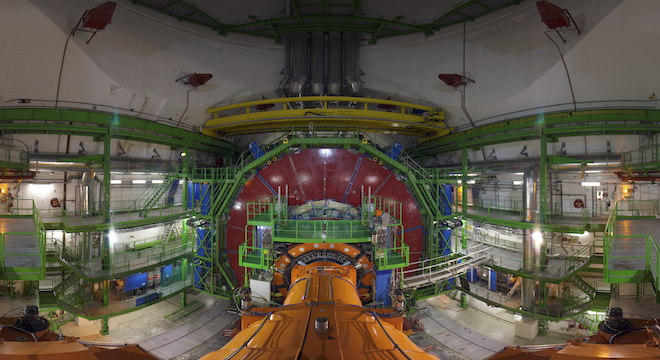
An entirely new type of particle has been discovered by scientists using the world’s largest and most powerful particle accelerator, the Large Hadron Collider (LHC), near Geneva, Switzerland.
The discovery of the new particle, called “neutral Xi_b^star baryon,” was made by the CMS experiment, one of six separate particle physics experiments running at the LHC. It was announced Friday by Symmetry Magazine.
“Besides helping to understand how quarks bind and therefore further validate the theory of strong interactions, one of the four basic forces of physics, this measurement represents a tour-de-force that opens up good perspectives for future discoveries,” wrote Carlos Lourenco, a senior researcher with the European Organization for Nuclear Research (CERN), the organization that oversees the experiments at the giant accelerator, in an email to TPM.The new type of particle is so rare that it cannot occur anywhere else on Earth outside of the accelerator, and only occasionally in outer space.
“It might get produced once in a while, when a high-energy cosmic ray collides with the moon, for instance,” Lourenco told TPM.
The particle’s rarity is due in part to its composition: It is made up of three quarks which normally aren’t found locked together.
“When these three quarks get together, they immediately divorce, instantaneously,” Lourenco explained.
The new particle was actually created in 2011, when the CMS researchers collected collisions between two beams of protons going in opposite directions through the 17-mile-long underground ring that comprises the LHC accelerator.
When the two beams smash into one another, they produce countless debris, a reaction designed to simulate the conditions just after the “big bang,” the theorized event that birthed the Universe, hence the LHC’s nickname as the “big bang machine.”
But the debris, which may contain previously unknown times of particles, are incredibly small, and only last for an unfathomably short time before decaying into nothing.
In fact, in the case of the new particle, by neutral Xi_b^star baryon, the existence of the particle itself was so brief that it could not be detected directly, but rather by its decay signature.
“We managed to find it nevertheless,” Lourenco said. “It is a ‘strongly decaying resonance’. It lives for less time than you or me can imagine.”
“However, the Xi_b^star breaks up in a known cascade of decay products,” Lourenco continued. “Ernest Aguiló, a postdoc from the University of Zurich, identified traces of the respective decay products in the data and was able to reconstruct the decay cascades starting from the Xi_b^star decays.”
A diagram of the decaying process of neutral Xi_b^star baryon can be seen below. The black star indicates the initial collision, with the arrows representing the decaying quarks that make up the particle.

As for why it took the CMS researchers several months to reveal their groundbreaking particle physics find to the world, he said: “It takes a while to check everything in detail and convince our colleagues and ourselves that this is a real particle and not a statistical fluctuation or some other spurious effect.”
To be clear, neutral Xi_b^star baryon isn’t the same thing as the long-sought Higgs boson, the famed “god particle” that is responsible for giving anything in the universe mass, which scientists are hoping that the LHC will be able to discover later this year.
“The Higgs mechanism, despite its fame, is responsible for only 0.1% of the matter in the Universe,” Lourenco told TPM.
Now, however, there is celebrating to be done by the CMS researchers.
“It also justifies opening a bottle of champagne, if you need a justification for that,” Lourenco said, of the discovery of the neutral Xi_b^star baryon.
Editor’s note: This article was updated to include more detailed information about the discovery of Xi_b^star baryon.