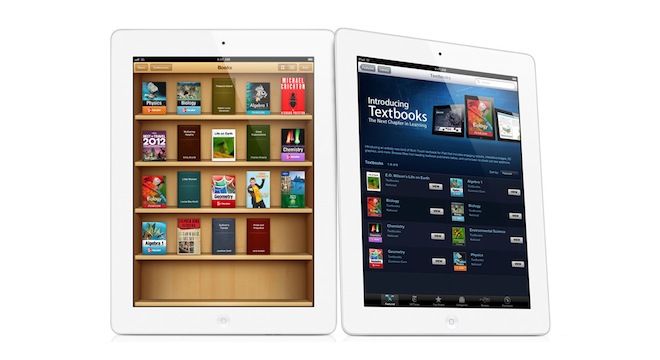
Apple’s historically high first quarter numbers posted Tuesday are the talk of Wall Street, but the company is also shaking-up the textbook publishing industry with its newest app — iBooks 2 for the iPad.
The new app — unveiled on January 19 — seeks to offer readers both increased portability, with full textbooks downloadable on the ultra-thin iPad, and a bevvy of added interactive features, including 3D animations, videos, music, even customizable flashcards. The books are also far cheaper than the usual textbook, beginning at $14.99 through Apple’s iBookstore.
So far, it’s a hit: Over 350,000 copies of textbooks were downloaded from the iBookstore in the first three days, according to tracking firm Global Equities Research, via All Things D.
Although it’s unclear how many of these were paid downloads at the standard $14.99 (as opposed to downloads of the free sample book E.O. Wilson’s Life on Earth), the fact that the store has seen so much interest in such a short time, with so few titles so far — just seven textbooks are available at present — would seem to bode quite well for Apple’s educational ambitions, to say the least.Five of those titles are from leading textbook publisher McGraw Hill Education. That’s not exactly a surprise, given that the company is projected to be the second largest educational publisher in the world by revenue after it spins off from the parent McGraw Hill later this year, according to Publisher’s Weekly.
“We welcome Apple as another valued partner in education as we build on our record of expanding innovative digital products,” said Vineet Madan, senior VP of New Ventures and Strategic Services at McGraw-Hill Education, in an interview with TPM. “We’re writing a new chapter in the move from textbooks to personalized learning platforms.”
Indeed, McGraw Hill has been a longtime partner of Apple — with the company’s CEO even letting the news of the original iPad slip ahead of its official launch in April 2010.
“More than 50 of our Higher Education and Professional titles have been available on the iPad since 2010,” Madan said. “McGraw-Hill has also released more than 170 medical and test-prep iPhone applications in partnership with leading iPhone developers.”
But up until now, the company has been unable to provide the kinds of rich multimedia educational experiences it was working on through Apple’s iBookstore.
“The previous version of iBooks didn’t allow for the kinds of things we wanted to do,” Madan said. “But iBooks 2 has it all: Videos, music, touch. Sheet music, for example, will now be synchronized with you, automatically moving through the piece, as you practice your instrument.”
Madan said that McGraw hill had actually been developing the kinds of interactive experiences it wanted to bring students on the iPad long before iBooks 2 was announced through its partnership with Inkling, a startup company founded in San Francisco in late 2009 to re-invent the textbook for the tablet age.
That partnership was announced in August 2010, when McGraw Hill invested an undisclosed amount in Inkling as part of its first major round of funding in exchange for having its content be adapted using Inkling’s interactive media tools.
Since then, McGraw Hill and Pearson have invested even more in Inkling, and the company is on the hook to produce iPad versions of the top 100 titles from McGraw Hill Education’s undergraduate library, according to Xconomy.
“We’ve already been doing some incredible things with Inkling and you’re only going to see more in the next year,” Madan told TPM.
There’s already a number of titles from McGraw available for the iPad on Inkling’s own store, but they start at much higher prices than what is being offered through Apple’s iBookstore, $69.99 according to GigaOm, which is closer to the wallet-emptying prices students are accustomed to paying for brand new textbooks these days.
Madan said that the company expects to at least “double” its “programming options” by the end of 2012.
Still, the big x-factor remains just how big of a cut Apple is taking from McGraw Hill and other publishers when it comes to the partnership between the companies.
Apple famously takes 30 percent of all sales in the regular iBookstore, though publishers get 100 percent if they bring in the customer from their website.
But it remains to be seen if Apple treats educational publishing in the same way — a lucrative market worth at least $800 million according to WikInevest.
McGraw Hill Ed’s Madan remained tight-lipped when asked about that:
“We haven’t disclosed details of the revenue sharing agreement but we are very excited about the prospects of working with Apple,” Madan told TPM.
Plus, the new iBooks Author software, released at the same time as iBooks 2, allows anyone with a Mac computer to create their own interactive volumes, leading Matthew Yglesias to call for a free textbook revolution. Apple’s iAuthor terms and conditions allow newly created books to be distributed freely throughout the iBookstore, but mandates that those looking to sell their books only do so through Apple, entering into a separate written agreement with the company.
And asked what separates McGraw Hill’s latest foray into interactive textbooks from previous, ill-fated CD-ROM textbooks, which were supposed to revolutionize the industry in the 1990s by offering some of the same rich multimedia features, Madan offered a completely unfazed endorsement of the new tablet textbooks.
“We’ve always been pushing the boundaries of what’s possible in educational publishing and learning at McGraw,” Madan told TPM. “Sometimes, that involved putting out products before the market was mature enough to embrace and understand them. But remember, CD ROMs, even though they were more portable than textbooks, were still relatively bulky, required lots of physical copies, and took a fairly long time to boot up. The iPad does away with all of that.”