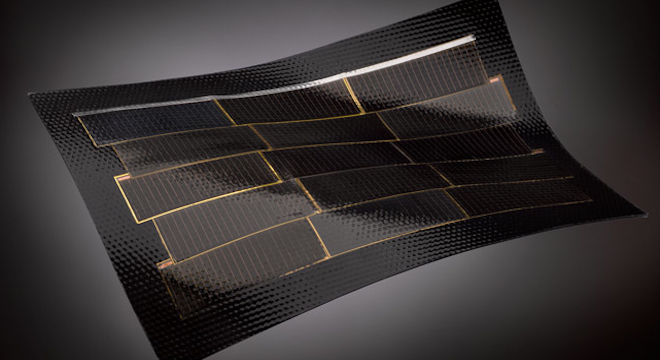
Alta Devices, the company that recently set the record for the highest efficiency solar panel ever certified by the U.S. government, is working to supply the U.S. military and defense contractors with its high-tech flexible solar panels, the company revealed exclusively to TPM.
Alta Devices President and CEO Christopher Norris told TPM in a telephone interview that the company has just begun working on demonstrating its equipment in a “small pilot line” of solar panels at the company’s headquarters in Sunnyvale, California, but that it already had spurred great interest from industry and government.
The small pilot line will produce about 2 megawatts of power, Norris told TPM, enough to power about 600 homes. But comparing Alta’s panels to standard fossil fuel power plant alternatives is a bit misleading, because the company isn’t looking to replace fossil plants or fuel sources, but rather go where they cannot.
“For some reason, solar has gotten into a trend of competing with fossil fuel plants head on,” said Norris, “We don’t think that’s necessarily the best use of solar, and certainly not our solar. We’re focusing on places where where solar is not and where electricity itself is not.”Norris believes that Alta’s panels will “fundamentally enable new product class.”
Alta’s high-efficiency, ultra-thin, flexible panels — which are 1/40th the thickness of a human hair — are “being integrated into lifting materials for residential and commercial buildings,” Norris said.
“We’re doing some work with electric vehicle companies that need solar to run cooling for their batteries, and some military work,” said Norris, adding that some of his customers, including those in the military and military contractors, will begin receiving the panels late this year or early 2013.
“The stuff you’re going to see first is going to be non-personnel,” Norris explained, “Applications on vehicles of different sort. We have quite a bit going on purely portable side. There will be some airborne infrastructure, as well as hybrid systems, mobile systems. The point is that our technology is flexible, mobile and turns on quick.”
Pressed to explain Alta’s connections to the military, Norris said that he couldn’t elaborate much due to non-disclosure agreements.
However, Norris did reveal that his work was being funded by the Pentagon’s future-flung Defense Research Projects Agency (DARPA), the same agency that birthed the predecessor of the Internet (ARPANET), as well as the Department of Energy and venture capital funding.
Alta Devices set the record for highest solar panel efficiency yet on February 6, clocking in at 23.5 percent efficiency, according to the National Renewable Energy Laboratory (NREL). That means that Alta’s panel was able to convert 23.5 percent of the sunlight it receives into usable energy, including losses due to heat, a humungous leap over the industry average of between 7 and 17 percent.
The way that Alta Devices was able to achieve such efficiency was due to an innovative, counter-intuitive approach it took to the problem of energy conversion and conservation: When Alta’s panels overheat, they actually emit some light themselves, albeit invisible fluorescent light, as opposed to conventional panels that waste energy as pure heat.
The company also uses a markedly different material to produce its panels than the industry standard panels, which use polysilicon. Alta uses gallium arsenide, a combination of gallium — a byproduct of aluminum smelting — and arsenic, which is better known as a poison.
However, according to Norris, the arsenic becomes inert when combined with gallium, so there’s no danger. And the solar cells themselves can be grown to the designers exact specifications, using as little gallium arsenide as possible to produce a photovoltaic — or light to energy — conversion.
“That’s the goal,” said Norris, according to TPM. “To use no more gallium arsenide than is absolutely needed to create solar panels.”
That’s because gallium arsenide is relatively expensive compared to polysilicon. However, Norris believes that Alta has found the perfect recipe: Using a gas-controlled gallium arsenide crystal growing process developed by researchers at Caltech and the University of California Berkeley.
It seems the U.S. military and its contractors agree.