

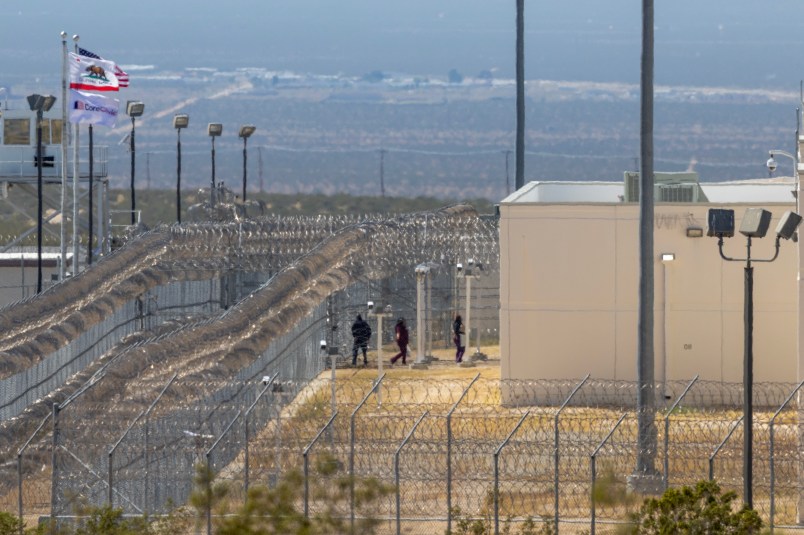
After a run-in with the police that ended in his arrest, Andry’s husband was supposed to be released from a New York jail in November 2024. Instead, he was transferred into ICE’s custody. The couple had come to the United States 18 years ago from the Dominican Republic. Her husband was incarcerated for all of last year.
In December, Andry (who asked not to use her last name to protect her family) seemed to catch a break: an immigration judge granted her husband bond, the only way to get out of immigration detention. The decision was far from a given: the second Trump administration has tried to make broad swaths of immigrants ineligible for bond, detaining them with no ability to get released, and even those who are eligible for a bond hearing might not be granted it. But the amount Andry was told she had to pay in order to secure his freedom was $25,000. Unlike in the pretrial bail system, where defendants can usually pay a fraction of their bail to get released, immigration courts demand the entire amount.
Andry had nothing like that kind of money sitting around. For over a year, she had been raising their two daughters alone without her husband’s income, running their remittance business while driving for Uber as much as she could in between. Beyond making $900 rent payments and covering their family’s expenses, she was using any extra funds to send her husband money so he could make calls or go to the commissary. “¿Qué voy a hacer?” she asked: What could I do?
She went online, desperately searching for a way to come up with $25,000. She came across a bail bondsman in Texas who said that if she paid him $5,500 he could get her husband out. She went to friends and family to try to piece together that fee, still a difficult amount to secure. One of those friends did more research into the bail company, only to find out that it was a fraud with a number of lawsuits pending against it. But Andry considered risking it anyway. She wasn’t sleeping; she was terrified that if she didn’t free her husband quickly, he would be deported.
That’s when she caught a real stroke of luck: Envision Freedom Fund, a bail fund in New York City, responded to her inquiry and said it would cover the entire $25,000 bond. It was “un momento de alegría,” she said: a moment of pure joy. Her husband came home that same day. She’s finally able to sleep again.
As the pace of immigration detention has soared under the second Trump administration — so far this year there have been 1,100 arrests per day, on average, according to a New York Times analysis — far more people have faced the prospect of paying bond in order to be released. When they do, their families are having to scrape together enormous sums to secure their freedom, far higher than what was typical in prior years. The Trump administration has fired a wave of immigration judges, and the ones who are left appear to be aligned with the administration’s goal of keeping people detained. Families have sold belongings and lost housing in the scramble to put together bond money.
That’s for the lucky few who get a chance at release; even before the second Trump administration, only about a third of detained immigrants who got a bond hearing were actually granted bond. Then, last summer, the administration tried to make those who had entered the country without inspection ineligible for bond entirely. The policy has been litigated extensively and is likely bound for the Supreme Court: More than 400 district court judges have rejected the administration’s move, while just 41, all appointed by Trump, have backed it. The issue has now moved to appeals courts, where one in California ruled against it. Crucially, however, two conservative circuits have ruled in favor of the administration, affecting all detainees in Texas and now Minnesota. Final word on the issue is still pending. In the meantime, immigrants have flooded district courts with habeas filings claiming that their detentions are illegal, and in most of those cases judges have granted them bond.
As the policy works its way through the legal system, the number of people who need help paying immigration bonds has dramatically increased since Trump retook office, according to bond funds across the country. Last year alone, Envision Freedom Fund in New York helped 167 people, a 160% increase over 2024; in January of 2026 it freed 31 people, triple the nine bonds it paid in January 2025, before Trump’s first full month in office. “The need is bigger now than ever,” said Envision co-executive director Rosa Santana. “We’ve been covering bonds for a long time already, but nothing like what we’re seeing now.”
The same is the case for the Prairielands Freedom Fund, which covers the Midwest. “We’re posting a lot more than we ever have,” said Julia Zalenski, co-founder of the fund. The fund averaged three or four calls for most of the last year, but in the first two months of 2026, it fielded 20 or more calls a day.
In Ohio, “I can’t remember the last time we saw a bond that was under $30,000.”
Julia Zalenski, co-founder of the Prairielands Freedom Fund
At the same time, the amounts that people have to come up with have skyrocketed. In 2023, the median bond set by an immigration judge was $7,000, while some 275 immigrants were able to go free without paying anything at all. In 2025, by contrast, the national average was $10,000, according to the National Bail Fund Network. Judges are setting bonds as high as $80,000. Few, if any, immigrants are being allowed to go free without paying a price.
By the first week of March 2026, Envision had already paid $1 million in bond, half of what it had expected to spend this entire year. Under federal immigration regulations, the lowest possible bond amount is $1,500, but “we hardly see those bonds nowadays,” Santana said. The most that the fund used to pay was $10,000. Now the lowest it sees, she said, is $7,500, while most are over $10,000; during the first week of March the fund paid amounts ranging from $10,000 to $20,000.
Zalenski has seen the same at Prairielands. In prior years, most bonds were $1,500 or $3,000 and “it was a big deal for us to get something like $7,500,” she said. The same was true for NorCal Resist, a Sacramento-based non-profit. While these sums were still significant, they were something families could sometimes cover themselves or, if not, the fund could easily pay, said NorCal Resist volunteer Autumn Gonzalez. Now the average bond Prairielands is paying in Michigan is around $10,000, and in Ohio, “I can’t remember the last time we saw a bond that was under $30,000,” Zalenski said. NorCal Resist is “regularly” helping people with $25,000 and $30,000 bonds, Gonzalez said. Even though the fund can typically cover anywhere between six and 10 bonds a week, there’s always “a good handful” of requests it can’t cover, she said.
There are no set guidelines for bond the way some states have set bail schedules, while bond decisions are “completely unreviewable,” Zalenski said. The system, then, is easily politicized. After Trump came into office, the administration began firing immigration judges; at least 98 had been terminated by the end of last year, many of whom had records of being more likely to side with immigrants. “Immigration judges have been getting fired when they’re not falling in line,” Zalenski noted. Many of the ones who are left are “anti-immigration,” Gonzalez said. The high bond amounts are “trying to keep someone from getting free.”
For families facing these amounts, coming up with that kind of money is often impossible. Many of the people who have been detained are the main or even sole income providers for their families. Increasingly, both parents and even the children in a family are detained at the same time. The rest of their families are left to survive at a time when costs are still high and work is not plentiful. Families also often have to pay an attorney to help them navigate the system. Some borrow money to pay bond or try to get pay advances at work, Gonzalez said. Families have lost housing because they had to put rent money toward bond; others have sold the few assets they had. One family sold their pickup truck and the detained husband’s tools from his construction business; another family had to sell its furniture, Santana said. “It is very hard on families to come up with $7,000, $10,000,” she said. “It’s impossible to come up with $20,000, $25,000.”
There are a few for-profit companies that will take a percentage of a bond amount and pay the rest to free someone, but they typically charge “exorbitant” fees, Santana said, that don’t go toward paying off the bond.
“We’ve been covering bonds for a long time already, but nothing like what we’re seeing now.”
Envision Freedom Fund co-executive director Rosa Santana.
Funds are doing as much as they can; the National Bail Fund Network includes 34 local immigration bond funds across the country. But they only have so much money. “There’s not enough funding out there to meet all the requests we are getting,” Gonzalez said. The donations tend to roll in when immigration is the biggest news of the day, such as when Trump first took office or during the ICE surge in Minnesota. Everyone’s money is “being depleted because of the amounts that we’re paying,” Santana said. “Unfortunately, most of the bond funds right now are tapped out.” Envision is facing running out of money this year if it can’t raise more.
And while bond funds are designed such that, if the person who was bonded out followed all of the court’s orders, they should get the money back at the end of a case and can use it to bond someone else out, these cases take years, not months, to resolve. Now they’re stretching even longer as the backlog of immigration cases mounts thanks to fewer judges: It currently stands at over 3 million. None of the money that funds have spent since the beginning of the second Trump administration has come back yet, fund leaders all said.
Yet they are facing far more urgency to pay bonds than they used to. ICE detention is unsafe; people inside report unhealthy food and a lack of medical care, while over 40 people have died since Trump took office. Then there’s the new but very real threat of someone being deported while the bond money is scraped together; funds used to feel comfortable taking a few weeks to get the money together, but now someone might be deported in that interim.
Bond funds were “never happy with the [immigration court] system,” Gonzalez pointed out, and had to help people pay bonds plenty of times during the Biden administration. But the current situation is “just clearly so different.”






Stop calling it bail, call it by its correct name bribery.
“Bail” is different in the UK and US. Sometimes the US racket is referred to as “cash bail.” It has a practical origin in medieval times when an offender could pay the full potential fine and return or not to fight the case when the circuit judge showed up once a year. It became a for-profit industry in the late 1800s. In the UK police have the option of setting bail pre-charges, and after charging, the court, can set bail based on the circumstances. The main difference is that the person seeking bail in the UK must promise to do certain things before returning to court, while in the US it is still mostly about money. In the context of “exclusionary patriotism”, even a bail bond is seen as a right. ICE often treats those who entered without inspection as arriving applicants, rendering them ineligible for bond and forcing detention, a policy challenged by numerous court rulings.
Agolf Twitler is certainly cruel.
Trump didn’t know that or think that. As evil as he is, there’s others behind him, a conspiracy, perhaps a foundation, that is researching our systems, looking specifically for any crack they can find to add torment to the guilty and – sadly, oh so sadly – the innocent.
FIFY.