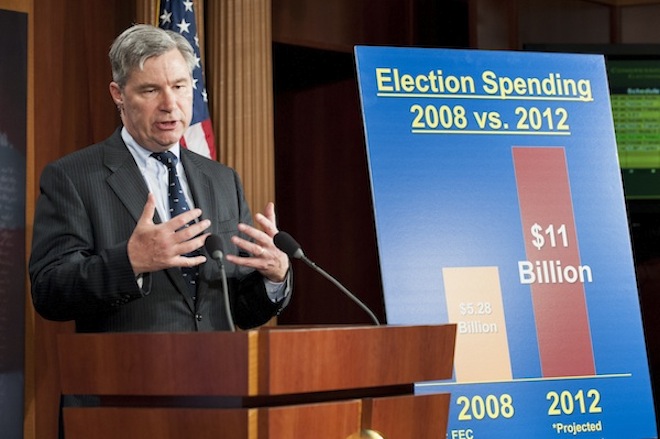
Sen. John McCain (R-AZ) has warned that if Republicans don’t join Democrats in reining in the Citizens United decision, Americans should brace for a new wave of corruption in politics. But Sen. Sheldon Whitehouse (D-RI), lead sponsor of the DISCLOSE Act, does not expect Republicans to help stem the tide anytime soon.
“I think that going in there’s very little prospect of bipartisanship,” Whitehouse told TPM in an interview. “John McCain has made some friendly noises in this discussion. No other Republican has found a kind word to say about requiring disclosure by these big contributors.”
The worst-case scenarios raised by critics of the Citizens United decision, namely an explosion in unlimited campaign spending with little transparency, are quickly coming to pass this election cycle. McCain warned earlier this month that Sheldon Adelson, who has contributed over $36 million to Republican groups this year and is reportedly planning another $35 million to GOP non-profits that don’t disclose donors, was in effect bringing “foreign money” to the political process since much of his fortune comes from casinos abroad.Whitehouse and other Democratic senators are planning to bring the latest version of the DISCLOSE Act, which would require anonymous big-money groups to disclose donors and require more information in political ads about their funding, to the floor for debate next month. While it has little hope of passing (the Senate GOP filibustered an earlier bill in 2010), Whitehouse believes it’s a critical step in building public pressure to eventually force some action on the issue.
In the meantime, Whitehouse has plenty of prescriptions for progressives looking to make a difference while Congress is deadlocked.
“I think there are a great number of fronts that activists could proceed along,” Whitehouse said. “One is the regulatory front, to put pressure on regulatory agencies to do their jobs so that, for instance, the IRS is enforcing 501c4 laws and the FEC is enforcing the coordination rules. Some of the referees have taken themselves off the field on this and that’s allowing the special interests to rule-break with relative impunity. Trying to pressure the regulators to put striped shirts back on and get back on the field is something the public can do.”
Whitehouse also recommended targeting corporations that don’t disclose political expenditures directly through boycotts, protests and shareholder resolutions, an increasingly common tactic for open-government advocates. One potential route, Whitehouse said, would be for state and local governments to require their pension funds to invest only in companies that have made their political activities transparent.
But Whitehouse still believes the best hopes for undoing the damage of Citizens United lies with the same body that gave it rise: the Supreme Court, which could one day reverse itself.
“Frankly, the Supreme Court reads the papers, and this decision is so wildly wrong that I think continuing to point it out could give the Supreme Court a better chance of correcting itself,” he said. “If the only place they hear from are special interests who love it, they’ll see the world a different way than if there’s wide outrage felt from a broad spectrum.”
That’s the long-term hope. In the short term, Democrats are getting badly outspent by their Republican counterparts and party officials are sounding the alarm at the House, Senate and presidential levels that if they don’t attract some more donors to outside groups soon, the GOP will have a dominant advantage on the airwaves this fall. Whitehouse said he had no objection to Democrats working within the current system to raise unlimited cash.
“If you don’t think there should be gun fights, but somebody’s got a gun, you can’t bring a knife to that gunfight,” he said.