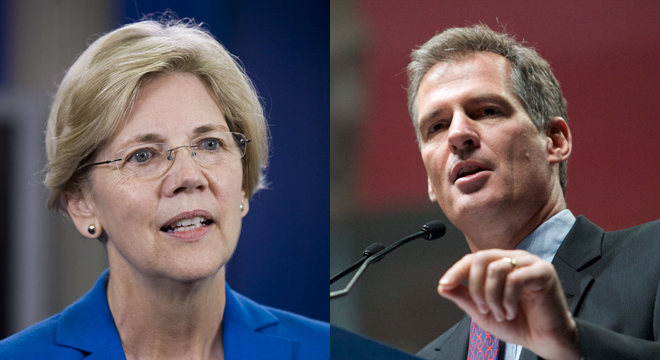
Republican Sen. Scott Brown and Democrat Elizabeth Warren pounded each other rhetorically on one point after another Thursday night, at their first debate in the top-tier Massachusetts Senate race.
The debate passed without any commentary on the big political story of this week: Mitt Romney’s secretly recorded comment that 47 percent of Americans are voting for President Obama because they pay no income taxes and want the government to take care of them. (Brown has already distanced himself from the comment.) But the two candidates went after each other on virtually everything else.
Right from the first question, moderator Jon Keller of the local CBS station asked Brown about attacks that each campaign has made on the opponent’s character, and whether character was an issue.
“As you know, I think what you’re referring to is the fact that professor Warren claimed she was a Native American, a person of color — And as you can see, she’s not,” said Brown. “That being said, she checked the box, and she had an opportunity actually to make a decision throughout her career when she applied to Penn and Harvard. She checked the box claiming she was a Native American. And you know, clearly she’s not.”
“That being said, I don’t know and neither do the viewers know whether she got ahead as a result of that checking of the box. But the only way that we’ll be able to find that out is to have her release her personnel records, have Harvard release their personnel records to make sure that she did not have an advantage that others were entitled to. So when you are a United States senator, you have to pass a test. And that’s one of character and honesty and truthfulness. And I believe and others believe that she’s failed that test.”
Warren, in her first answer, said that Brown is a “nice guy” — and then shot back, reciting her family history.
“Sen. Brown wants to raise an issue about my character, then I’ll lay it out there. You know, when I was growing up, these are the stories I knew about my heritage. I believed my mother and my father and my aunts and my uncles. And I never asked anybody for any documentation — I don’t know any kid who did.
“But I did know this about my parents: That my mother and dad loved each other very, very much, and they wanted to get married. And my father’s family said no — because my mother was part Delaware and part Cherokee. And all of our lives for my three brothers and me, that was a big part of the separation in our families.
“But, you know, I never used it. Never used it for getting into college. Never used it for getting into law school. And the people who’ve hired me for my jobs have all made clear that they didn’t even know about it until long after I was hired. So I think it’s out there what, the story is. What I really want this race to be about is about the issues, not about my family but about the families across the Commonwealth of Massachusetts who are very affected by this race.”
Brown did not let up: “You’re a nice woman, too. And I know you’re a good teacher and a hard worker. But this is about character. This is about something that can be answered very easily, folks. All she needs to do is release her personnel records, and she’s refused to do so. And I think that speaks volumes, and says I think, the answer that we all know.”
The two candidates each stuck to various refrains throughout the night: For Warren, it was that Brown has voted to protect big business and the top 2 percent of income-earners, and also that the election is a fight for Senate control. And for Brown, his contention was that he is a moderate, bipartisan legislator compared to Warren, who he cast as extreme and eager to raise taxes.
“The criticism that you are hearing from professor Warren and her supporters is that I don’t want to raise taxes. Guilty as charged,” said Brown. “Im not going to raise taxes. I’m going to protect the pocketbooks and wallets of everybody listening. If you want someone who’s going to spend your tax dollars — give it to professor Warren, she’ll spend them.”
Warren shot back: “Just last Friday, Sen. Brown went on the radio and when asked if it comes down to it and the question is, extend tax breaks so taxes don’t go up for 98 percent of families, or vote no and let them go up because there aren’t enough breaks for the top 2 percent, how will you vote? Sen. Brown said, let me make this ‘crystal clear,’ I [Brown] will vote to let taxes go up for everyone. Now I want to say, I’ll make it crystal clear, I will not vote to increase taxes on working families. Not ever.”
“Bottom line is,” Brown said, “what she is referring to is the fact that we already have a tremendous amount of tax revenue in Washington right now. When she’s talking about raising taxes and the fact I’m not going to raise them. I’m not going to raise taxes on our job creators. Those small and medium-sized businesses, those sub-s corporations and others who pass through ordinary income and are considered the so-called wealthy. I’m going to fight for every taxpayer. So once again her criticism of me is that I’m not going to raise taxes.”
Warren also repeatedly cast the race as a battle for Senate control — a key issue in this usually heavily Democratic state — for issues such as Supreme Court appointments, and whether Roe v. Wade will be upheld.
Warren focused on Brown’s vote in 2010 against the confirmation of Supreme Court Justice Elena Kagan.
“When Elena Kagan came up, she was a pro-choice woman who had been Solicitor General of the United States, America’s top lawyer. And when she was nominated to the United States Supreme Court — you know, she’s from here in Massachusetts — I was really surprised when Sen. Brown voted against her. This really may be a race for control of the Senate. And the Supreme Court may very well hang in the balance.”
“I’m sorry I didn’t vote for your boss. I know that you and Justice Kagan are very close,” Brown said, saying that Kagan did not reach his own litmus tests of temperament and previous judicial experience. “And I wish her well, I hope she proves me wrong.”
“With that being said, when it comes to your question about protecting women’s rights — listen, I’ve been fighting for women’s rights since I was 6 years old, since I had to battle when my mom was being abused by one of my stepfathers. And I’ve been fighting as a teenager, in the same way, protecting us from our abusive stepfather. So I’ve been fighting for women for a long, long time.
“And on that, I will make sure that if somebody is going to try — a judge is up there and they’ve made it very clear that they’re gonna try to change Roe v. Wade, I will oppose that judge. Listen, we’re both pro-choice, I’m a moderate, pro-choice Republican, I always have been. I’ve been working on the Violence Against Women Act, on women in combat, if women are raped in the military, I want to make sure that they get the care and coverages that they deserve. So you know, we agree on those issues, and I”m glad for it.”
Later, in a discussion of climate change (Brown said he indeed believes in climate change as a mix of both human and natural factors, and favors an “all of the above” energy approach) Warren again sought to tie Brown to his national party.
“Sen. Brown has been going around the country talking to people, saying you’ve got to contribute to his campaign because it may be for the control of the Senate. And he’s right. This race may be for the control of the Senate. But what that would mean is if the Republicans take over the Senate, Jim Inhofe would be the person who would be in charge of the committee that oversees the Environmental Protection Agency. He’s a man who has called global warming a hoax. In fact, that’s the title of his book. A man like that should not be in charge of the Environmental Protection Agency overseeing their work. I just don’t understand how we could talk about going in that direction.
“You’re not running against Jim Inhofe,” Brown said. “You’re running against me, professor. I am one of the original sponsors of the production tax credit for our green energy producers. The production tax credit makes our energy producers more competitive. And I supported that, and I’m in full favor — I support wind, solar, nuclear, coal-sighting and permitting, that full all of the above approach, which you don’t do.”
At the very end, the candidates made their final pitch.
“I’m the second most bipartisan in the Senate,” Brown said. “I was named the least partisan senator by Washington magazine. Can you imagine a hundred professor Warrens down there placing blame and raising taxes? Remember, the founder of the radical Occupy protest movement — the person who said, by the way, you didn’t build this on your own, folks, it was the roads and bridges all of us put forth so you could help you get your goods to market.”
“I think it’s clear: This race is about whose side you stand on,” Warren said. “Sen. Brown has made it clear with his votes. Subsidizing the oil industry, the billionaires, and saying taxes can go up on middle-class families. But remember, at the end of the day this race may be for control of the Senate. Sen. Brown can’t have it both ways. He’s out there raising from republicans all around the country, saying if you give me money and I win, it means the Republicans can take control of the United States Senate.”
The next debate will held Oct. 1, and the University of Massachusetts-Lowell. The PollTracker Average shows Warren leading 47.5 percent to 45.6 percent.