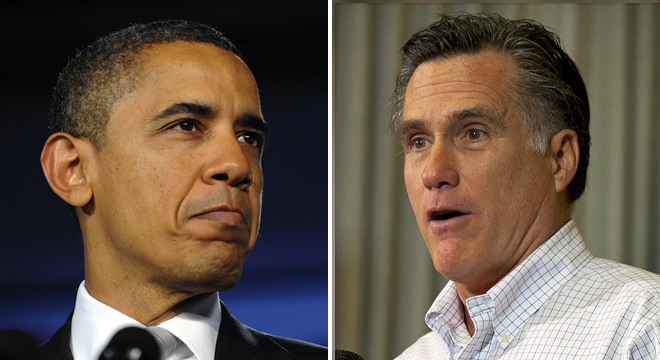
President Obama and Mitt Romney both addressed women and worked to win their votes this week. Their responses to what Democrats argue is a continuing “war on women” could not have been more different: Obama believes women have unique and specific economic desires from their economy. Romney says women need no tailor-made policies; what’s already in his policy platform is enough to close the gap in the polls among women.
With the contraception battle fading on the national level (and top Republicans conceding the fight turned into a disaster for the GOP), President Obama shifted the talk about women’s rights to the economy.The crux of his argument, from a forum on women and the economy held at the White House Friday:
“There’s been a lot of talk about women and women’s issues lately, as there should be. But I do think that the conversation has been oversimplified. Women are not some monolithic bloc. Women are not an interest group. You shouldn’t be treated that way.”
To Obama and the Democrats, the focus on women and the economy comes with a discussion of pay inequities and health care — an economic issue women list as their chief concern in this election.
This is the same distinction the administration drew during the contraception debate — insisting it was trying to save women the “$30-$50” per month they spend on average for contraceptive services. The White House has published a big report (pdf) tailoring economic messaging to the specific circumstances of American women. For example, this from the section on Medicare:
The coverage Medicare provides is particularly critical for women, who tend to have lower incomes and more significant health needs and — because of their greater life expectancies — rely on Medicare longer than men. Women in Medicare also spend a greater share of their income on health care, partially because of costs related to preventive services such as mammograms, clinical breast exams, bone density tests, and visits for Pap tests and pelvic exams.
Romney, by contrast, says women shouldn’t be treated as a separate bloc with specific concerns — they care primarily about the economy and jobs, just as men do, he argues. He’s enlisted women surrogates like New Hampshire Sen. Kelly Ayotte and South Carolina Gov. Nikki Haley to reinforce this message. It’s this line of reasoning that allows him to argue that women won’t care that his platform cuts off federal funding for Planned Parenthood and favors a transition to privatized Medicare.
“[T]he women that I speak with, and the women that my wife speaks with, tell her that their No. 1 issue is the economy so that they can get good jobs for themselves and their families and they can have confidence their children can get good jobs when they come out of college or high school,” Romney told Newsmax recently.