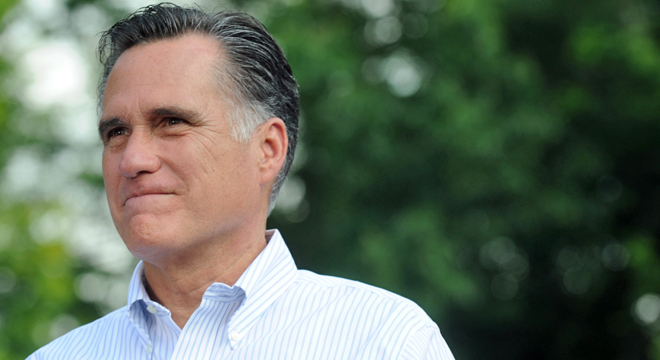
Mitt Romney went to great lengths to connect to his audience at the NAACP Wednesday, name-checking prominent black leaders, speaking about spirituality and acknowledging the economic plight of the African-American community. But he steered clear of many of the controversial issues that black leaders on both sides of the aisle say are important to them today — issues that have been mainstays of the NAACP conference so far.It marked a departure for Romney, who usually keeps things strictly economically-focused when speaking to minority groups. When he woos the female electorate, Romney tells them his wife Ann keeps him apprised of what’s important to women. When he speaks to Hispanics, he sidesteps the entire discussion about a significant part of the Hispanic population.
But before the NAACP, Romney tried to make a personal connection, using the same basic strategy he’s used to connect with evangelicals in the past. Romney talked up the value of family and promised to defend traditional marriage — both lines that were well-received, despite the NAACP’s recent vote in support of gay marriage.
He specifically appealed to the crowd’s devotion to family:
“I’m hopeful that together we can set a new direction in federal policy, starting where many of our problems do — with the family. A study from the Brookings Institution has shown that for those who graduate from high school, get a full-time job, and wait until 21 before they marry and then have their first child, the probability of being poor is two percent. And if those factors are absent, the probability of being poor is 76 percent.
Here at the NAACP, you understand the deep and lasting difference the family makes. Your former executive director, Dr. Benjamin Hooks, had it exactly right. The family, he said, ‘remains the bulwark and the mainstay of the black community. That great truth must not be overlooked.'”
It was almost word-for-word the same line he used to connect with the evangelical conservative Christians at the Faith & Freedom conference in June and at Liberty University the month before that, when both crowds were still relatively wary of him, only this time around, Romney replaced “Rick Santorum” (who pushed the Brookings study on the primary campaign trail) with Hooks, the former NAACP official.
Romney seemed to think he could find common ground with African American voters by appealing to the electorate’s concern with faith and classic “values” issues. But Romney also suggested he was making a push on behalf of the Republican Party to do a better job of connecting with African American voters.
“I do promise that your hospitality to me today will be returned. We will know one another, and work to common purposes. I will seek your counsel,” he said. “And if I am elected president, and you invite me to next year’s convention, I would count it as a privilege, and my answer will be yes.”
That was a subtle reminder that President George W. Bush routinely declined the NAACP’s invitation. Romney implied he will be different.
On substance, however, the speech failed to address almost any of the NAACP’s recent central issues. The NAACP has complained about perceived racism among tea party conservatives (a charge black Republicans dismissed), expressed fears over voter ID laws and called for massive reforms to the criminal justice system. Romney sidestepped each of those.
Political observers on both sides of the aisle said Romney’s speech to the NAACP was likely more about convincing white suburban voters that he’s not racist than it was about actually reaching across the deep political divide that separates most of the black electorate from the Republican Party. But Romney seemed to make an effort — while still making clear why the divide exists in the first place.