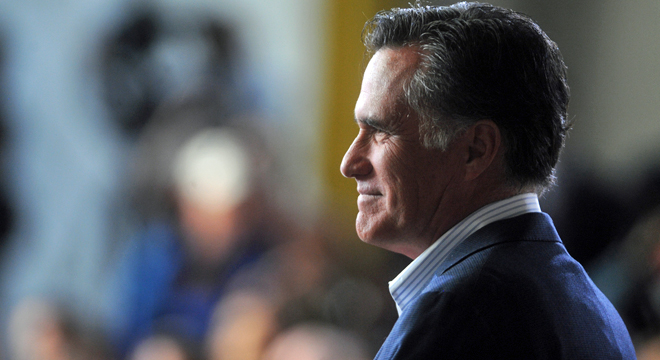
Mitt Romney clashed with a state commission tasked with helping LGBT youth at risk for bullying and suicide throughout his term as Massachusetts governor over funding and its participation in a pride parade. He eventually abolished the group altogether.
“We remember well what Romney tried to do as governor of Massachusetts and we now we have more info on some of his own attitudes that may have led to his policy actions,” Eliza Byard, executive director of LGBT anti-bullying organization GLSEN, told TPM, drawing a connection with reports that Romney cornered a youth in high school and cut his hair. “If he’s willing to dismiss that incident as ‘hijinks,’ I could understand that he wouldn’t understand at all why this program was so critical.”The Governor’s Commission on Gay and Lesbian Youth, created by Republican Gov. William Weld in 1992 in response to newly released statistics showing alarmingly high suicide rates among gay and lesbian teens, was designed to combat harassment in schools. It served at the pleasure of the state’s chief executive. The commission funded Gay Straight Alliances in high schools and provided training and information for teachers.
Romney continued its existence upon taking office, but a rift began in 2005, when he vetoed a $100,000 increase in its budget, prompting the state legislature to overturn his move and restore funding. Conservative anti-gay activists, who had mobilized in the wake of the state’s gay marriage fight, publicly opposed the commission’s budget request.
Romney’s office reiterated at the time that the governor’s initial objection was over funding levels, and not the group’s goal of helping gay youth, which he supported.
“If the governor does have national aspirations, the rest of the country doesn’t buy this stuff,” said Brian Camenker, then director of the anti-gay marriage Article 8 Alliance, told the Boston Globe at the time. “The governor has to decide where he stands on some of these issues.”
At the time, the commission’s co-chair, Kathleen Henry, defended Romney, and the next year the governor doubled his requested funding for the group. But while the budget fight subsided, relations between the governor and commission collapsed in mid-2006, after the commission lent its name to materials promoting a long-running annual pride parade for LGBT youth that it helped organize using private funds. Romney, incensed at being officially associated with a gay pride event, threatened to dissolve the commission on the spot.
The move came after Camenker showed Romney aides pictures of the previous parade his group had posted online that he claimed were inappropriate.
”Last year [at the parade] they had boys in fishnet stockings and high heels parading down Boylston Street,” Camenker told the Globe. ”They had boys dressed as women embracing. We presented stuff, and they were visibly sickened by what they saw. I said, basically, this group has to go.”
Romney’s spokesman Eric Fehrnstrom later confirmed that the photos were a key concern as well as the events inclusion of the transgender community.
“This year, what was brought to our attention was a press release that was not authorized by this office but which went out on state letterhead promoting a parade that was hosted by a crossdresser and celebrating, among other things, transgenderism,” Fehrnstrom said.
The governor ultimately backed down from ending the commission, after Henry and supporters “inundated them with outrage,” as she told the Globe. Romney’s spokesman Eric Fehrnstrom told the paper at the time they had received no calls on the issue, but changed their mind because ”the governor thought that was too harsh.”
Lawmakers supportive of the commission were particularly upset with Romney’s turn because he had issued official statements in 2003 and 2004 praising a similar gay youth pride day and parade.
“I’m left with the question of what’s changed since 2003, and I’m left with the governor’s political ambitions,” openly gay state Rep. Carl Sciortino (D) complained to the Associated Press.
Although Romney backed off his initial plan to end the commission, the damage was irreparable. Fehrnstrom told state representatives that Romney would like to narrow the commission’s focus to eliminate events like the pride parade and broaden its mission to bullying among youth in general and not just among the LGBT community. Romney also wanted the new commission to consist of all new members, according to the Globe. Democrats revolted. Legislators created a new independent commission — over Romney’s veto — tasked with “school-based and community-based programs focusing on suicide prevention, violence intervention and the promotion of zero-tolerance policies regarding harassment and discrimination against gay and lesbian youth.” Romney responded by eliminating the governor’s commission. Aides explained it was redundant to have two groups working on the issue.
“There was a feeling we needed to empower the youth around whatever way they needed to try to deal with their issues and I think [Romney] was trying to narrow that focus.” ” State Rep. Alice Wolf (D), who helped create the new commission, told TPM.
The Romney campaign did not respond to multiple requests for comment.