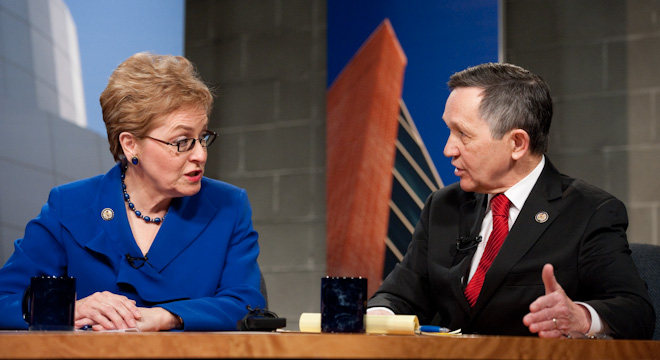
LORAIN, OHIO — The Hunger Games, about two otherwise friendly neighbors forced into a small arena to fight until only one remains, opens later this month. But a real-life version is taking place in Ohio’s 9th District primary on Tuesday.The state is losing two seats after the latest census, and the GOP-controlled legislature forced two of Ohio’s most seasoned Democratic politicians, Dennis Kucinich and Marcy Kaptur, into the same district to set up an intra-party battle royale. Kaptur has held her seat since 1983, while Kucinich has held his own since 1997 and previously served as mayor of Cleveland in the 1970s.
Despite being friends before the race began, things have quickly gotten ugly. Kucinich radio ads say Kaptur “voted to waste half a trillion on Bush’s wars” by approving military spending bills (both opposed the Iraq war). His campaign has accused Kaptur’s supporters of tearing down its signs. Kaptur has ads accusing Kucinich of shady political dealings, citing his praise of a local Democratic official now on trial for corruption. And, in an unexpected development, a super PAC run by a conservative Houston businessman is running attack ads highlighting Kaptur’s house in Washington, D.C. and late payments on her Ohio property taxes.
The new district is a thin sliver stretching 120 miles across the Lake Erie coast, bookended on the west by Kaptur’s home base of Toledo and on the east by Kucinich’s Cleveland-area core. The numbers appear to favor Kaptur, who retains more of her district, but both sides are aggressively targeting the other’s turf.
In between the two population centers sits Lorain, a racially diverse steel town of 64,000, that neither has represented before. Like the similarly named Alsace-Lorraine of France, each candidate has some claim to its residents’ loyalty. Kaptur’s district has included parts of the county, while the city’s shared media market with Cleveland means they’ve seen plenty of Kucinich on TV.
 The candidates’ campaign offices are on the same street. Emmett Duffy, a retired Cleveland firefighter backing Kucinich, met me at a coffeehouse in between putting up signs and knocking on doors. At a spry 93 years old, Duffy can recall Kucinich’s entire career with ease. He remembers Kucinich throwing a perfect strike at the Cleveland Indians’ opening game as mayor, working to keep steel mills and post offices from closing down and always working closely with labor.
“I’ve known Dennis since way back,” he said. “He was always good to the Fire Department when he was mayor. I’ve probably met him 100 times.”
Duffy said he especially appreciated Kucinich’s rise to the national stage over the last decade, taking special pleasure in his appearances as a guest with Bill O’Reilly.
“I don’t know how the hell he does it,” he said. “You know, O’Reilly always interrupts his guests every time, but he doesn’t get away with it with Dennis on the show. He’s not used to that.”
That last point, that Kucinich is an unabashed liberal, is a common source of pride among supporters — and a source of criticism from his detractors. Kaptur and Kucinich may be similar on most issues, but here they each represent very different types of politicians.
Kucinich has used his seat to wage a war for ideological purity in the Democratic Party, frequently bucking leaders from the left in order to prove a point, whether it’s on the Iraq war or health care (President Obama had to personally come to Cleveland to get him to vote for his reforms). He’s run two presidential campaigns in the last decade promoting his idea for a “Department of Peace.”
His fervent activism, especially against America’s wars and drug laws, has brought a raft of celebrity endorsements: hip-hop mogul Russell Simmons, actor James Cromwell and singers Willie Nelson and Ani DiFranco have all helped out on his current election fight.
“He’s a fighter,” Richard Romero, co-coordinator for Kucinich’s Lorain County campaign, said. “He takes on issues where other people would go ‘Why would do that?’ He was right that there were no weapons of mass destruction in Iraq, he’s right when he says, ‘What if we spent the trillions there on bridges and health care here instead?”
Kaptur, by contrast, has slowly moved up within the ranks of the Democratic Party and now stands poised to chair the Appropriations Committee if the party retakes the House in 2012, generally considered one of the most powerful positions in government. Her big-name endorsements are much more moderate, but not without their own star power. George Voinovich, the former Republican governor who defeated Kucinich to become mayor of Cleveland decades ago, is supporting her. So is former presidential candidate Bob Dole, along with actor Tom Hanks, as thanks for her help building the World War II memorial in Washington, D.C.
She’s the substance to Kucinich’s style, her supporters argue.
“She won’t necessarily get the same media attention others strive for,” said campaign press secretary Matthew Klempner. “But she’s very good at working behind the scenes to get things done.”
Inside her Lorain headquarters, city treasurer and Kaptur supporter Karen Shawver, praised her steady demeanor.
“She’s calm and thorough, willing to understand the whole picture before she decides how she’ll vote,” she said.
Shawver said that despite the civil war-like nature of the contest, it’s been a pleasant experience working on behalf of Kaptur.
“All my friends are for Marcy, just about every single elected official in the county.” As for the other side? “It’s kind of how you’d envision them,” — an allusion to the hardcore left. I admit, to her amusement, that one of the Kucinich volunteers I talked to down the street, Mike Leonardi, is a writer for the radical newsletter CounterPunch.
 Kaptur’s campaign has done its best to portray Kucinich as naively fringe. “Unlike my colleague from Cleveland I would not have shaken the bloody hand of Assad,” she said in one recent debate, pointing to a 2011 trip by Kucinich to meet with Syria’s president amid a violent offensive against his own people. Kucinich says he was there to try and make peace.
It’s moments like these, Klempner says, that are responsible for conservative super PACs trying to take out Kaptur instead of Kucinich.
“They’d rather see someone as the face of Ohio Democrats who is, quite frankly, a little on the fringe and outspoken on issues mainstream voters aren’t concerned with,” he said.
One unpredictable factor in the race is a third candidate, Graham Veysey, a 29-year-old first-time candidate who’s positioning himself as a fresh alternative to two of Ohio’s most deeply entrenched politicians. Jerry Austin, a veteran Democratic strategist advising Veysey, told TPM that while he didn’t expect Veysey to win, he might soak up enough votes to swing the race one way or the other.
Even if Kucinich goes down on Tuesday, however, it may not be the end of his House career. He has reportedly explored running for a seat in Washington state.