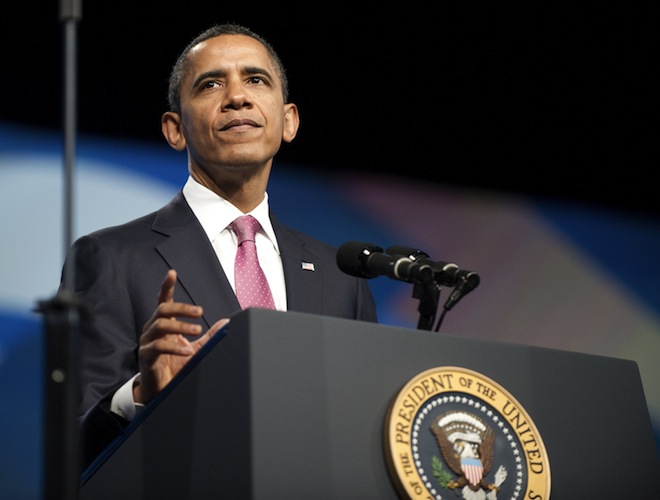
President Obama got a laugh out of a Maryland audience on Thursday when he mocked the Republican Party in a speech, comparing their skepticism of alternative energy to the “Flat Earth Society” in Christopher Columbus’ day and President Rutherford B. Hayes’ apparent dismissal of the telephone. But while Obama thinks the GOP is in need of a science lesson, he may need to bone up on history himself.
In mocking the GOP, Obama cited an anecdote about Hayes in which, upon using the telephone for the first time, he said, “It’s a great invention, but who would ever want to use one?”
“That’s why he’s not on Mount Rushmore,” Obama said. “He’s explaining why we can’t do something instead of why we can do something.”
But Nan Card, curator of manuscripts at the Rutherford B. Hayes Presidential Center in Ohio, told TPM that the nation’s 19th president was being unfairly tagged as a Luddite.“He really was the opposite,” she said. “He had the first telephone in the White House. He also had the first typewriter in the White House. Thomas Edison came to the White House as well and displayed the phonograph. Photographing people who came to the White House and visited at dinners and receptions was also very important to him.”
While often cited, Card said Obama’s cited quote had never been confirmed by contemporary sources and is likely apocryphal. A contemporary newspaper account of his first experience with telephone in 1877 from the Providence Journal records a smiling Hayes repeatedly responding to the voice on the other line with the phrase, “That is wonderful.” You can read the full story here.
“He was pretty technology-oriented for the time,” Card said. “Between the telephone, the telegraph, the phonograph and photography, I think he was pretty much on the cutting edge.”
As for why he’s not on Mt. Rushmore, Card noted that popular history tends to favor wartime presidents in the long run. To be fair, modern historians aren’t too hot on Hayes either in their rankings.
Obama’s invocation of the “flat earth” theory in the context of Christopher Columbus’ journey across the ocean also contained some dubious (if incredibly widespread) history.
“If some of these folks were around when Columbus set sail, they must have been founding members of the Flat Earth Society,” Obama said. “They would not have believed that the world was round.”
In fact, historians have long contended that the notion Europeans widely believed the Earth was flat, let alone 15th century Spanish scholars, is a myth developed centuries later. From the late Harvard paleontologist Stephen Jay Gould’s 1995 book “Dinosaur In a Haystack”:
There never was a period of “ï¬at earth darkness” among scholars (regardless of how many uneducated people may have conceptualized our planet both then and now). Greek knowledge of sphericity never faded, and all major medieval scholars accepted the earth’s roundness as an established fact of cosmology. Ferdinand and Isabella did refer Columbus’s plans to a royal commission headed by Hernando de Talavera, Isabella’s confessor and, following defeat of the Moors, Archbishop of Granada. This commission, composed of both clerical and lay advisers, did meet, at Salamanca among other places. They did pose some sharp intellectual objections to Columbus, but all assumed the earth’s roundness. As a major critique, they argued that Columbus could not reach the Indies in his own allotted time, because the earth’s circumference was too great. Moreover, his critics were entirely right. Columbus had “cooked” his figures to favor a much smaller earth, and an attainable Indies. Needless to say, he did not and could not reach Asia, and Native Americans are still called Indians as a legacy of his error.
As far as muddled historic references go, Obama’s hardly the first presidential candidate to screw things up on the trail. But for an address specifically going after his opponents for their ignorance, it’s probably not great to have a “citation needed” banner on top of his speech.
Update: Looks like the legendary Hayes anecdote was used by Ronald Reagan in the 1980s as well, a fact mentioned in Walter Isaacson’s recent bestselling biography of Steve Jobs, who was present for one such speech. The Atlantic suggests this may explain how it popped back into the popular consciousness recently.