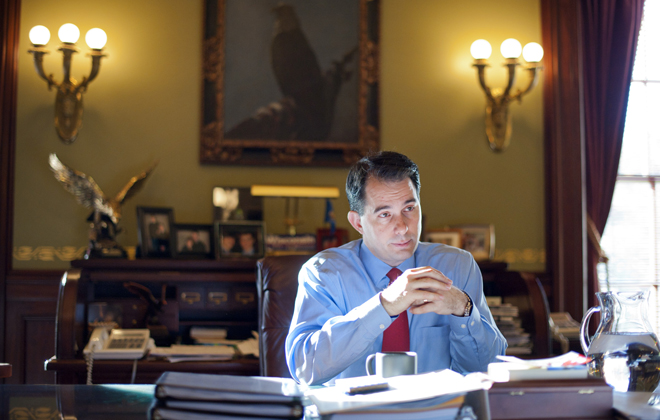
Wisconsin Gov. Scott Walker (R) was just dealt a defeat in court, with Dane County Judge Richard Niess denying a request by Walker for more time — on top of a previous extension — to review and challenge the more than one-million signatures that Democrats filed last month to recall him.
The request was filed with the court on Tuesday, and argued Friday, with a ruling coming very quickly afterward. Had the request been granted, the potential existed for the official certification and triggering of the recall to be delayed. As the Associated Press reports, Niess said that Walker did not show good cause for a further extension.
This result may have come about due to an admission that Walker’s legal team made in their filing: Of the amount of processing that they had completed, they claimed a discovered an error rate of only between 10 and 20 percent, consistent with the 15% figure in a random sampling by the Milwaukee Journal Sentinel. Such a rejection rate is not unusual when an opposing campaign actively looks for alleged deficiencies and challenges against signatures.
However, the Democrats’ submission of over a million signatures was nearly twice the required threshold of just over 540,000, or 25 percent of the total number of voters in the 2010 gubernatorial election. As a result, the Walker campaign would need to disqualify nearly half of the signatures in play here — a rate that is very far above their current tally.TPM asked state Republican Party spokesman Ben Sparks for comment on the ruling.
“The court’s decision to deny Friends of Scott Walker an extension to verify these recall petitions is concerning, given that it has become apparent that an adequate review of recall signatures could not be met within the current time limit,” said Sparks. “Nevertheless, the Republican Party of Wisconsin and Friends of Scott Walker will continue our efforts to verify these signatures so as to protect Wisconsin residents from being disenfranchised by invalid signatures.”
Meanwhile, the state Democratic Party provided TPM this statement from chairman Mike Tate:
“Contrary to what he has said publicly, Scott Walker and his Tea Party Republicans have tried to delay the recall election to unseat him using every trick in the book. We hope today’s ruling, where a judge stated that all recall elections likely will happen, will end his heinous attempt to avoid accountability.
“For months, we have had to listen to Scott Walker defenders smear what was a miracle of democracy. Today’s ruling should give comfort to the people of Wisconsin who, unlike Scott Walker, still believe in fairness, who still believe in democracy and who still believe in the rule of law.”
Under state law, a recall target has 10 days to review signatures, starting from when petitions are filed, and then register their challenges with the state Government Accountability Board, which oversees elections.
Late last month, Niess granted the GAB a further 30 days, for 61 days total through March 19. Niess also restarted the clock for Walker, due to the GAB’s initial inability to deliver copies of the sheer number of petitions, to begin once the copies were fully supplied. And on top of that, Niess granted Walker an extra 20 days, for 30 days total, which ultimately worked out to a deadline of February 27.
On Tuesday, however, Walker’s legal team asked for a further extension of two weeks, up through March 12 — getting close to the GAB’s own deadline — in order to accommodate their requirements for data analysis by their contracted third-party vendor.
The Walker campaign’s filing said that the Walker campaign was able to complete a review of the petitions for clear errors such as signature problems, thanks to the labor of 3,000 volunteers. But beyond that, they said, they must also compile and analyze a full database, in order to screen for duplicate names and invalid addresses — a process that they said is “not yet 25 percent complete.”
And despite the 10%-20% error rate they had found, they argued that a full review was still necessary, and assured that it would only “minimally impact” the public interest of a quick process and promptly scheduled election: “While an error rate of close to 50 percent would be needed to put a recall election in doubt, the office holders still have a valid interest in filing objections and determining that a sufficient number of individually valid signatures are present. The current time frame is insufficient even for the most minimal of review.”
But in arguments today, Niess clearly did not agree.