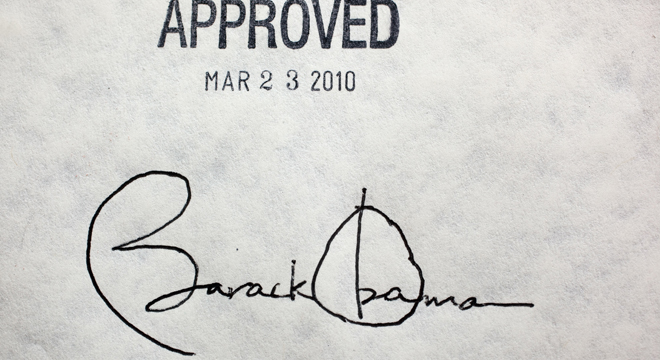
For decades, Americans have identified health care reform as a national priority. Two years ago, President Obama worked with Congress to pass a landmark overhaul, something numerous other Presidents had tried and failed to do.
But has a major accomplishment become a major political liability for 2012?
Not surprisingly, the political outcomes are as complicated as the issue and the law itself — it depends on what information is presented to voters, who’s presenting it, and who those voters are. And with the recent embrace of the word “Obamacare” by the Obama campaign directly, it looks like the messaging is shifting — not to mention the fact that the Supreme Court can disrupt everything by declaring part or all of the law is unconstitutional. But as of now, here’s where the politics stand.First of all, the issue cuts much harder for Republicans in a political sense. Pollsters TPM spoke with defined it as a issue that fuses the GOP together, just when the party needs to coalesce. After a fractious presidential primary process, which has seen the intramural battles rage between the establishment-moderate-electable choice in former Massachusetts Gov. Mitt Romney and a chorus of other Republican candidates that fought for the mantle as the “true conservative” in the race, it’s the issue that combines both moderate and right wing Republicans.
“This is base unifying issue for Republicans,” said Bruce Haynes, a founding partner of Purple Strategies and a veteran of GOP campaigns. “Inside heath care reform is every good dog whistle issue for the Republican Party. It’s deficits, taxes, spending, even religious freedom. Every issue you could find inside a Republican Party platform is contained inside health care reform.”
That’s good for Republicans in two ways. Yes, it helps to put the party back together. But further in 2012, it can help motivate the GOP base in an election that may hinge on both sides getting their people to the polls, unlike 2008, which was a change election. If the contest comes down to the traditional battle between two massive presidential campaigns and a billion dollars in negative ads funded by super PACs, some pollers argue voters in the middle may tune out, at which point it’s a race to see who can turn out their base. And if Republicans aren’t excited about their nominee then the anti-health care reform message becomes even more important.
Beyond the right side of the political equation, the heath care reform law doesn’t enjoy much popularity. Whether they are asked if they support the law itself or whether it should be repealed, most Americans aren’t a fan, and if given only the option to repeal the whole thing, they say scrap it.
“The problem for Obama is that he was at cross purposes with the electorate, proposing an unpopular solution to an issue that was unimportant to the voters,” said Haynes. “It’s an issue that people have been interested in time of peace and economic health. But when we were in the throes of the economic crisis we were in, most people say, ‘Health care reform — I understand, it’s important matter, but jobs and the economy are more important to me right now. I don’t understand that the leadership of the country is focused on health care when I don’t have a job.'”
Which is why Democrats say President Obama and his team won’t speak about the law as an overarching policy. It’ll be about specifics.
“The first rule of messaging is to talk about things people already believe,” said Doug Usher, a managing parner at Purple Strategies and the former pollster for Sen. John Kerry’s (D-MA) run for the White House. “He’ll say, ‘Is the law perfect? No. But the other side wants to get rid of the most basic things that we feel are important.'”
Stopping insurance companies from canceling or denying coverage because of a pre-existing condition. Allowing younger Americans to stay on their parents health care plan until they turn 26. Eliminating the “donut hole” in Medicare part D, the government prescription drug plan. Expect all those messages to be delivered sooner rather than later.
“I think a good offense is a good defense on this one, I think the President’s team is going to point to a lack of counter-proposals,” Dr. Lee Miringoff, director of the Marist Institute for Public Opinion told TPM. “The White House is not trying to sell this in broad strokes. It’s individual people coming forward to tout what its done for them personally. Then the Obama campaign will point those those people and ask the Republicans what they will replace the reforms with.”
But to do that, Miringoff said they really have to execute two strategies. First, they have to re-sell heath care reform to a public that was wary of it the first time around, and then make the comparison of specific reforms to the blank slate that Republicans are offering on the subject. That looks like it’s already started.
On Friday, the Obama team look their first step in rebranding the law, strongly embracing the term ‘Obamacare’ through an email to supporters from Obama’s chief campaign strategist David Axelrod with the subject line, “Hell yeah, I like Obamacare.”
“President Obama never lost sight of the fact that this reform is about people. People like his own mother, who spent the last years of her life fighting cancer — and fighting with insurance companies, too,” the email read. “That shouldn’t happen. And because of Obamacare, it can’t. So next time you hear someone railing against Obamacare, remember what they’re actually saying they want to take away.”
The email also hits on another aspect of the message strategy — utilizing President Obama himself. The President is trying to make this thing personal, said Miringoff, because that’s one of his best attributes. Obama, despite longstanding difficulties with his job approval rating through the prolonged recession and squabbles with Congress, has always remained personally popular and favorable to Americans at large. And while it can be specifically used on the health care reform issue, it provides a more general contrast to likely GOP challenger Romney who has struggled to connect with Americans personally according to his favorability ratings.
Combine the specifics of health care, and the personal popularity of the President, and you’ve got a strategy, Miringoff told TPM.
“If you look at the Republican campaign so far, it’s been mostly abstract. Save for 999 [businessman Herman Cain’s tax plan], there hasn’t been much specific discussion,” he said. “I think the White House sees an opening to make it seem more personal. That politics are more about people.”