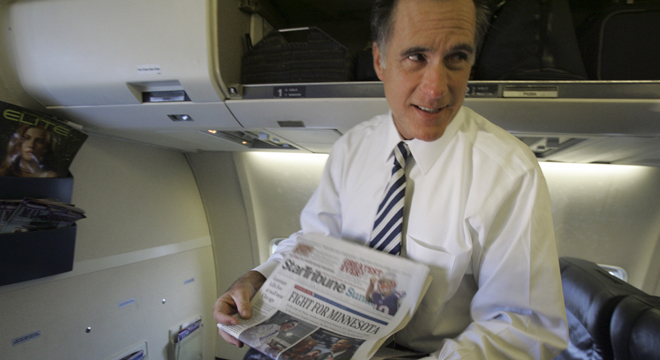
Mitt Romney’s campaign is trying to mitigate the damage done when it sent out a Detroit News endorsement and edited it to remove a paragraph critical of Romney’s stance on the auto bailout by claiming that copyright law prevented them from sending out the full version to reporters.
The paper’s not happy with the move, and famous First Amendment lawyer Floyd Abrams isn’t buying the excuse. He told me Wednesday evening that the News could actually sue Romney if it wanted (though he noted the paper would be “ill-advised” to bring it).
“This is a situation where if anything the Detroit paper has a claim if it wanted to assert it against Romney for printing what it said in a distorted way,” he said. “For the Romney people to print so much of it and leave out only the bad parts is by it’s nature a distortion.”Team Romney told Jim Romenesko that copyright law meant the campaign was “required when sending something out that it’s less than half the original article.”
Abrams said that excuse was essentially total crap. Though a newspaper maybe could sue a campaign for reprinting their work in its entirety, it never happens (candidates and committees routinely blast out full copies of articles to reporters. The standard Romney’s campaign cited is non-existent, Abrams said.
“The short answer is the 50% doesn’t come from anywhere,” Abrams said. “And saying that they had to cut out what they did for copyright reasons is wholly unpersuasive.”
The whole thing has turned into today’s lesson in campaign optics: try not to start the day with the endorsement from a prominent newspaper and end it with that newspaper publicly expressing its displeasure with your campaign.
“We’re not pleased,” Detroit News Editorial Page editor Nolan Finley told me. “We would have preferred the campaign link to the electronic version of the editorial at DetNews.com so that readers could see the complete version. If they were going to simply present excerpts, as sometimes happens, they should’ve identified them as excerpts.”
The Romney camp’s version of the editorial — which removed a paragraph that criticized Romney for his opposition to the auto bailout — included elipses in the places where the criticism was removed. Finley said they weren’t enough.
“I don’t think that’s entirely appropriate,” he said. “Readers have no way of knowing what’s missing and are clearly being led to believe that this is the editorial as written by the Detroit News.”
Finley said the paper has contacted the Romney campaign “and expressed our displeasure.”
I asked if the edit showed that the News was right in its contention that Romney’s opposition to the auto bailout (something he shares with the entire GOP field, the paper wrote) was a problem for Romney.
“Well, of course we think we’re right,” Finley said, adding that he didn’t want to “get too far down the road” in speculating on the motives for the Romney move.
However, to clear things up Finley said he wants the campaign to either make it clear they’re using excerpts or link to the whole electronic version. “It’s a simple request,” he said.
Update: Finley told me after our first interview that he had spoken with the Romney campaign about his concerns. The campaign told him about their 50% threshold and pointed him to a link to the full version they included in the original email.
Finley said the link was “satisfactory,” but he still wasn’t happy with the Romney campaign edits.
“We’re not as concerned,” he said. “We still would have liked them to say it was excerpts. That’s what we do when we edit something down.”