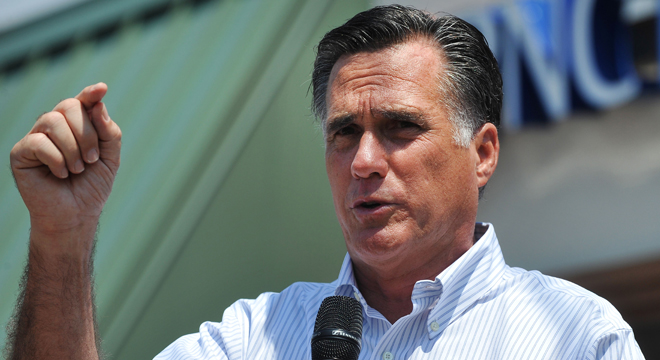
Mitt Romney is rebooting his campaign with a bold new attack against President Obama: The White House, he claims, is a hotbed of “crony capitalism” designed to pay off big-time Democratic donors. Government transparency groups say that if Romney wants to attack the president, he better put his anonymous money where his mouth is.
Romney’s case against Obama is that clean-energy companies like Solyndra received loan guarantees (through a Bush administration program) after executives donated to the president’s 2008 campaign, and that other top contributors also received government benefits. The corruption claims have not held up well with fact-checkers or voters wary of personal attacks on a personally well-liked president, Romney is doubling down: The Obama administration is doling out “political payoffs.”Sheila Krumholz, executive director of the Center for Responsive Politics, which tracks campaign donations, expressed shock and amazement that Romney would try to claim the high ground on rooting out undue influence from big donors. After all, Romney refuses to even name his top fundraisers, commonly called “bundlers,” in the first place. The information has been standard for presidents and presidential hopefuls in recent election cycles: Obama has named his bundlers, as did President George W. Bush and Sen. John McCain (R-AZ).
“It’s ironic that Romney would criticize Obama for doing something while shielding his campaign from being similarly criticized,” Krumholz told TPM. “Romney’s house isn’t exactly shatter-proof.”
By coincidence, a coalition of campaign finance advocates, including the Center for Responsive Politics, launched a petition drive Monday to demand Romney follow past precedent and release his bundlers.
Krumholz noted that it was entirely legitimate to scrutinize the Obama administration’s top donors to see whether they received any benefits, a concern she says has been endemic across all recent presidencies. But Romney’s historically weak standing makes him an unusual messenger, Krumholz said. “Unlike Obama and all other recent presidential nominees, Romney’s refusal to release bundlers is really sticking a finger in the eye of citizens who need this information to effectively monitor government.”
Romney’s dissonant position hasn’t gone unnoticed, either: His campaign surrogate Ed Gillespie was grilled Monday over how Romney can attack Obama while keeping his own bundlers hidden. Gillespie responded that the campaign had followed the law when it came to disclosures.
There’s an added layer of irony. Romney is required by the FEC to release the names of bundlers who are also registered lobbyists — i.e. people whose stated job is to secure favorable treatment from the federal government. Many of them work in industries where Romney could give their clients a boost: Bundler Van Hipp works in military contracting, for example, and bundler Patrick Durkin lobbies for banks. Obama, by contrast, prohibits his campaign from even using lobbyists as bundlers (although the distinction can be blurry).
“Mitt Romney is raking in big bucks from lobbyists whose main goal is to secure government contracts and get deals for their clients,” Adam Smith, communications director for Public Campaign Action Fund, which has been monitoring Romney’s supporters, told TPM. “He should be careful about throwing stones from his big glass house.”
On top of funds from bundlers, Romney and Republicans are expected to receive as much as $1 billion from conservative outside groups this election cycle, many of which do not disclose their donors in any way, shape or form to the public.
Obama’s supporters are soliciting donations to similar Democratic groups, but Republicans have consistently opposed legislation that would shine a light on big-money donors — an essential part of tracking whether multimillion-dollar backers receive special treatment from the White House next year. On Monday, Senate Republicans are expected to block a vote on the DISCLOSE Act, which would require anonymous money groups to disclose who exactly is backing their political advertising.