


With the President’s “Big Beautiful Bill,” there’s been a general assumption. It’s super, super unpopular. And, also, it doesn’t matter. It’s going to pass anyway. That assumption is very likely true. Perhaps they’ll hit some speed bumps that prevent the bill from passing in time for July 4th, as Trump wants and has demanded. But these kinds of bills tend to be “failure is not an option” type affairs. You have obstacles but they get crumpled like things that go under a steam roller or mashed up in an industrial trash compactor. That’s particularly the case in Trump’s second term, where hints of the old ungovernable GOP caucus get flattened when word comes from Trump that it’s over. But here we see again the central tension point of the Trump presidency: he owns, dominates and controls everything but public opinion.
That much of it is almost conventional wisdom at this point. The bill thing is really, really unpopular. Even the inside-DC sheets say as much. So Republicans are starting to do something we’re used to seeing Democrats do with some of their more aspirational policies. Which is basically this: You think it’s unpopular. But that’s just because you’re not polling it right.
Famous last words.
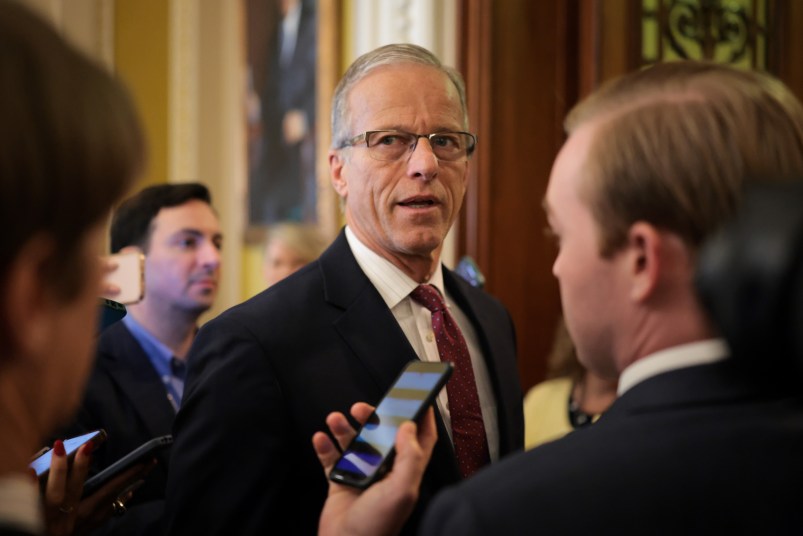
I first noticed this a couple weeks ago when I got an email from one of the big GOP polling operations highlighting the fact that while the bill is unpopular overall its individual components are popular. Axios published some of this polling a couple weeks ago as a big scoop. Senate Majority Leader John Thune pressed the same argument in an Axios interview yesterday. You can see the arguments in the linked piece. But they amount to, hey, when people hear about what’s actually in the bill, they love it.
Famous last words. Good luck with that.
There are two ways to understand this argument. The first is that political people have really reliable ways of fooling themselves and others with polls. It’s true that if you ask voters about your policies in the ways you want them to be framed you can usually get at least reasonably good results. But that’s meaningless. If you really want to understand the state of public opinion, you need to try to approximate how a question will be framed in a campaign context, in the court of public opinion — in the wild, for lack of a better term, where both sides get their say. A good example of this is the polling on Medicare for All. If you poll whether people would support a plan to make everyone eligible for Medicare, people love that. You get support approaching two-thirds of the public. When you say it means banning or taking away people’s private insurance, support nosedives. In a similar way, most of these polls are just pollster happy talk.
But it’s not solely that. There are things in the bill that actually do have some public support: no taxes on tip income, a small but real tax cut for average earners (more on this in a moment), an increase in the child tax credit. But these are generally small, ancillary parts of the bill and the bill has already been defined as a mix of massive tax cuts for the very rich, draconian cuts to Obamacare and Medicaid and exploding deficits. That’s sticking because it’s the simple numerical reality of the bill. But it’s also sticking for an equally important reason: Even more than the first, the second Trump presidency has overflowed with the atmospherics of ultra-wealth and communicated clearly that it is government, to paraphrase Lincoln, of, by and for the ultra-rich.
You see it in the Cabinet, in the trooping of billionaires at the front seats of Trump’s inaugural, the world’s richest man given two or three months to actually run the government by himself. Trump critics get lost in the doomerist plasma of “Nothing matters.” But these things do matter. The public is getting the impression that the Trump BBB is taking things from average families to give things to the ultra-wealthy not only because that’s what it does but because Trump’s been communicating in imagery for months that that’s what this White House is about.
And there’s one additional point that doesn’t figure into most of these conversations. People assume that there are massive tax cuts. They may go mostly to the super rich. But, people assume, they’re there.
Only they’re kinda not there.
Allow me to explain.
The whole point of this exercise is to pay for the tax cuts. But if you’re super rich, will you actually get a tax cut? Or if you’re not rich, will you get the fig-leaf nano-cut? Not really. You’re only getting a tax cut if you operate in the alternative reality of Senate reconciliation math. Reconciliation (over-simplification coming) requires not increasing the deficit on a 10-year time scale. So like the Bush tax cuts, these mega tax cuts — passed via reconciliation in 2017 — are about to expire after a decade. So the “tax cuts” are simply re-upping the ones that in theory are scheduled to snap back to what they were before 2017. In other words, in the real world, they’re just keeping the 2017 cuts in place.
If you’re making $5 million a year and you’re worried about losing the benefits you gained back in 2017, this remains quite awesome. But it wasn’t until I noticed someone discussing this on Twitter yesterday that I thought through the electoral consequences of this snapback dimension to the bill. To the extent Republicans are selling this bill, the pitch is heavily based on everyone getting some tax cut. Only they won’t. The rates cuts are just cuts against the notional snapback to the 2017 rates. You won’t actually see any difference between your rate in 2025 and 2026. This maybe isn’t the hugest thing. The differences for the average taxpayer aren’t that big in the first place. But if you’re looking for it, it won’t be there. What this means electorally is that people will be seeing and hearing about (and for many eventually experiencing) the downsides of the budget without the upsides actually showing up.
Republicans have thought of this to a degree. They’ve set all the Medicaid and Obamacare cuts (as of the current budget outline) to go into effect on the last day of 2026, right after the midterms. Cynical but clever. But news stories will be full of what’s coming and the fact that health insurance costs will soon explode for those able to keep their care.
Republicans seem convinced that the future will take care of itself. I’m more than skeptical.