


The Supreme Court has just issued its much-anticipated decision on campaign finance law in the Citizens United case. The people who know this field far better than I are calling it an upheaval in the regulation of corporate contributions. “A small revolution in campaign finance law,” says Tom Goldstein of SCOTUSBlog.
The mood on the Hill seems to be trending away from efforts to walk away from Health Care Reform. But of those who say they will not pass the Senate bill as is, one faction says the best approach is to break the current bill into its constituent parts and pass them in succession over the course of 2010. Read More
Landrieu: We’ve been working on Health Care Reform for 47 years, what’s a year or a decade more?
According to Majority Leader Hoyer, at the House Dems caucus meeting this morning, the leadership presented no plan or options for moving forward to get reform passed.
From a longtime political operative …
I can expand on this thought if you want, but something roiling underneath in Democratic politics right now. In nearly two decades in politics, I don’t think I’ve ever seen people who have spend their professionals lives electing Democrats to office as angry at the people they elect as they are right now.
We took him up on his offer and he expands on his comment after the jump … Read More
From Justice Stevens dissent in Citizens United:
“It is gutting campaign finance laws across the country.”
“Today’s decision is backwards in many senses. It eleÂvates the majority’s agenda over the litigants’ submisÂsions, facial attacks over as-applied claims, broad constituÂtional theories over narrow statutory grounds, individual dissenting opinions over precedential holdings, assertion over tradition, absolutism over empiricism, rhetoric over reality.”
“While American democracy is imperfect, few outside the majority of this Court would have thought its flaws included a dearth of corporate money in politics.”
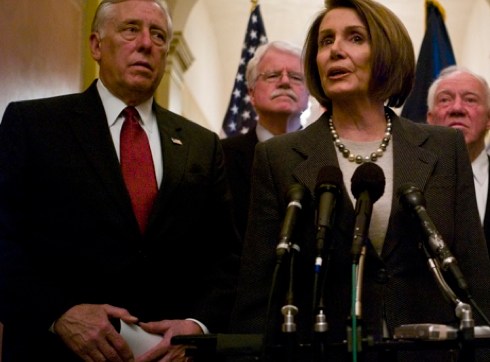
Speaker Pelosi just said “I don’t see the votes for [passing the Senate bill] at this time.”
In other words, plug pulled. Health care reform over.
Pelosi followed with a bunch of muddying caveats that seemed to make the statement more ambiguous. So I strongly recommend reading her whole statement word for word so you can interpret it yourself. But the other ‘options’ she mentions seem to be clearly impossible. So I don’t think there’s any way to read her comments other than to say she’s ready to sweep health care reform into the dustbin for good.
She says she lacks the votes now but hopes at some point in the future she might.
Would have been nice to know back in January they didn’t have the fortitude for this.
From Bay State TPM Reader JM …
I live in Northampton, MA. I just spoke to a legislative aide in the office of Richard Neal, my representative, and asked how he would vote if the only alternatives were the Senate bill or no health care legislation. She told me he would vote against the Senate bill, because of concerns it would reduce payments to Massachusetts hospitals. I asked in disbelief if that was sufficient reason to leave 30 million people uninsured, and she said “Well, hopefully it won’t come to that.”
Jon Stewart: “Scott Brown is now apparently the 45th president of these United States Of America! Wooo! Yeah baby! Welcome. It has been a long, incredibly grueling couple of days since we first heard of this man. And now he’s in charge of everything.”
Let me take a moment and explain where I think we are on the Health Care Reform front.
As I’ve argued, procedurally, with the senate Dems reduced to 59 votes, there’s no way to get a better or revised bill through the senate. (Frankly, it’s not clear to me that there are still 59 votes.) That means the only realistic path to getting a reform bill is for the House to pass the Senate bill or pass the Senate bill as part of a global agreement in which the House passes the senate bill in exchange for another bill — which would focus on budgetary impact and thus be viable through reconciliation — which would make some of the key revisions the House demands.
There are various arguments about waiting to see if things get easier in the spring or summer. Or perhaps cutting the bill up into individual bills and passing them in the succession over the course of the year. But as I’ve argued — rightly or wrongly — those options seem nonsensical in political terms.
So is that it? Read More