


Ha! Okay, this is funny. Rep. John Murtha (D-PA) is going to campaign against Rep. Jean Schmidt (R-OH), the representative who called him a coward last year on the House floor.
Roll Call (sub.req.): Rep. Shimkus to testify before Ethics Committee Friday.
I don’t know if the Democrats are going to win back the House this year. And I’d really caution people against falling under the false assumption that anything is in the bag at this point. But I am starting to become cautiously optimistic that Joe Donnelly (D-IN) is just a few weeks away from sending Rep. Chris “the Count” Chocola (R-IN) packing. And that would end the one man reign of evil Chocola has brought to the House of Representatives since 2002.
You may think ‘evil’ is too strong a word. But a lot of conservatives bewail the fact that in modern secular society we are too cautious about using terms like ‘good’ and ‘evil’. So I figure Chocola is as good a candidate as any. See his record of Social Security bamboozlement here.
On our IN-2 page we’ve now got eight polls going back to July 18. Two of those are sponsored by Dems, one by Republicans. But of those eight, Chocola has been behind every time, though three times within the margin of error. Four of those polls are from the last eight days.
Constituent Dynamics out today has the Count down by 4 points. A GOP poll out yesterday has him down by 1%. A Dem poll has him down 16 points. And a Zogby poll from October 4th has him down 10 points. Of all the independent polls, the closest is the one out today that has him down 4 points. The others have him at a 10, 10, 8, 8 and 5 point deficit.
If you’re in Indiana’s 2nd district, drop us a line and let us know how it looks to you on the ground.
Gail Collins stepping down as editorial page editor at the Times.
Momma don’t take my 501(c) status away: A new Senate Finance Committee report busts Abramoff-tied charities, including Grover Norquist’s Americans for Tax Reform, for possible violations of law and tax code.
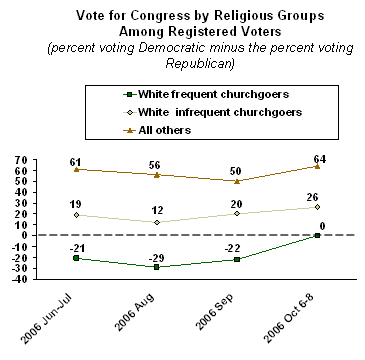
This analysis of the internal numbers out of the latest Gallup poll provides a very clear sense of why so many Republicans are shaking in their boots waiting the results of the November election. Gallup divided respondents into “white frequent churchgoers”, “white infrequent churchgoers” and “all others.”
Here we what are perhaps the two major cleavages in contemporary American politics — religion and race. And we’re looking at them through a rightward prism.
Whites tend to vote Republican as a group, if by not that great a margin. And strong religious identification/church attendance is a very strong indicator of Republican party affiliation. So “white frequent churchgoers” should be — and through most of my adult life — have been the sweet spot of the electorate for the Republican party.
Yet, according to this latest Gallup survey, Republicans are only coming in even with this group. If that number is even close to on the mark and remains so for the next four weeks you can be next to certain that the Democrats will blow the Republicans out in the House and very likely win back control of the senate too.
You see this in this graph. Anything above the dotted line is the margin of Democratic advantage. So in August infrequent churchgoing whites were favoring the Democrats by 12 points. Now they do so by 26 points.
As I think I’ve made clear a number of times in recent weeks I am very much in the ‘believe it when I see it’ campaign when it comes to November. But this is the core of the modern Republican party. And they can only split the votes evenly with Democrats in this core group, election day will really be a disaster.
The only thing this break down leaves me wanting to know more of is a denominational breakdown. I’d be particularly curious to see the breakdown between churchgoing Catholics and evangelicals.
Here’s another look at the same process. Over at TPM Election Central, Matt Corley looked at two of the most watch election rating sites, CQ Politics and the Cook Political Report.
He found that over the two week period since Foleygate blew up on September 29th, no few than 30 House races had their ratings changed. And 29 of those were moves favoring the Democrats.
That is a sign both of tremendous flux and a decisive movement in one direction.
Next up, is it really all Foley?
The Times and the Post both have matter-of-fact run-downs of Kirk Fordham’s testimony Thursday before the House Ethics Committee. The juicy details were behind closed doors. But the essential story is this: he said under oath what he told the FBI and the press last week — that he warned Denny Hastert’s Chief of Staff about Foley three years ago, that Palmer went as far as to meet with Foley and that Palmer told Fordham that he’d discussed the matter with Speaker Hastert.

That leaves two possibilities. Fordham is lying. Or the story put together by Hastert’s staff two weeks ago is bogus, Palmer is lying and Hastert is lying. Real life seldom leaves such cut-and-dry alternatives. But in this case both sides have dug themselves in on very specific and unambiguous versions of what happeend.
The weak link may be Palmer’s oddly broad and ambiguous denial of Fordham’s account. Last week he said simply: “What Kirk Fordham said did not happen.”
If you want to get squirrelly about, that might simply mean that it didn’t happen in precisely the way Fordham said it. Maybe Fordham says they spoke in person when Fordham remembers them speaking on the phone. In other words, it may really be a classic non-denial denial.
In the real world, though, if he’s lying, he’s done and so is Hastert. It’s just a matter of who gets to them first, the investigators or the voters.
TPM Reader CH on whether it’s all Foley …
You will soon post on the “is it all Foley?” question, and I wanted to submit my 2 cents in advance. Here’s the thing about the Foley scandal: it gives people space to change their minds about things. Think about when you’ve admitted a mistake or accepted someone’s knockdown argument on a topic you believe in strongly. Sure, you look at the facts and exercise your capacity for reason. But there is an emotional component too, and it’s a lot easier to change your mind when the other person, or in this case the general public mood, makes it OK for you to shift your perspective.
That’s what Foley has done–provided an emotional space within which people can reevaluate their views without having to question themselves or their previous beliefs too deeply. I believe there has been a growing sense in the country that things are going badly, very badly, on all sorts of fronts. Foley, frankly, doesn’t have much to do with that. But now it’s OK to step up and say, “Hell with it, I’m tired of this crap.” And change your vote.
I think CH is on to something here. I’d been thinking along the lines of a slightly different take. But I think we’re getting at the same basic point. To me, you look at the basic numbers going back many months and they’re simply terrible for the Republicans. There was a halt in the deterioration and then a very small but discernible rebound in early-mid-September, tied largely to the 9/11 anniversary. Among the political class that very small stabilization was very over-interpreted. Then came the NIE, more bad news out of Iraq, Woodward and then Foley.
In discussing the dynamics of elections we’re all always groping around trying to find the least inapt metaphor. But my hunch is that that late September bad news for the White House didn’t cut short a GOP resurgence. The blip was more of an Indian summer or dead cat bounce.
At the same time, Foley does seem to have been a deal clincher for a substantial number of people. Not that more than a very few people are going to consciously or affirmatively vote on the basis of Foleygate. But in our own lives we all have moments where we’re frustrated, more frustrated, passively angry and then at one crystalizing moment something clicks in your head and you say, Enough. I’m done. And then you act.
I think that’s something like what we’ve seen over the last two weeks, though we won’t be able to know for sure until after election day. There’s been a tremendous dissatisfaction in the country on many fronts. But it’s been amorphous and latent. Or perhaps better to say people hadn’t yet had to concentrate on just how they were going to act on those sentiments. Partisan identification also does weird stuff to people. For instance, is it really true that 40% of the public is satisfied with the job the president has done on Iraq? Objectively, I find that difficult to believe. But Republicans are Republicans. And for a lot of committed partisans, the Dems say No, so they say Yes. What the question in becomes somewhat beside the point. And, yes, same on both sides. My point is only that strong partisan identification props up support for things people probably don’t really, in their heart or hearts, support.
In itself, Foleygate isn’t going to drive many people’s votes. And even fewer will admit that it has in polls. But I think Foley has provided a collective gut-check moment for the country, when perhaps a critical portion of the country has said, Enough. it’s not about Foley. It’s really about everything that has come before. But it’s allowed people to step back, take in the whole picture and say: No, I’m done.
This is surprising. We were supposed to think that Kirsten Gillibrand’s race against Rep. John Sweeney (R-NY) just hadn’t caught fire and was pretty much done. But CQ has just moved the race into the toss-up category. This is one we’re going to be watching really closely.
For background, see this golden oldie from November 22, 2004 in which mutliple Sweeney constituents try in vain to get an answer out of Sweeney about whether or not he voted for the DeLay Rule.

Here’s the results of Justin Rood’s investigation of whether the kid in the background of this Sweeney frat house picture was smoking a joint (alas, he was not). Remember, back in April, Sweeney showed up sloshed at a frat house in the district and proceeded to have himself photographed with cracking up college kids who posed with him like he was … well, like he was.
Then, again, who can forget Rep. Sweeney’s many legislative fact-finding excursions aboard yachts provided by the National Marine Manufacturers’ Association.
The list just goes on and on.
And, actually, isn’t he about due for another boffo moment?