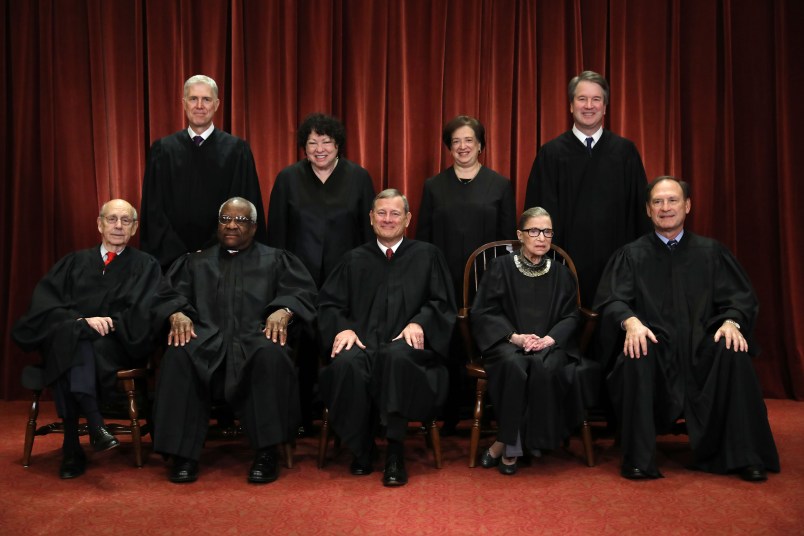
One of the most encouraging things I have seen recently are complaints from the right, as well as what we might call the supercilious center, bewailing, whining about, or just generally objecting to adding new Justices to the Court. They’re talking because they see it coming. I’m not saying it’s a certainty. Obviously they want to forestall it. But this isn’t just something folks like me, or others, are talking about. We have their attention. We clearly have the Justices’ attention. That shows we are moving in the right direction.
I’m writing today because I want to address one of the most common and one of the best (although still insufficient) opposing arguments. That is this: if you expand the Court, won’t Republicans come right back and expand it even more? And then don’t you just have an on-going war of tit-for-tat expansions?
My short answer is, yes. And that’s okay.
Let me give you the slightly longer answer.
I’m enough of an institutionalist that I very much want to get back to a stable, non-corrupt structure for the federal judiciary. I think, or at least hope, that we can get back to that over time. But “over time” is key. What we want to have, as a long term plan, is for both sides to understand that you’re not going to dominate or destroy the other half of the country. We’ve gotten to this point because only one side is playing constitutional hardball. If one side is committed to avoiding extreme measures, the incentives are simply too great for the other side to do it with impunity and without limit. There are also ways that I think you can structure reform that make that outcome more likely over time. This isn’t the place I want to get into those details. But it’s important to have structural reforms in addition to expanding the number of justices.
But yes, to get to the point, there’s a very good chance that Republicans will do the exact same thing as soon as they get a trifecta. But this is largely a self-correcting problem. Because successive expansions will have the effect both of reducing the centrality of the Court in our politics, as well as the importance of any single Justice. And that’s good. We want the Supreme Court to be more limited in its interventions into our politics and we want to reduce the perceived advantages of stacking or corrupting it again. One of the most salutary impacts of expanding the Court will simply be to send the message you spent half a century building the machinery for stacking the Court with corrupt ideologues, then you did it and now it’s gone. Poof.
You need to reduce the incentives for these kinds of efforts.
There are so many other issues concerning the details of reform that are important for people to think through, to answer, to game out. Those are all for other posts. We should remember more broadly that there is no possible argument for not expanding the Court when it has made clear it will manufacture fraudulent constitutional doctrines at will and not allow Democrats to exercise political power when they are elected. To accept that is simply to cash in your chips on democratic self-governance and accept that we have what is often called a ‘managed democracy’ in which you have elections but only the favored party is allowed to exercise power. In this post I want to make this one simple but fairly central point: Yes, the other side will probably do it too. And that’s okay. Because it’s a self-correcting problem. We want to reduce the centrality of the Court, it’s overweening dominance over our politics, as well as that of any individual Justice. As we strive to supersize its head count we are very much trying to downsize its role in American political life.