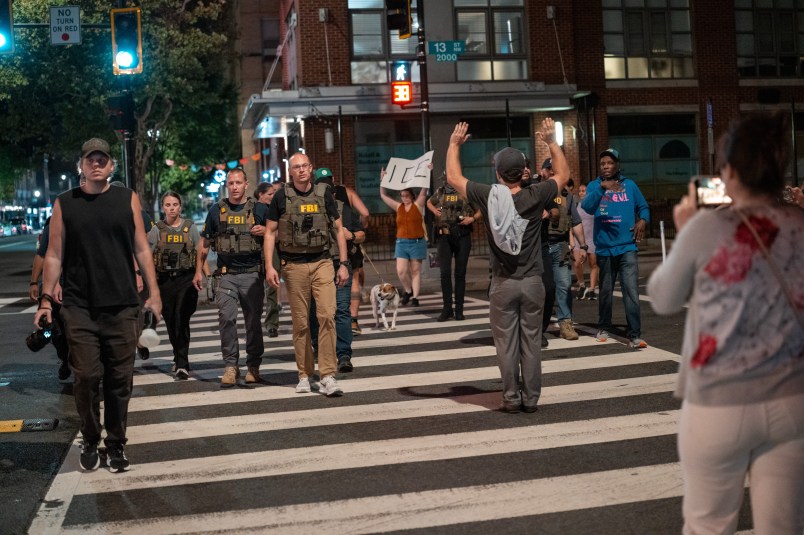
I had an interesting exchange with a TPM reader this week about President Trump’s takeover of the DC Metro Police Department and his conjoined decision to deploy National Guard troops to the nation’s capital. This reader’s argument was that it was a mistake to make a big deal of the DC decision, casting it as a dramatic and consequential abuse of power, because in fact Trump was acting within the statute that gives DC home rule. He said that what happened in Los Angeles this summer was different precisely because Trump had no legal right to do any of it. The reality — and this is true — is that DC is different. It’s not a state and it is in fact the domain of the federal government. Congress runs it. Congress decided to delegate that authority half a century ago to a local self-government. But the president can do these things. It’s right there in the Home Rule law. His justifications may be specious. But his actions in this case are likely unreviewable.
It was an interesting point and we went back and forth over it a few times. The opposition should save its mobilization and outrage, the reader argued, for when Trump crosses a line as he did in LA. DC is different.
My argument was that even though the unique rules governing DC make this legal it is by Trump’s own argument part of a rollout he envisions for using federal police (ICE, CBP, FBI) and the National Guard to start taking over policing in big U.S. cities, universally blue cities and in every case in blue states. The substance is what’s important, not the technicalities. To my thinking, we’re way past the point where we should be hung up on technicalities.
I was reminded of this when I saw this clip today of Rep. James Comer (R-KY) saying again explicitly that this is a test case for a future rollout in “Democrat-run cities,” as he put it. “We’re gonna support doing this in other cities if it works out in Washington DC. We spend a lot on our military. Our military has been in many countries around the world for the past two decades walking the streets trying to reduce crime. We need to focus on the big cities in America now.” (You can see the clip here.)
Comer introduces another interesting and telling dimension. We do in fact spend vast sums of money on the military. And the idea seems to be that now that we’re not fighting “forever wars” abroad it makes sense to start occupying American cities. He’s admirably frank about it. There’s a whole Arendtian story there, how the tools a state uses in warfare abroad get adapted (or not terribly much adapted) for use at home. But I want to focus on the main through-line: the goal of both militarizing law enforcement and treating blue states as something like conquered territories, as he’s already doing in Washington, DC, which is, yes, the national capital but also an extremely Democratic and plurality black city. Along these lines, a senior administration official just told Rolling Stone that a key goal of these deployments is to normalize them in American political culture, especially during times of relative calm.
I strongly suspect I’m mostly preaching to the choir on the small email debate I was having with this TPM reader. The reason I’m noting the exchange is to make a related point we should all be thinking about more explicitly. What violates specific statutes is not really the point at the stage of the game we’re at. It’s important in itself of course. It can have legal and judicial review significance. But it’s not what’s most important. Because, let’s be frank, Trump is breaking the law in so many ways right now it’s difficult to keep track of them.
I go back to a point I’ve made repeatedly over the last six-plus months. We are fundamentally in a battle over public opinion. If a decisive majority of the public opposes Trump, his rule and criminality won’t stand. What follows from that is that what might be technically legal under some obscure statute or simply unreviewable isn’t the point. That’s deep in the weeds. That’s playing to the mindset and politico-cultural mores of the opposition itself — one of its great virtues and also one its deepest weaknesses. That’s Michael Dukakis delving into statutes and principled opposition to the death penalty when the moment calls for modulated fury and outrage.
The issue is do people want to live under martial law, in cities occupied by the military. Opposition to these kinds of things is deeply, deeply rooted in American political culture. We’ve already seen a lot of data from the spectacle in Los Angeles. People don’t like that. It cuts against all sorts of things inculcated in Americans in their civic culture. Leaders should be zeroing in on this question and this mantra: No troops in our cities, no troops in our homes.
We should put these questions at the forefront of the public mind. Do you want soldiers on your streets? Do you want to self-govern at the local level or be the target of a vengeful and lawless president? These are the questions to focus on. The technicalities of the law are, sad to say, secondary now.