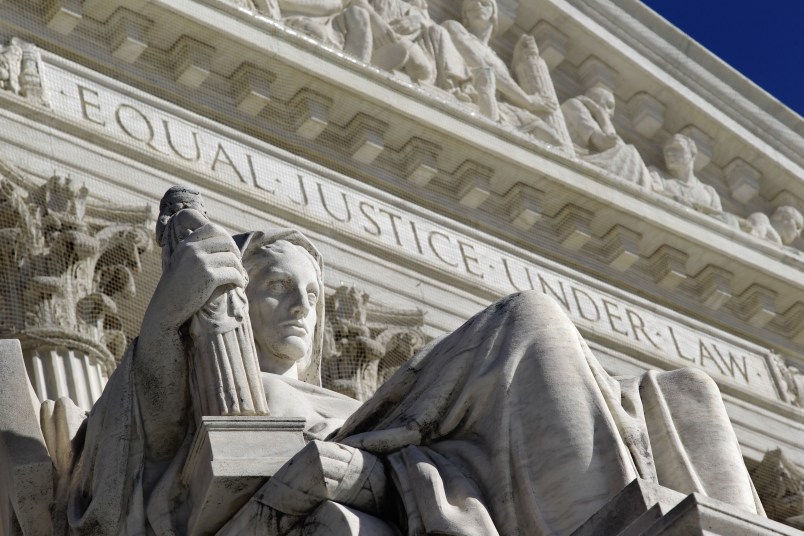
The health care ruling will be announced in the next few hours so this post won’t have a long shelf life. But I think it’s worth breaking down explicitly why even certain conservative legal scholars regard the thought that the Affordable Care Act might disappear today to be so troubling — why it’s not just partisan disagreement all the way down.The most important thing to remember this morning is that the legal dispute in the case is exceptionally narrow and technical. Nobody — not even the challengers’ lawyer Paul Clement — believes Congress couldn’t have tweaked a few words in the legislation and passed essentially the same law without coming within 100 miles of constitutional controversy. To name just one example, an explicit health insurance tax incentive would’ve accomplished the exact same thing the law’s mandate and penalty intend, and made it constitutionally bulletproof.
But in over two years of reporting on the legal case against ACA, I’ve encountered precisely zero critics who believe the mandate is technically unconstitutional but also think the right course would be for the Supreme Court to strike the mandate, then leave it to Congress to tweak the rest and make the policy work as intended. Instead the ACA’s foes want the Court to use the mandate’s supposed unconstitutionality as a pretext to throw the whole thing out.
Now, these critics are political actors, and it’s basically appropriate that they’ve argued for a maximal outcome. But there should be no mistaking the thin reed their argument hangs on for the idea that its myriad other provisions are also unconstitutional.
The constitutional dispute is arcane. And yet the stakes today are enormous.
I bring this up because of something Randy Barnett — the intellectual godfather of the case against the ACA — wrote on Wednesday in advance of today’s ruling. Emphasis added.
I especially want to thank Orin Kerr for his unstinting and unflagging skepticism from day one. I admit that, at times, I found his posts personally annoying, and my one regret over the past 2+ years of litigation is in sometimes letting my annoyance show. But this was entirely my problem, not his. His indefatigable resistance to every argument offered against the constitutionality of the individual insurance mandate was essential to the growth and improvement of these arguments, especially in the first year of their development. He was a one-man moot court testing every claim, refusing to be brow beaten into concurring with a conclusion he simply could not accept. There is no question in my mind that our theories would not have developed as well as they did without his intellectual combativeness and persistence. If the challenge happens to succeed tomorrow, he will merit some share of the credit for that outcome.
This was never a slam dunk case. Quite the opposite — it was from the outset a hoped-for ruling in search of an argument.
The fact that the Court might completely void the law is the consequence of an extremely esoteric oversight. The challengers’ case rests on a legal theory hatched explicitly to achieve a political end. That’s why most Constitutional scholars continue to believe the case for the law is strong, even if its legal chances have dimmed over the past several months. And that’s the reason why it would be extraordinary and condemnable if the Court throws the whole thing out anyhow.