


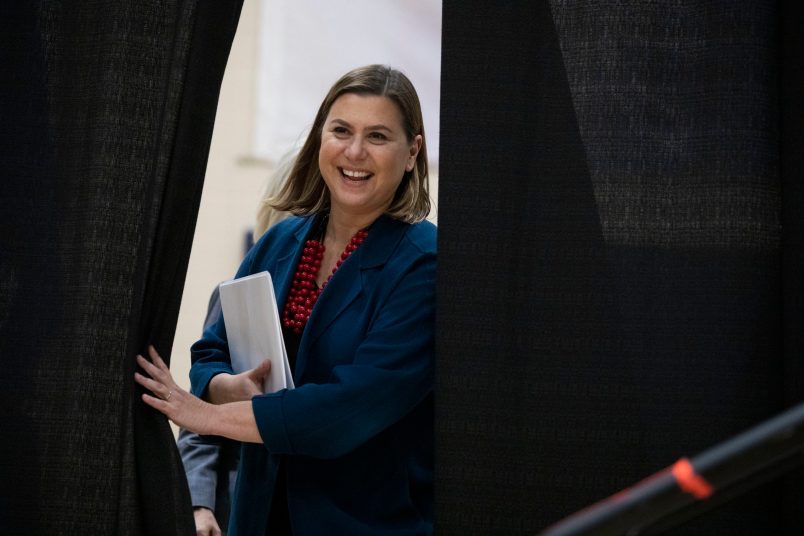
I wanted to flag your attention to this Dave Weigel piece in Semafor. It’s about an event (“WelcomeFest”) put on by a centrist PAC called WelcomePAC, which is presenting itself as a kind of latter-day Democratic Leadership Council or punchy and centrist group focused on picking fights with the party’s left wing. It’s a kind of set piece for a lot of stuff that’s going on among Democrats right now. The big push is to defang the power of “the groups” and then, on a secondary level, get the party away from various litmus tests and speech policing. Then there’s a secondary push for “abundance” politics. They brought together several centristy members of Congress — Rep. Ritchie Torres (NY), Rep. Jake Auchincloss (MA), Sen. Elissa Slotkin (MI) — and then commentator Matt Yglesias, data influencer David Schor and former Senate staffer Adam Jentleson, among others.
As Weigel reports, moments after Torres starts his remarks, this happens …
Seconds after Torres’ shot at “the groups” that have become intra-Democratic shorthand for excessive left-wing influence, protesters from … the group Climate Defiance charged on stage with signs reading “GAYS AGAINST GENOCIDE” and “GENOCIDE RITCHIE,” attacking his support for Israel’s war in Gaza.
As the activists were yanked out of the room, conference organizers played Carly Simon’s You’re So Vain on the loudspeakers in the room.
The mockery was part of the point. Welcome PAC, the main organizer of the conference and one of several outfits that have emerged in recent months to try to reverse the party’s post-Obama losses, was happy to be accused of embracing a pro-growth “Abundance” agenda or attacking progressive urban policies.
Now, the “Genocide Ritchie” thing is almost too spot-on for what these folks are trying to do. It was hard not to think, did the WelcomePac folks pay these protestors for this scene? I jest. But like I said, it’s just so spot on. A big point this faction makes is that a lot of “the left” they’re trying to knock down a peg is stuck in the hyper-online left-leaning bubbles you find on Bluesky or used to on Twitter. There’s a lot to that. But the You’re So Vain soundtrack (which was kind of clever) struck me as … well, extremely online! And by that I mean, the smashmouth, dominance pyrotechnics that is both kind of Trumpy but also just very much the idiom of the online world and social media.
Meanwhile, as “WelcomeFest” was going on, their intra-party opponents flooded the Bluesky zone with talking points against the Welcomers, showing how the money for the effort has more than a bit of Republican tinge.
I take a kind of middle position on the meta-issues swirling through this debate. On the general issue of left-wing and groups-based litmus tests, I’m at least half with these folks. I don’t think they’re “why” Democrats lost the 2024 election. But I do think the Democrats’ focus on a number of these litmus tests or language discourses were a real contributor to making a slice of voters see Democrats as focused on issues distant from their lives and not concerned with issues that mattered to them a lot — inflation, cost of living, etc. That’s not the same as saying Democrats lost because of trans rights or immigration. But the way you talk can make your politics seem insular and distant or indifferent to other concerns that are more salient to voters. Saying this leads to very reflexive claims that this means betraying or abandoning various marginalized groups. And I understand that reflex. But I think it’s part of Democrats’ current problem, and it is mainly a question of emphasis, language and focus.
Here is where I should restate an obligatory and important point. If you read the inside DC press these days, you see an overpowering and overwhelming consensus that is basically unchallenged that Democrats are destroyed and the public has utterly rejected their “woke” politics and focus on language policing and that whole bill of particulars. It’s really necessary to come back, just momentarily, to the real world where the Democrats lost the 2024 president election by exactly 1.5% percentage points. That’s simply not a party destruction result — not even close, frankly. So while there are important lessons to learn, important pitfalls to avoid and repositionings to be done, we shouldn’t lose sight of this reality of the situation.
And beyond all that, repositioning or just talking in a way that most ordinary voters talk (please, people, this isn’t that hard), is not in itself a platform or anything you can really run a campaign on. A 30-second TV ad that says “I’m Katrina and I’m a Democrat who’s not super obsessed with telling you my pronouns!” may get this crowd excited, but I’m not sure that really gets you anywhere in a general election — not because most voters want to hear about your pronouns but because their big hunger isn’t intramural fireworks among Democratic factions. Other points Dave and others reported from this event include members of Congress getting praised for defying the party consensus by voting for this or that Republican bill. I think we should probably have a bit more of that — though some consensuses are more important than others. In this week’s podcast, Kate and I talked about how there’s at least some movement afoot to primary Washington state Rep. Marie Gluesenkamp Perez. That is just stupid and crazy. She’s not a reliable vote for Democrats on every issue. And she does various positioning that rankles some Dems. But she’s figured out how to win consistently in a pretty Trumpy district. So that’s great. More power to her. You want elected Democrats carving out versions of what being a Democrat can be in different regions of the country. It’s idiotic that any Democrats think they’ll be gaining anything by replacing her with a more cookie-cutter blue-district Dem and seeing that person get beat by a Republican.
But as I said, speaking in the vernacular tongue and not getting trapped into highly insular lefty discourses is not in itself a platform or an alternative that you can bring to voters and say, “Here’s what Trump offers, and here’s a better/different vision that we’re for.” And that was the general vibe. For all the talk about how Democrats need to be “for something” as opposed to just waiting for Trump to fail, what that “for” should actually be seems kind of absent.
The big exception is “abundance,” the new counter-left-wing buzzword among Democrats. I’m of kind of a mixed mind about “abundance” and to an extent I still need to learn more about it. The most referenced example is loosening zoning and housing regulations so we can build more housing and thus make housing more affordable. In general, that makes a lot of sense. But it’s not something “abundance” has exclusive ownership over by any means. One of the outside voices Weigel quoted pointed out that, to the extent we’re now seeing a polarized conversation about “abundance” vs “populist” messaging, there’s no reason that making it possible to build a lot more housing can’t fit as easily into one as the other.
I’ve mentioned a number of times that I think the most important dividing line for Democrats right now is not ideology — left vs. center — but fight vs. complacency. Another way to describe that is the willingness and ability to wield power and build power to achieve political aims. There’s a lot of polling evidence that failure on this front is the biggest sources of Democrats’ electoral problems. Ideological disagreements are real too. They’re not misunderstandings. And you can’t simply sweep them under the rug. But the importance of those disagreements can also be exaggerated or intensified in these intramural contests. I’m more enthused by advocates and candidates and party idea-makers who make a case with the full package, an alternative vision to Trumpism, which really is no different from an opposition (they’re for taking away people’s health care, we’re for protecting it) to it and then being willing to make that case clearly and aggressively and to fight to make it a reality.